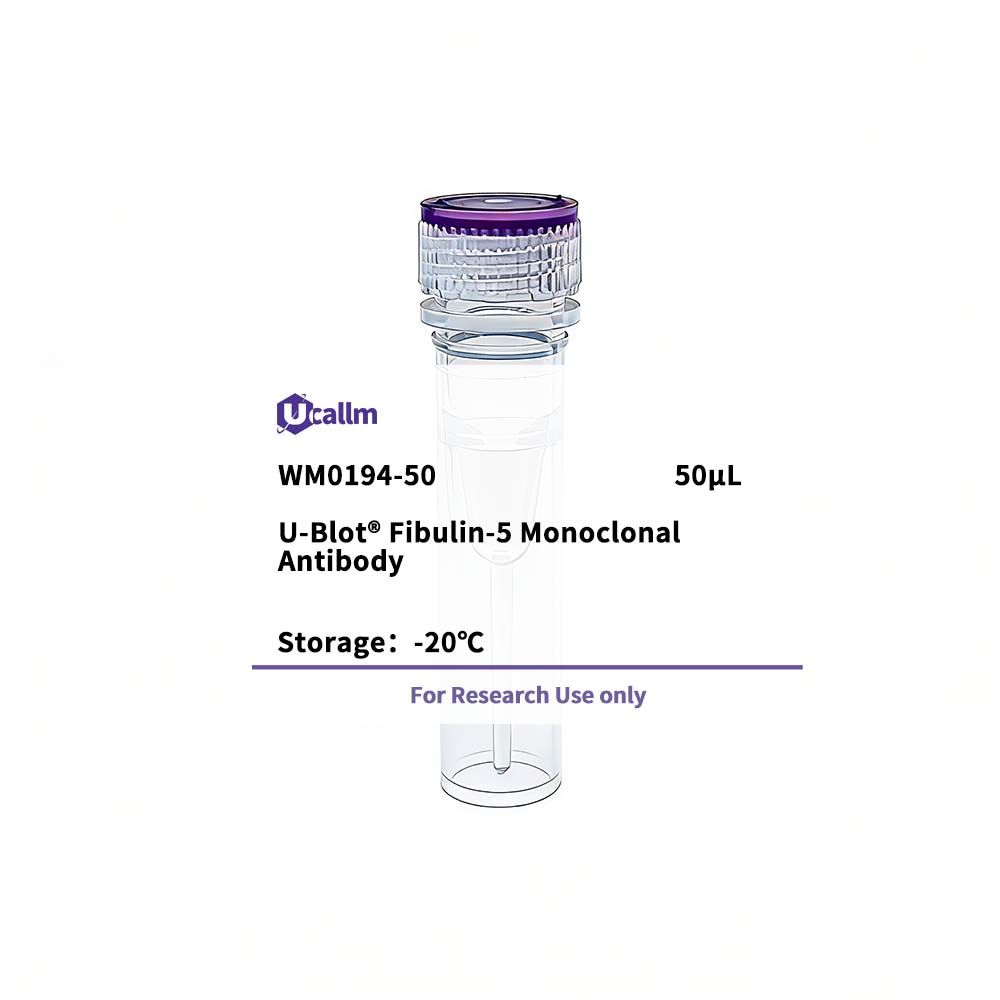
SKU: WM0194 Categories: ,

Fibulin-5 Monoclonal Antibody

Price range: $268.00 through $328.00

SKU: WM0194-50
Enter the quantity you would like, or drag the panel to find the quantity and price that best for you
Bulk QuoteAuthorize OEM & ODM

Product details

Background:
The protein encoded by this gene is a secreted, extracellular matrix protein containing an Arg-Gly-Asp (RGD) motif and calcium-binding EGF-like domains. It promotes adhesion of endothelial cells through interaction of integrins and the RGD motif. It is prominently expressed in developing arteries but less so in adult vessels. However, its expression is reinduced in balloon-injured vessels and atherosclerotic lesions, notably in intimal vascular smooth muscle cells and endothelial cells. Therefore, the protein encoded by this gene may play a role in vascular development and remodeling. Defects in this gene are a cause of autosomal dominant cutis laxa, autosomal recessive cutis laxa type I (CL type I), and age-related macular degeneration type 3 (ARMD3). [provided by RefSeq, Jul 2008],

Specifications

Size50μL/100μL
TargetFibulin-5
ReactivityHuman
ApplicationsWB, IHC, IF, ELISA
MW(Calculated)50kD
MW(Observed)
Host SpeciesMouse
Isotype
Conjugate/ModificationUnmodified
Recommended Dilution RatioWB 1:500-1:2000; IHC 1:200-1:1000; ELISA 1:10000; IF 1:50-200 / Note: For IHC, we suggest antigen retrieval with TE buffer pH 9.0 (Cat#WT1004)
FormulationLiquid in PBS containing 50% glycerol, 0.5% BSA and 0.02% sodium azide.
PurificationAffinity purification
Storage-15°C to -25°C/1 year(Do not lower than -25°C)
Concentration
ClonalityMonoclonal
Clone Number10C6
ImmunogenPurified recombinant fragment of Fibulin-5 expressed in E. Coli.
SpecificityFibulin-5 Monoclonal Antibody detects endogenous levels of Fibulin-5 protein.
Gene NameFBLN5
Protein NameFibulin-5
Other NameFBLN5; / DANCE; / Fibulin-5; / FIBL-5; / Developmental arteries and neural crest EGF-like protein; / Dance; / Urine p50 protein; / UP50
SpeciesHuman
Gene ID10516
UniprotQ9UBX5
Species.1
Gene ID.1
Uniprot.1
Species.2
Gene ID.2
Uniprot.2
Cellular LocalizationSecreted . Secreted, extracellular space, extracellular matrix . co-localizes with ELN in elastic fibers. .
Tissue ExpressionExpressed in skin fibroblasts (at protein level)(PubMed:17035250). Expressed predominantly in heart, ovary, and colon but also in kidney, pancreas, testis, lung and placenta. Not detectable in brain, liver, thymus, prostate, or peripheral blood leukocytes (PubMed:10428823).
Signaling_pathway
Research Areas
FunctionDisease:Defects in FBLN5 are a cause of autosomal dominant cutis laxa [MIM:123700]. Hereditary cutis laxa refers to a heterogeneous group of connective tissue disorders characterized by cutaneous abnormalities and variable systemic manifestations. The most constant clinical feature is loose skin, sagging over the face and trunk. Hereditary cutis laxa is inherited in both autosomal dominant and autosomal recessive modes. Autosomal dominant cutis laxa is a relatively benign inherited and acquired connective tissue disorder.,Disease:Defects in FBLN5 are a cause of autosomal recessive cutis laxa type I (CL type I) [MIM:219100]. CL type I shows the most severe phenotype and has the poorest prognosis. In addition to the skin, internal organs enriched in elastic fibers, such as the lung and arteries, are affected.,Disease:Defects in FBLN5 are the cause of age-related macular degeneration type 3 (ARMD3) [MIM:608895]. ARMD is a multifactorial disease and the most common cause of irreversible vision loss in the developed world. In most patients, the disease is manifest as ophthalmoscopically visible yellowish accumulations of protein and lipid (known as drusen) that lie beneath the retinal pigment epithelium and within an elastin-containing structure known as Bruch membrane.,Function:Promotes adhesion of endothelial cells through interaction of integrins and the RGD motif. Could be a vascular ligand for integrin receptors and may play a role in vascular development and remodeling.,similarity:Belongs to the fibulin family.,similarity:Contains 6 EGF-like domains.,tissue specificity:Expressed predominantly in heart, ovary, and colon but also in kidney, pancreas, testis, lung and placenta. Not detectable in brain, liver, thymus, prostate, or peripheral blood leukocytes.,
Please login to post questions
Back to Top
Product has been added to your cart

