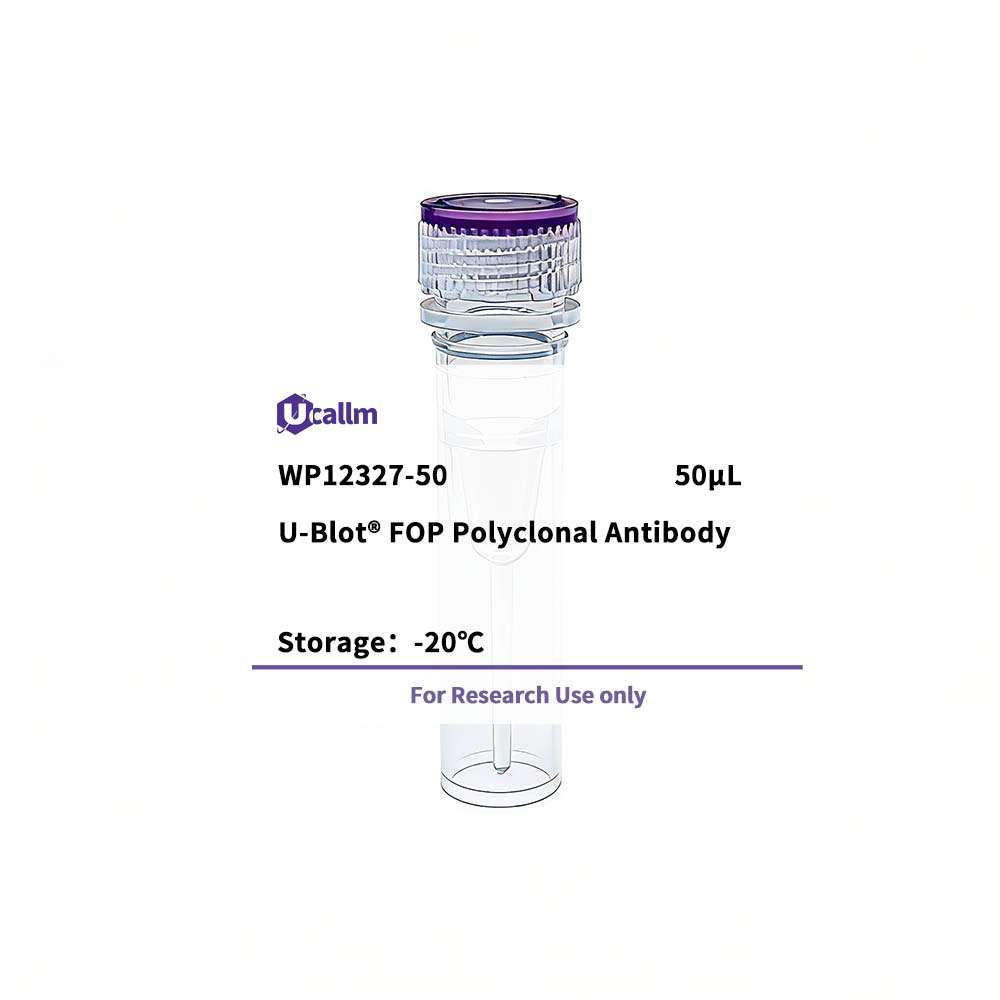
SKU: WP12327 Categories: ,

FOP Polyclonal Antibody

Price range: $268.00 through $328.00

SKU: WP12327-100
Enter the quantity you would like, or drag the panel to find the quantity and price that best for you
Bulk QuoteAuthorize OEM & ODM

Product details

Background:

FGFR1 oncogene partner(FGFR1OP) Homo sapiens This gene encodes a largely hydrophilic centrosomal protein that is required for anchoring microtubules to subcellular structures. A t(6;8)(q27;p11) chromosomal translocation, fusing this gene and the fibroblast growth factor receptor 1 (FGFR1) gene, has been found in cases of myeloproliferative disorder. The resulting chimeric protein contains the N-terminal leucine-rich region of this encoded protein fused to the catalytic domain of FGFR1. Alterations in this gene may also be associated with Crohn's disease, Graves' disease, and vitiligo. Alternatively spliced transcript variants that encode different proteins have been identified. [provided by RefSeq, Jul 2013],


Specifications

Size50μL/100μL
TargetFOP
ReactivityHuman, Mouse, Rat
ApplicationsWB, IHC, IF, ELISA
MW(Calculated)
MW(Observed)43kD
Host SpeciesRabbit
IsotypeIgG
Conjugate/ModificationUnmodified
Recommended Dilution RatioWB 1:500-1:2000; IHC 1:100-1:300; IF 1:200-1:1000; ELISA 1:10000; Not yet tested in other applications. / Note: For IHC, we suggest antigen retrieval with TE buffer pH 9.0 (Cat#WT1004)
FormulationLiquid in PBS containing 50% glycerol, 0.5% BSA and 0.02% sodium azide.
PurificationThe antibody was affinity-purified from rabbit antiserum by affinity-chromatography using epitope-specific immunogen.
Storage-15°C to -25°C/1 year(Do not lower than -25°C)
Concentration1 mg/ml
ClonalityPolyclonal
Clone Number
ImmunogenThe antiserum was produced against synthesized peptide derived from human FGFR1 Oncogene Partner. AA range:341-390
SpecificityFOP Polyclonal Antibody detects endogenous levels of FOP protein.
Gene NameFGFR1OP
Protein NameFGFR1 oncogene partner
Other NameFGFR1OP; / FOP; / FGFR1 oncogene partner
SpeciesHuman
Gene ID11116
UniprotO95684,
Species.1Mouse
Gene ID.175296
Uniprot.1Q66JX5,
Species.2Rat
Gene ID.2683722
Uniprot.2Q4V7C1
Cellular LocalizationCytoplasm, cytoskeleton, microtubule organizing center, centrosome . Cytoplasm, cytoskeleton, microtubule organizing center, centrosome, centriole . Cytoplasm, cytoskeleton, cilium basal body . Associated with gamma-tubulin (PubMed:16314388). Localizes on both mother and daughter centrioles (PubMed:28625565, PubMed:28428259). Localizes to an axial position on the mother centriole (PubMed:28625565). Localizes to the distal end of the centriole partly on the subdistal appendage region (PubMed:28659385). .
Tissue ExpressionUbiquitous. Highly expressed in heart, liver, muscle, kidney, intestine, colon, adrenal gland, prostate, testis, and pancreas.
Signaling_pathway
Research Areas
FunctionDisease:A chromosomal aberration involving FGFR1OP may be a cause of stem cell myeloproliferative disorder (MPD). Translocation t(6; 8)(q27; p11) with FGFR1. MPD is characterized by myeloid hyperplasia, eosinophilia and T-cell or B-cell lymphoblastic lymphoma. In general it progresses to acute myeloid leukemia. The fusion proteins FGFR1OP-FGFR1 or FGFR1-FGFR1OP may exhibit constitutive kinase activity and be responsible for the transforming activity.,Function:Required for anchoring microtubules to the centrosomes.,similarity:Contains 1 LisH domain.,subcellular location:Associated with gamma-tubulin.,subunit:Homodimer. Part of a ternary complex that contains CEP350, FGFR1OP and MAPRE1. Interacts directly with CEP350 and MAPRE1.,tissue specificity:Ubiquitous. Highly expressed in heart, liver, muscle, kidney, intestine, colon, adrenal gland, prostate, testis, and pancreas.,
Please login to post questions
Back to Top
Product has been added to your cart
