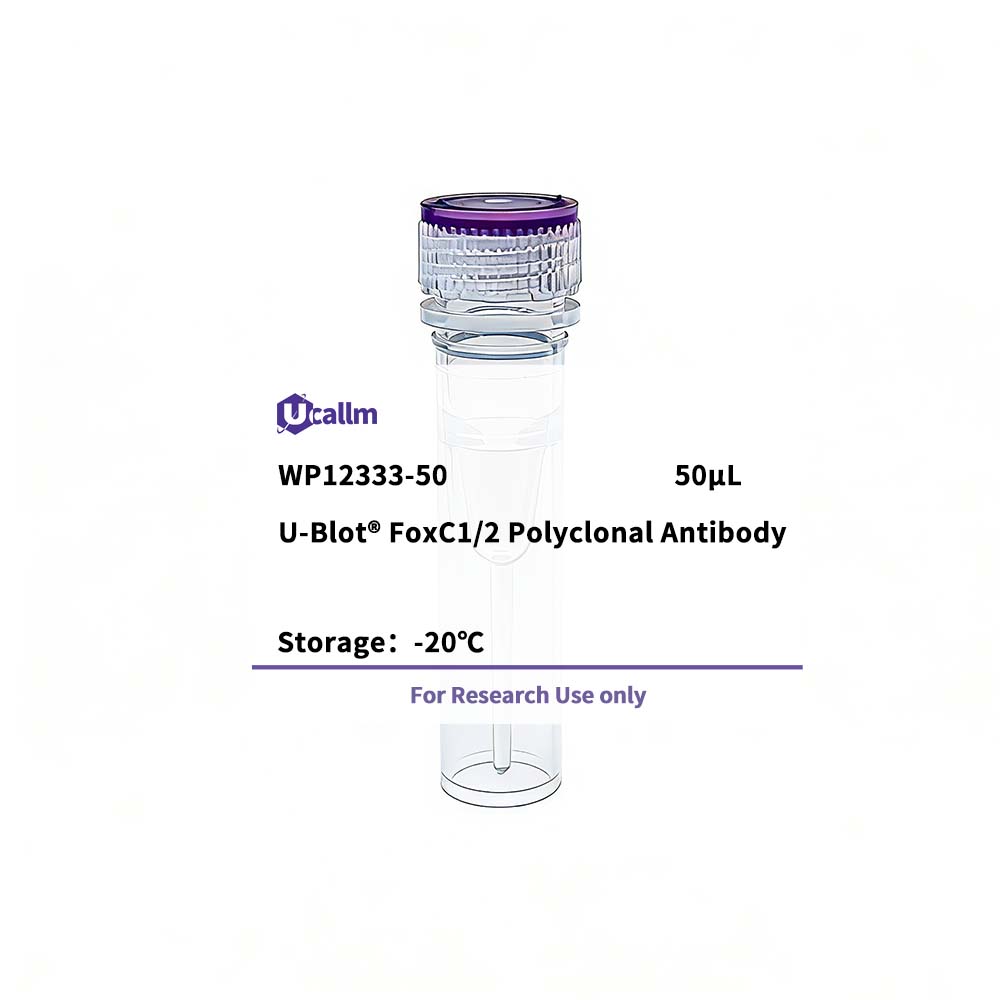
SKU: WP12333 Categories: ,

FoxC1/2 Polyclonal Antibody

Price range: $268.00 through $328.00

SKU: WP12333-100
Enter the quantity you would like, or drag the panel to find the quantity and price that best for you
Bulk QuoteAuthorize OEM & ODM

Product details

Background:

This gene belongs to the forkhead family of transcription factors which is characterized by a distinct DNA-binding forkhead domain. The specific function of this gene has not yet been determined; however, it has been shown to play a role in the regulation of embryonic and ocular development. Mutations in this gene cause various glaucoma phenotypes including primary congenital glaucoma, autosomal dominant iridogoniodysgenesis anomaly, and Axenfeld-Rieger anomaly. [provided by RefSeq, Jul 2008],


Specifications

Size50μL/100μL
TargetFoxC1/2
ReactivityHuman, Mouse, Rat
ApplicationsWB, IHC, IF, ELISA
MW(Calculated)
MW(Observed)57kD
Host SpeciesRabbit
IsotypeIgG
Conjugate/ModificationUnmodified
Recommended Dilution RatioWB 1:500-1:2000; IHC 1:100-1:300; IF 1:200-1:1000; ELISA 1:40000; Not yet tested in other applications. / Note: For IHC, we suggest antigen retrieval with TE buffer pH 9.0 (Cat#WT1004)
FormulationLiquid in PBS containing 50% glycerol, 0.5% BSA and 0.02% sodium azide.
PurificationThe antibody was affinity-purified from rabbit antiserum by affinity-chromatography using epitope-specific immunogen.
Storage-15°C to -25°C/1 year(Do not lower than -25°C)
Concentration1 mg/ml
ClonalityPolyclonal
Clone Number
ImmunogenThe antiserum was produced against synthesized peptide derived from human FOXC1/2. AA range:151-200
SpecificityFoxC1/2 Polyclonal Antibody detects endogenous levels of FoxC1/2 protein.
Gene NameFOXC1/FOXC2
Protein NameForkhead box protein C1/2
Other NameFOXC1; / FKHL7; / FREAC3; / Forkhead box protein C1; / Forkhead-related protein FKHL7; / Forkhead-related transcription factor 3; / FREAC-3; / FOXC2; / FKHL14; / MFH1; / Forkhead box protein C2; / Forkhead-related protein FKHL14; / Mesenchyme fork head protein 1
SpeciesHuman
Gene ID2296;2303
UniprotQ12948;Q99958,
Species.1Mouse
Gene ID.117300;14234,
Uniprot.1
Species.2Rat
Gene ID.2
Uniprot.2Q63246
Cellular LocalizationNucleus . Colocalizes with PITX2 isoform 3 in the nucleus at subnuclear chromatine regions (PubMed:16449236). Colocalizes with CBX5 to a heterochromatin-rich region of the nucleus (PubMed:15684392). Colocalizes with GLI2 in the nucleus (By similarity). .
Tissue ExpressionExpressed in keratinocytes of epidermis and hair follicle (PubMed:27907090). Expressed strongly in microvascular invasion (MVI) formation, basal-like breast cancer (BLBC) and hepatocellular tumors (PubMed:20406990, PubMed:22991501). Expressed in breast cancers (at protein level) (PubMed:26565916). Expressed in hematopoietic cells (PubMed:8499623).
Signaling_pathway
Research Areas
FunctionDisease:Defects in FOXC1 are a cause of Axenfeld-Rieger syndrome (ARS) [MIM:601090]; also known as Axenfeld syndrome or Axenfeld anomaly. It is characterized by posterior corneal embryotoxon, prominent Schwalbe line and iris adhesion to the Schwalbe line. Other features may be hypertelorism (wide spacing of the eyes), hypoplasia of the malar bones, congenital absence of some teeth and mental retardation. When associated with tooth anomalies, the disorder is known as Rieger syndrome. Glaucoma is a progressive blinding condition that occurs in approximately half of patients with Axenfeld-Rieger malformations.,Disease:Defects in FOXC1 are a cause of Peters anomaly [MIM:604229]. Peters anomaly consists of a central corneal leukoma, absence of the posterior corneal stroma and Descemet membrane, and a variable degree of iris and lenticular attachments to the central aspect of the posterior cornea.,Disease:Defects in FOXC1 are the cause of iridogoniodysgenesis anomaly (IGDA) [MIM:601631]. IGDA is an autosomal dominant phenotype characterized by iris hypoplasia, goniodysgenesis, and juvenile glaucoma.,Function:Binding of FREAC-3 and FREAC-4 to their cognate sites results in bending of the DNA at an angle of 80-90 degrees.,similarity:Contains 1 fork-head DNA-binding domain.,subunit:Monomer.,tissue specificity:Expressed in all tissues and cell lines examined.,
Please login to post questions
Back to Top
Product has been added to your cart

