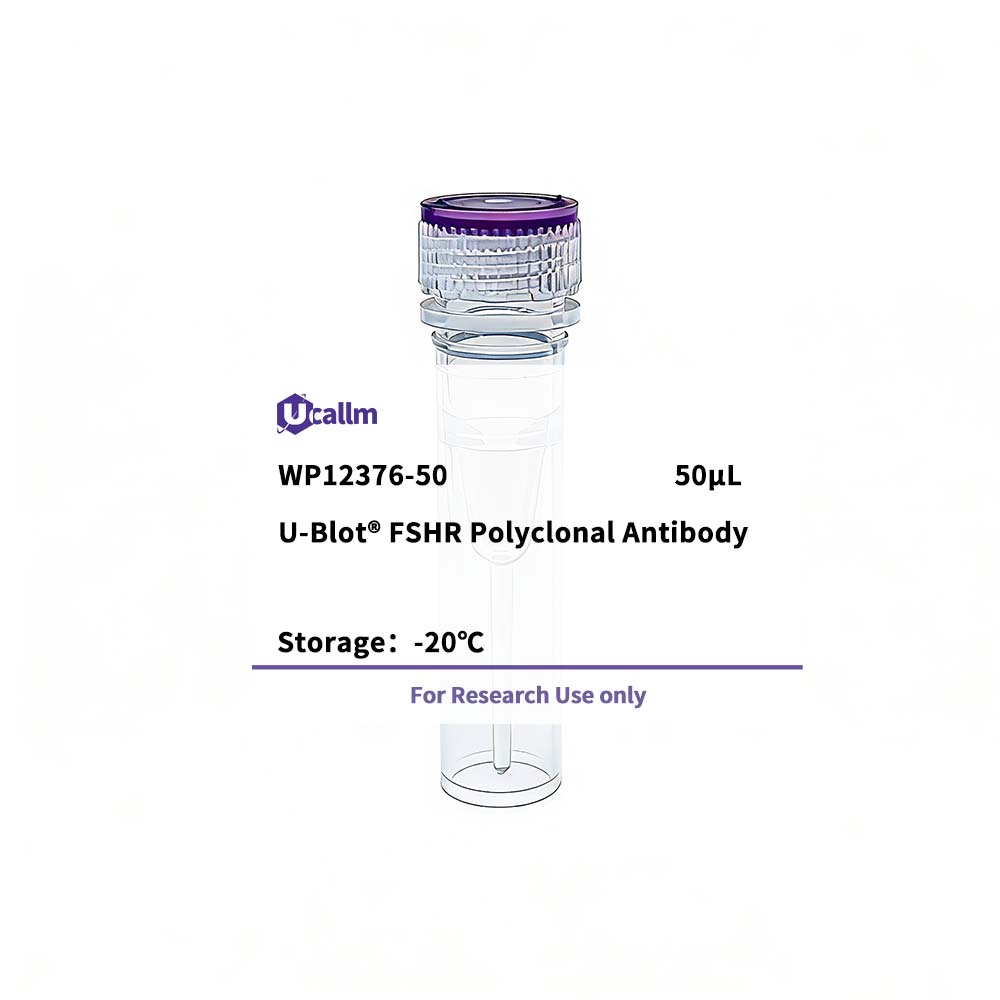
SKU: WP12376 Categories: ,

FSHR Polyclonal Antibody

Price range: $268.00 through $328.00

SKU: WP12376-100
Enter the quantity you would like, or drag the panel to find the quantity and price that best for you
Bulk QuoteAuthorize OEM & ODM

Product details

Background:

The protein encoded by this gene belongs to family 1 of G-protein coupled receptors. It is the receptor for follicle stimulating hormone and functions in gonad development. Mutations in this gene cause ovarian dysgenesis type 1, and also ovarian hyperstimulation syndrome. Alternative splicing results in multiple transcript variants. [provided by RefSeq, Mar 2010],


Specifications

Size50μL/100μL
TargetFSHR
ReactivityHuman, Mouse, Rat
ApplicationsWB, IHC, IF, ELISA
MW(Calculated)
MW(Observed)70kD
Host SpeciesRabbit
IsotypeIgG
Conjugate/ModificationUnmodified
Recommended Dilution RatioIHC: 100-300; WB 1:500-1:2000; ELISA 1:5000; IF 1:50-200 / Note: For IHC, we suggest antigen retrieval with TE buffer pH 9.0 (Cat#WT1004)
FormulationLiquid in PBS containing 50% glycerol, 0.5% BSA and 0.02% sodium azide.
PurificationThe antibody was affinity-purified from rabbit antiserum by affinity-chromatography using epitope-specific immunogen.
Storage-15°C to -25°C/1 year(Do not lower than -25°C)
Concentration1 mg/ml
ClonalityPolyclonal
Clone Number
ImmunogenThe antiserum was produced against synthesized peptide derived from human FSHR. AA range:211-260
SpecificityFSHR Polyclonal Antibody detects endogenous levels of FSHR protein.
Gene NameFSHR
Protein NameFollicle-stimulating hormone receptor
Other NameFSHR; / LGR1; / Follicle-stimulating hormone receptor; / FSH-R; / Follitropin receptor
SpeciesHuman
Gene ID2492
UniprotP23945,
Species.1Mouse
Gene ID.114309
Uniprot.1P35378,
Species.2Rat
Gene ID.225449
Uniprot.2P20395
Cellular LocalizationCell membrane; Multi-pass membrane protein .
Tissue ExpressionSertoli cells and ovarian granulosa cells.
Signaling_pathwayEnvironmental Information Processing >> Signal transduction >> cAMP signaling pathway
Research Areas>>cAMP signaling pathway; / >>Neuroactive ligand-receptor interaction; / >>Ovarian steroidogenesis
FunctionDisease:Defects in FSHR are a cause of ovarian dysgenesis 1 (ODG1) [MIM:233300]; also known as premature ovarian failure or gonadal dysgenesis XX type or XX gonadal dysgenesis (XXGD) or hereditary hypergonadotropic ovarian failure or hypergonadotropic ovarian dysgenesis with normal karyotype. ODG1 is an autosomal recessive disease characterized by primary amenorrhea, variable development of secondary sex characteristics, and high serum levels of follicle-stimulating hormone (FSH) and luteinizing hormone (LH).,Disease:Defects in FSHR are a cause of ovarian hyperstimulation syndrome (OHSS) [MIM:608115]. OHSS is a disorder which occurs either spontaneously or most often as an iatrogenic complication of ovarian stimulation treatments for in vitro fertilization. The clinical manifestations vary from abdominal distention and discomfort to potentially life-threatening, massive ovarian enlargement and capillary leak with fluid sequestration. Pathologic features of this syndrome include the presence of multiple serous and hemorrhagic follicular cysts lined by luteinized cells, a condition called hyperreactio luteinalis.,Function:Receptor for follicle-stimulating hormone. The activity of this receptor is mediated by G proteins which activate adenylate cyclase.,online information:Glycoprotein-hormone Receptors Information System,online information:The Singapore human mutation and polymorphism database,PTM:N-glycosylated; indirectly required for FSH-binding, possibly via a conformational change that allows high affinity binding of hormone.,similarity:Belongs to the G-protein coupled receptor 1 family.,similarity:Belongs to the G-protein coupled receptor 1 family. FSH/LSH/TSH subfamily.,similarity:Contains 10 LRR (leucine-rich) repeats.,tissue specificity:Sertoli cells and ovarian granulosa cells.,
Please login to post questions
Back to Top
Product has been added to your cart


