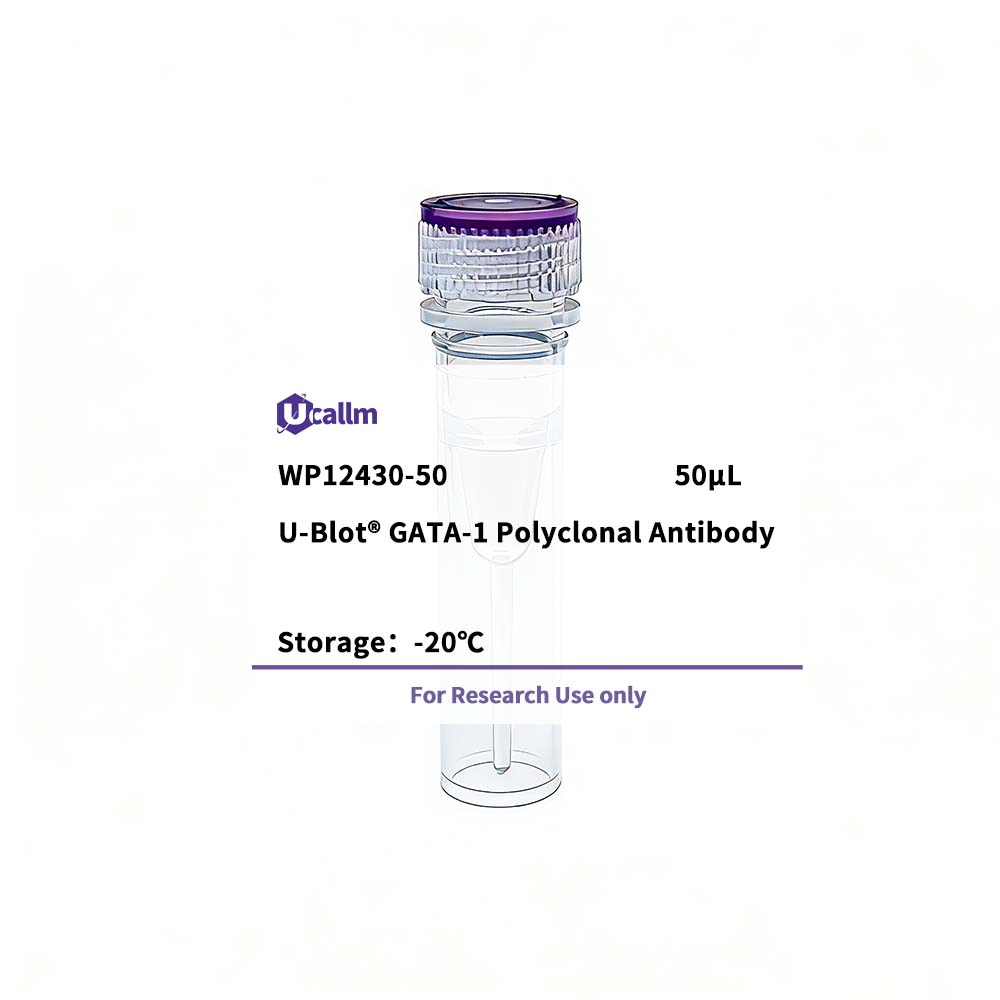
SKU: WP12430 Categories: ,

GATA-1 Polyclonal Antibody

Price range: $268.00 through $328.00

SKU: WP12430-100
Enter the quantity you would like, or drag the panel to find the quantity and price that best for you
Bulk QuoteAuthorize OEM & ODM

Product details

Background:

This gene encodes a protein which belongs to the GATA family of transcription factors. The protein plays an important role in erythroid development by regulating the switch of fetal hemoglobin to adult hemoglobin. Mutations in this gene have been associated with X-linked dyserythropoietic anemia and thrombocytopenia. [provided by RefSeq, Jul 2008],


Specifications

Size50μL/100μL
TargetGATA-1
ReactivityHuman, Mouse, Rat
ApplicationsWB, IHC, IP, IF, ELISA
MW(Calculated)
MW(Observed)43kD
Host SpeciesRabbit
IsotypeIgG
Conjugate/ModificationUnmodified
Recommended Dilution RatioWB 1:500-1:2000; IHC 1:100-1:300; IP 2-5 ug/mg lysate; IF 1:200-1:1000; ELISA 1:10000; Not yet tested in other applications. / Note: For IHC, we suggest antigen retrieval with TE buffer pH 9.0 (Cat#WT1004)
FormulationLiquid in PBS containing 50% glycerol, 0.5% BSA and 0.02% sodium azide.
PurificationThe antibody was affinity-purified from rabbit antiserum by affinity-chromatography using epitope-specific immunogen.
Storage-15°C to -25°C/1 year(Do not lower than -25°C)
Concentration1 mg/ml
ClonalityPolyclonal
Clone Number
ImmunogenThe antiserum was produced against synthesized peptide derived from human GATA1. AA range:109-158
SpecificityGATA-1 Polyclonal Antibody detects endogenous levels of GATA-1 protein.
Gene NameGATA1
Protein NameErythroid transcription factor
Other NameGATA1; / ERYF1; / GF1; / Erythroid transcription factor; / Eryf1; / GATA-binding factor 1; / GATA-1; / GF-1; / NF-E1 DNA-binding protein
SpeciesHuman
Gene ID2623
UniprotP15976,
Species.1Mouse
Gene ID.114460
Uniprot.1P17679,
Species.2Rat
Gene ID.225172
Uniprot.2P43429
Cellular LocalizationNucleus.
Tissue ExpressionErythrocytes.
Signaling_pathway
Research Areas
FunctionDisease:Defects in GATA1 are the cause of X-linked dyserythropoietic anemia and thrombocytopenia (XDAT) [MIM:300367]. XDAT is a disorder characterized by erythrocytes with abnormal size and shape, and paucity of platelets in peripheral blood. The bone marrow contains abundant and abnormally small megakaryocytes.,Disease:Defects in GATA1 are the cause of X-linked thrombocytopenia with beta-thalassemia (XLTT) [MIM:314050]; also called thrombocytopenia, platelet dysfunction, hemolysis, and imbalanced globin synthesis. The disease consists of an unusual form of thrombocytopenia with beta-thalassemia. Patients have splenomegaly and petechiae, moderate thrombocytopenia, prolonged bleeding time due to platelet dysfunction, reticulocytosis and unbalanced (hemo)globin chain synthesis resembling that of beta-thalassemia minor.,Domain:The two fingers are functionally distinct and cooperate to achieve specific, stable DNA binding. The first finger is necessary only for full specificity and stability of binding, whereas the second one is required for binding.,Function:Transcriptional activator which probably serves as a general switch factor for erythroid development. It binds to DNA sites with the consensus sequence [AT]GATA[AG] within regulatory regions of globin genes and of other genes expressed in erythroid cells.,PTM:Highly phosphorylated on serine residues. Phosphorylation on Ser-310 is enhanced on erythroid differentiation. Phosphorylation on Ser-142 promotes sumoylation on Lys-137.,PTM:Sumoylation on Lys-137 is enhanced by phosphorylation on Ser-142 and by interaction with PIAS4. Sumoylation by SUMO1 has no effect on transcriptional activity.,similarity:Contains 2 GATA-type zinc fingers.,subunit:Interacts (via the N-terminal zinc finger) with ZFPM1. Interacts with GFI1B. Interacts with PIAS4; the interaction enhances sumoylation and represses the transactivational activity in a sumoylation-independent manner.,tissue specificity:Erythrocytes.,
Please login to post questions
Back to Top
Product has been added to your cart

