

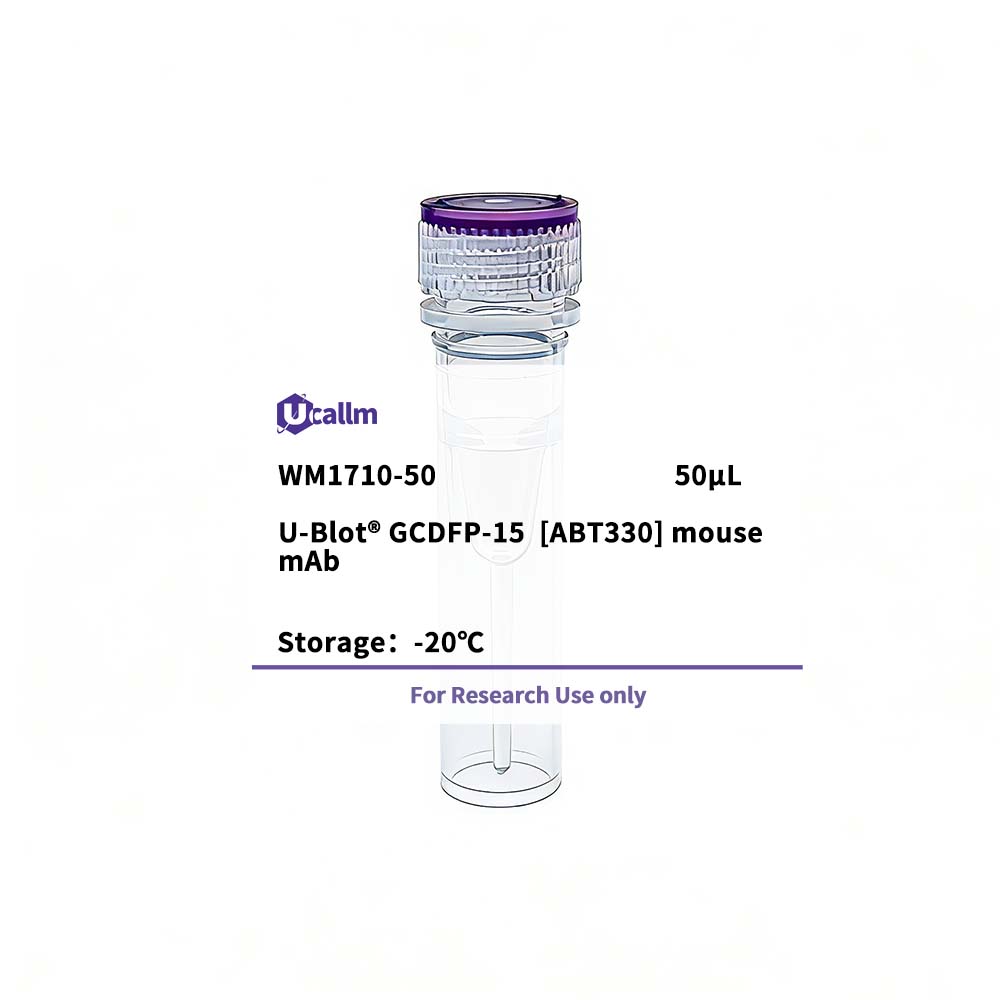
Specifications
| Size | 50μL/100μL |
| Target | GCDFP-15 |
| Reactivity | Human |
| Applications | IHC, ELISA |
| MW(Calculated) | 17kD |
| MW(Observed) | |
| Host Species | Mouse |
| Isotype | IgG1,Kappa |
| Conjugate/Modification | Unmodified |
| Recommended Dilution Ratio | IHC 1:200-400; ELISA 1:500-5000 / Note: For IHC, we suggest antigen retrieval with TE buffer pH 9.0 (Cat#WT1004) |
| Formulation | PBS, 50% glycerol, 0.05% Proclin 300, 0.05%BSA |
| Purification | The antibody was affinity-purified from ascites by affinity-chromatography using specific immunogen. |
| Storage | -15°C to -25°C/1 year(Do not lower than -25°C) |
| Concentration | |
| Clonality | Monoclonal |
| Clone Number | RMM330 |
| Immunogen | Synthesized peptide derived from human Gross cystic disease fluid protein-15 (GCDFP-15) AA range: 50-146 |
| Specificity | The antibody can specifically recognize human GCDFP-15 protein. |
| Gene Name | PIP GCDFP15 GPIP4 |
| Protein Name | Gross cystic disease fluid protein-15 (GCDFP-15) |
| Other Name | Prolactin-inducible protein; / Gross cystic disease fluid protein 15; / GCDFP-15; / Prolactin-induced protein; / Secretory actin-binding protein; / SABP; / gp17 |
| Species | Human |
| Gene ID | 5304 |
| Uniprot | P12273 |
| Species.1 | |
| Gene ID.1 | |
| Uniprot.1 | |
| Species.2 | |
| Gene ID.2 | |
| Uniprot.2 | |
| Cellular Localization | Cytoplasmic |
| Tissue Expression | Expressed in pathological conditions of the mammary gland and in several exocrine tissues, such as the lacrimal, salivary, and sweat glands. |
| Signaling_pathway | |
| Research Areas | |
| Function | induction:By prolactin and androgen; inhibited by estrogen.,similarity:Belongs to the PIP family.,subunit:Monomer. Interacts with AZGP1.,tissue specificity:Expressed in pathological conditions of the mammary gland and in several exocrine tissues, such as the lacrimal, salivary, and sweat glands., |




