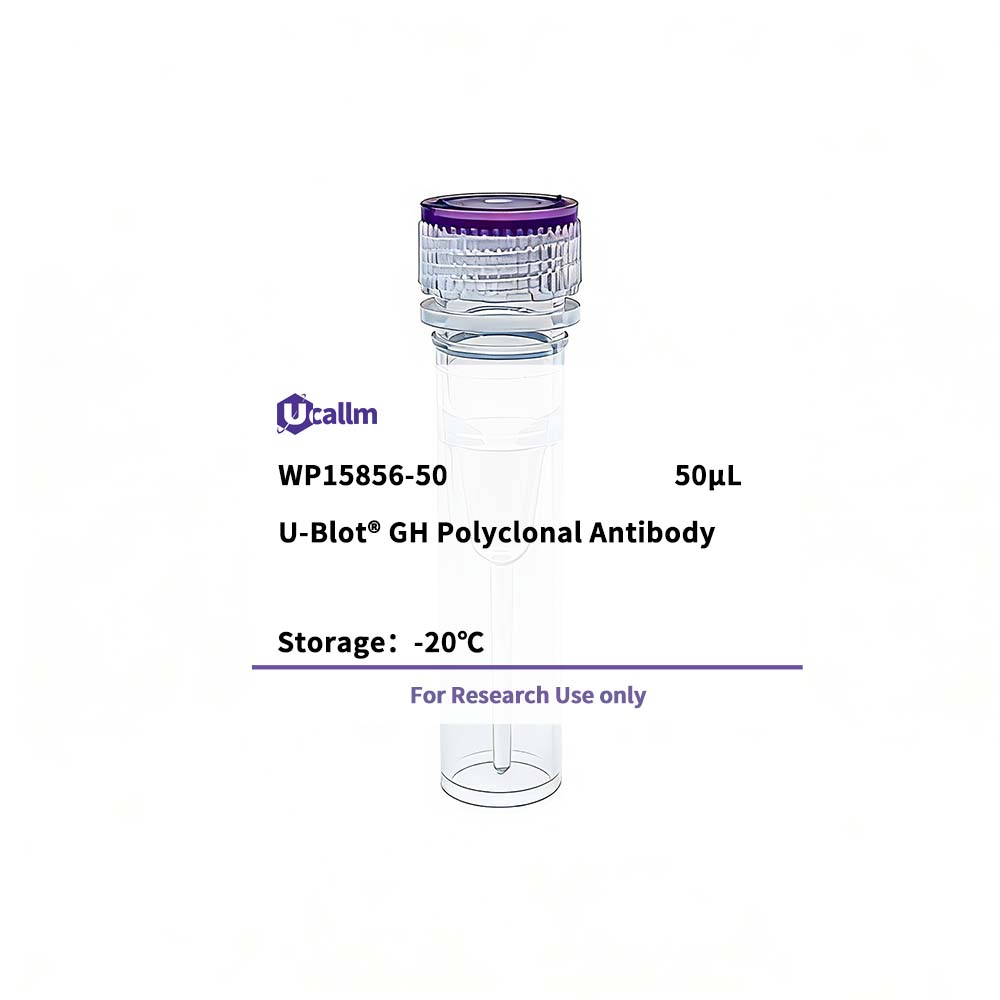
SKU: WP15856 Categories: ,

GH Polyclonal Antibody

Price range: $268.00 through $328.00

SKU: WP15856-100
Enter the quantity you would like, or drag the panel to find the quantity and price that best for you
Bulk QuoteAuthorize OEM & ODM

Product details

Background:

The protein encoded by this gene is a member of the somatotropin/prolactin family of hormones which play an important role in growth control. The gene, along with four other related genes, is located at the growth hormone locus on chromosome 17 where they are interspersed in the same transcriptional orientation; an arrangement which is thought to have evolved by a series of gene duplications. The five genes share a remarkably high degree of sequence identity. Alternative splicing generates additional isoforms of each of the five growth hormones, leading to further diversity and potential for specialization. This particular family member is expressed in the pituitary but not in placental tissue as is the case for the other four genes in the growth hormone locus. Mutations in or deletions of the gene lead to growth hormone deficiency and short stature. [provided by RefSeq, Jul 2008],
Specifications

TargetGrowth Hormone
ReactivityHuman, Mouse, Rat
ApplicationsIHC, IF, ELISA
MW(Calculated)
MW(Observed)
Host SpeciesRabbit
IsotypeIgG
Conjugate/ModificationUnmodified
Modification
Recommended Dilution RatioIHC 1:50-200; ELISA 1:10000-20000; IF 1:50-200 / Note: For IHC, we suggest antigen retrieval with TE buffer pH 9.0 (Cat#YS0004)
FormulationLiquid in PBS containing 50% glycerol, 0.5% BSA and 0.02% sodium azide.
Source
PurificationThe antibody was affinity-purified from rabbit antiserum by affinity-chromatography using epitope-specific immunogen.
Purity
Storage-15°C to -25°C/1 year(Do not lower than -25°C)
Concentration1 mg/ml
ClonalityPolyclonal
Clone Number
ImmunogenSynthetic peptide from human protein at AA range: 180-217
Sequence
SpecificityThe antibody detects endogenous GH
Gene NameGH1/2
Protein NameSomatotropin (Growth hormone) (GH) (GH-N) (Growth hormone 1) (Pituitary growth hormone)
Other NameSomatotropin; / Growth hormone; / GH; / GH-N; / Growth hormone 1; / Pituitary growth hormone; / Growth hormone variant; / GH-V; / Growth hormone 2; / Placenta-specific growth hormone
SpeciesHuman
Gene ID-12688
UniprotP01241;P01242
Species.1
Gene ID-2
Uniprot.1
Species.2
Gene ID-3
Uniprot.2
Organism-4
Gene ID-4
SwissProt-4
BackgroundThe protein encoded by this gene is a member of the somatotropin/prolactin family of hormones which play an important role in growth control. The gene, along with four other related genes, is located at the growth hormone locus on chromosome 17 where they are interspersed in the same transcriptional orientation; an arrangement which is thought to have evolved by a series of gene duplications. The five genes share a remarkably high degree of sequence identity. Alternative splicing generates additional isoforms of each of the five growth hormones, leading to further diversity and potential for specialization. This particular family member is expressed in the pituitary but not in placental tissue as is the case for the other four genes in the growth hormone locus. Mutations in or deletions of the gene lead to growth hormone deficiency and short stature. [provided by RefSeq, Jul 2008],

Cellular LocalizationSecreted.
Tissue ExpressionPituitary,
Signaling_pathwayOrganismal Systems >> Endocrine system >> Growth hormone synthesis, secretion and action;Environmental Information Processing >> Signal transduction >> JAK-STAT signaling pathway;Environmental Information Processing >> Signal transduction >> PI3K-Akt signaling pathway;Environmental Information Processing >> Signaling molecules and interaction >> Cytokine-cytokine receptor interaction
Research Areas>>Cytokine-cytokine receptor interaction; / >>Neuroactive ligand-receptor interaction; / >>PI3K-Akt signaling pathway; / >>JAK-STAT signaling pathway; / >>Growth hormone synthesis, secretion and action
FunctionAlternative products:Additional isoforms seem to exist,Disease:Defects in GH1 are a cause of isolated growth hormone deficiency type IB (IGHD IB) [MIM:262400]; also known as pituitary dwarfism I. IGHD IB is an autosomal recessive deficiency of GH which causes short stature.,Disease:Defects in GH1 are a cause of isolated growth hormone deficiency type II (IGHD II) [MIM:173100]. IGHD II is an autosomal dominant deficiency of GH which causes short stature.,Disease:Defects in GH1 are the cause of Kowarski syndrome [MIM:262650]; also known as pituitary dwarfism VI.,Disease:Defects in GH1 may be a cause of short stature [MIM:604271]. Short stature is defined by a subnormal rate of growth.,Function:Plays an important role in growth control. Its major role in stimulating body growth is to stimulate the liver and other tissues to secrete IGF-1. It stimulates both the differentiation and proliferation of myoblasts. It also stimulates amino acid uptake and protein synthesis in muscle and other tissues.,miscellaneous:Circulating GH shows a great heterogeneity due to alternative splicing, differential post-translational modifications of monomeric forms, oligomerization, optional binding to 2 different GH-binding proteins, and potentially proteolytic processing.,online information:Growth hormone entry,pharmaceutical:Available under the names Nutropin or Protropin (Genentech), Norditropin (Novo Nordisk), Genotropin (Pharmacia Upjohn), Humatrope (Eli Lilly) and Saizen or Serostim (Serono). Used for the treatment of growth hormone deficiency and for Turner's syndrome.,similarity:Belongs to the somatotropin/prolactin family.,subunit:Monomer, dimer, trimer, tetramer and pentamer, disulfide-linked or non-covalently associated, in homopolymeric and heteropolymeric combinations. Can also form a complex either with GHBP or with the alpha2-macroglobulin complex.,
RRID
Please login to post questions
Back to Top
Product has been added to your cart