

GLI-1 Polyclonal Antibody
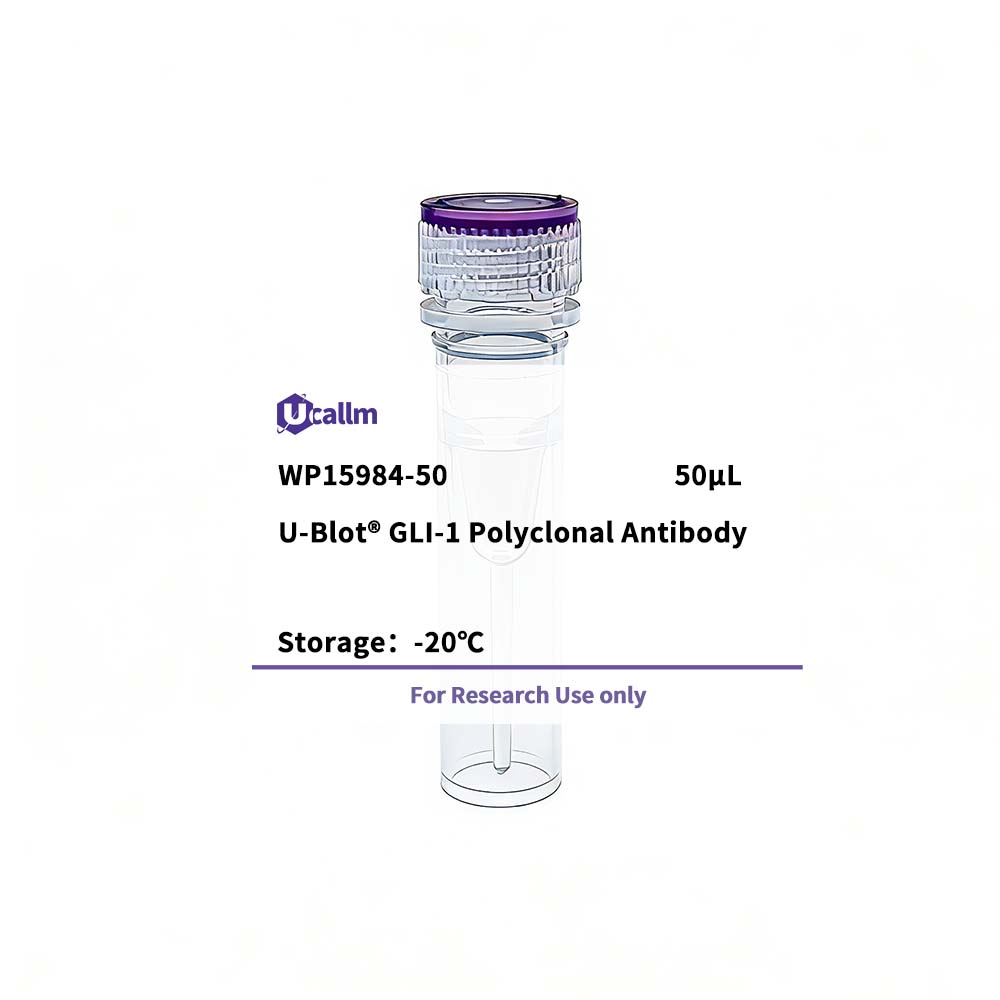
Ucallm_WP15984-50
Price range: $268.00 through $328.00
Product details
Background:
This gene encodes a member of the Kruppel family of zinc finger proteins. The encoded transcription factor is activated by the sonic hedgehog signal transduction cascade and regulates stem cell proliferation. The activity and nuclear localization of this protein is negatively regulated by p53 in an inhibitory loop. Multiple transcript variants encoding different isoforms have been found for this gene. [provided by RefSeq, May 2009],
Specifications
| Size | 50μL/100μL |
| Target | GLI-1 |
| Reactivity | Human, Mouse |
| Applications | WB, ELISA |
| MW(Calculated) | |
| MW(Observed) | 120kD |
| Host Species | Rabbit |
| Isotype | IgG |
| Conjugate/Modification | Unmodified |
| Recommended Dilution Ratio | WB 1:500-2000; ELISA 1:10000-20000 |
| Formulation | Liquid in PBS containing 50% glycerol, 0.5% BSA and 0.02% sodium azide. |
| Purification | The antibody was affinity-purified from rabbit antiserum by affinity-chromatography using epitope-specific immunogen. |
| Storage | -15°C to -25°C/1 year(Do not lower than -25°C) |
| Concentration | 1 mg/ml |
| Clonality | Polyclonal |
| Clone Number | |
| Immunogen | Synthesized peptide derived from human GLI-1. at AA range: 460-490 |
| Specificity | This antibody detects endogenous levels of GLI-1 |
| Gene Name | GLI1 GLI |
| Protein Name | GLI-1 |
| Other Name | Zinc finger protein GLI1; / Glioma-associated oncogene; / Oncogene GLI |
| Species | Human |
| Gene ID | 2735 |
| Uniprot | P08151, |
| Species.1 | Mouse |
| Gene ID.1 | 14632 |
| Uniprot.1 | P47806 |
| Species.2 | |
| Gene ID.2 | |
| Uniprot.2 | |
| Cellular Localization | Cytoplasm . Nucleus . Tethered in the cytoplasm by binding to SUFU (PubMed:10806483). Activation and translocation to the nucleus is promoted by interaction with STK36 (PubMed:10806483). Phosphorylation by ULK3 may promote nuclear localization (PubMed:19878745). Translocation to the nucleus is promoted by interaction with ZIC1 (PubMed:11238441). .; [Isoform 2]: Cytoplasm . Nucleus . |
| Tissue Expression | Detected in testis (at protein level) (PubMed:2105456). Testis, myometrium and fallopian tube. Also expressed in the brain with highest expression in the cerebellum, optic nerve and olfactory tract (PubMed:19878745). Isoform 1 is detected in brain, spleen, pancreas, liver, kidney and placenta; isoform 2 is not detectable in these tissues (PubMed:19706761). |
| Signaling_pathway | Human Diseases >> Cancer: overview >> Pathways in cancer;Human Diseases >> Cancer: specific types >> Basal cell carcinoma;Environmental Information Processing >> Signal transduction >> Hedgehog signaling pathway;Environmental Information Processing >> Signal transduction >> cAMP signaling pathway |
| Research Areas | >>cAMP signaling pathway; / >>Hedgehog signaling pathway; / >>Pathways in cancer; / >>Basal cell carcinoma |
| Function | Disease:Defects in GLI1 may be a cause of breast cancer.,Function:May regulate the transcription of specific genes during normal development. May play a role in craniofacial development and digital development, as well as development of the central nervous system and gastrointestinal tract. Mediates SHH signaling and thus cell proliferation and differentiation.,induction:Amplified in glioblastoma cells.,similarity:Belongs to the GLI C2H2-type zinc-finger protein family.,similarity:Contains 5 C2H2-type zinc fingers.,subcellular location:Tethered in the cytoplasm by binding to SUFU. Activation and translocation to the nucleus is promoted by interaction with STK36.,tissue specificity:Testis, myometrium and fallopian tube., |
Please login to post questions
Related products





