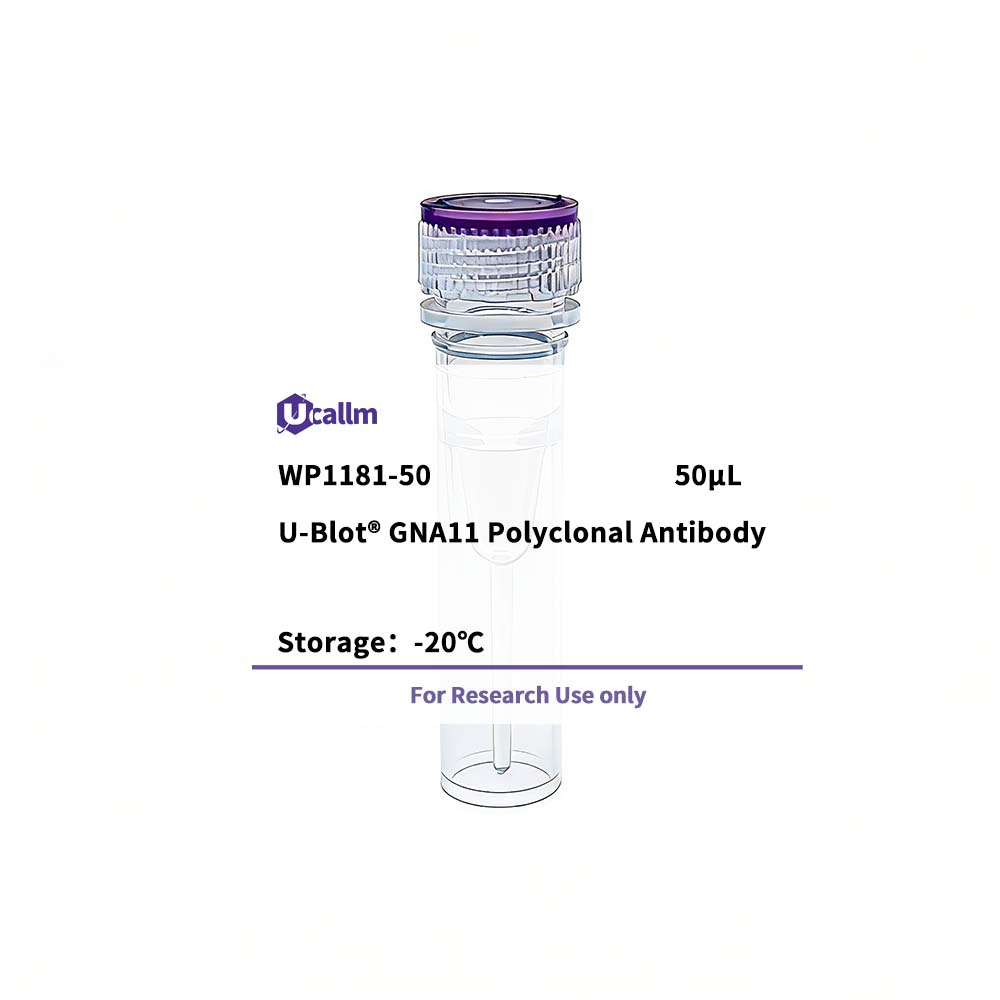
SKU: WP1181 Categories: ,

GNA11 Polyclonal Antibody

Price range: $268.00 through $328.00

SKU: WP1181-100
Enter the quantity you would like, or drag the panel to find the quantity and price that best for you
Bulk QuoteAuthorize OEM & ODM

Product details

Background:

The protein encoded by this gene belongs to the family of guanine nucleotide-binding proteins (G proteins), which function as modulators or transducers in various transmembrane signaling systems. G proteins are composed of 3 units: alpha, beta and gamma. This gene encodes one of the alpha subunits (subunit alpha-11). Mutations in this gene have been associated with hypocalciuric hypercalcemia type II (HHC2) and hypocalcemia dominant 2 (HYPOC2). Patients with HHC2 and HYPOC2 exhibit decreased or increased sensitivity, respectively, to changes in extracellular calcium concentrations. [provided by RefSeq, Dec 2013],

Specifications

Size50μL/100μL
TargetGNA11
ReactivityHuman, Mouse, Rat
ApplicationsWB, ELISA
MW(Calculated)
MW(Observed)39kD
Host SpeciesRabbit
IsotypeIgG
Conjugate/ModificationUnmodified
Recommended Dilution RatioWB 1:500-2000; ELISA 1:5000-20000
FormulationLiquid in PBS containing 50% glycerol,0.5% BSA and 0.02% sodium azide.
PurificationThe antibody was affinity-purified from rabbit antiserum by affinity-chromatography using epitope-specific immunogen.
Storage-15°C to -25°C/1 year(Do not lower than -25°C)
Concentration1 mg/ml
ClonalityPolyclonal
Clone Number
ImmunogenSynthesized peptide derived from part region of human protein
SpecificityGNA11 Polyclonal Antibody detects endogenous levels of protein.
Gene NameGNA11 GA11
Protein NameGuanine nucleotide-binding protein subunit alpha-11 (G alpha-11) (G-protein subunit alpha-11) (Guanine nucleotide-binding protein G(y) subunit alpha)
Other Name
SpeciesHuman
Gene ID2767
UniprotP29992,
Species.1Mouse
Gene ID.1
Uniprot.1P21278,
Species.2Rat
Gene ID.2
Uniprot.2Q9JID2
Cellular LocalizationCell membrane; Lipid-anchor . Cytoplasm . In testicular cells, expressed exclusively in the cytoplasm.
Tissue ExpressionExpressed in testis.
Signaling_pathwayCellular Processes >> Cellular community - eukaryotes >> Gap junction;Organismal Systems >> Endocrine system >> Insulin secretion;Organismal Systems >> Endocrine system >> GnRH signaling pathway;Organismal Systems >> Endocrine system >> Growth hormone synthesis, secretion and action;Organismal Systems >> Endocrine system >> Aldosterone synthesis and secretion;Organismal Systems >> Circulatory system >> Vascular smooth muscle contraction;Organismal Systems >> Nervous system >> Cholinergic synapse;Human Diseases >> Cancer: overview >> Pathways in cancer;Environmental Information Processing >> Signal transduction >> Calcium signaling pathway;Environmental Information Processing >> Signal transduction >> cGMP-PKG signaling pathway
Research Areas>>Calcium signaling pathway; / >>cGMP-PKG signaling pathway; / >>Vascular smooth muscle contraction; / >>Gap junction; / >>Cholinergic synapse; / >>Long-term depression; / >>Insulin secretion; / >>GnRH signaling pathway; / >>Aldosterone synthesis and secretion; / >>Cortisol synthesis and secretion; / >>Parathyroid hormone synthesis, secretion and action; / >>GnRH secretion; / >>Cushing syndrome; / >>Growth hormone synthesis, secretion and action; / >>Chagas disease; / >>Amoebiasis; / >>Human cytomegalovirus infection; / >>Human immunodeficiency virus 1 infection; / >>Pathways in cancer
FunctionFunction:Guanine nucleotide-binding proteins (G proteins) are involved as modulators or transducers in various transmembrane signaling systems. Acts as an activator of phospholipase C.,similarity:Belongs to the G-alpha family. G(q) subfamily.,subunit:G proteins are composed of 3 units; alpha, beta and gamma. The alpha chain contains the guanine nucleotide binding site.,
Please login to post questions
Back to Top
Product has been added to your cart
