SKU: WP3476 Categories: ,

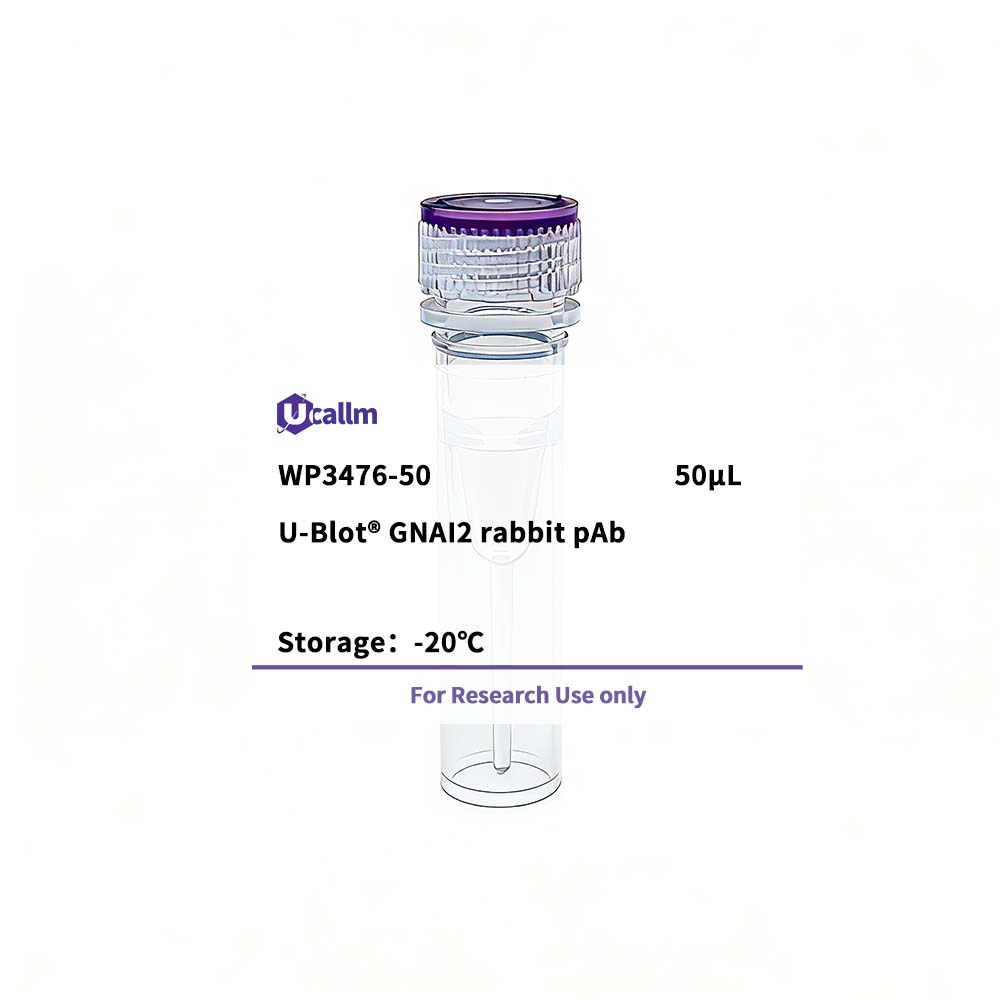
GNAI2 rabbit pAb

Price range: $268.00 through $328.00

SKU: WP3476-100
Enter the quantity you would like, or drag the panel to find the quantity and price that best for you
Bulk QuoteAuthorize OEM & ODM

Product details

Background:

The protein encoded by this gene is an alpha subunit of guanine nucleotide binding proteins (G proteins). The encoded protein contains the guanine nucleotide binding site and is involved in the hormonal regulation of adenylate cyclase. Several transcript variants encoding different isoforms have been found for this gene. [provided by RefSeq, Sep 2013],


Specifications

Size50μL/100μL
TargetGNAI2
ReactivityHuman, Mouse, Rat
ApplicationsWB
MW(Calculated)
MW(Observed)38kD
Host SpeciesRabbit
IsotypeIgG
Conjugate/ModificationUnmodified
Recommended Dilution RatioWB 1:500-2000
FormulationLiquid in PBS containing 50% glycerol, 0.5% BSA and 0.02% sodium azide.
PurificationThe antibody was affinity-purified from rabbit antiserum by affinity-chromatography using epitope-specific immunogen.
Storage-15°C to -25°C/1 year(Do not lower than -25°C)
Concentration1 mg/ml
ClonalityPolyclonal
Clone Number
ImmunogenSynthesized peptide derived from human GNAI2 AA range: 274-324
SpecificityThis antibody detects endogenous levels of GNAI2 at Human/Mouse/Rat
Gene NameGNAI2 GNAI2B
Protein NameGNAI2
Other NameGuanine nucleotide-binding protein G; / i; / subunit alpha-2; / Adenylate cyclase-inhibiting G alpha protein
SpeciesHuman
Gene ID2771
UniprotP04899,
Species.1Mouse
Gene ID.114678
Uniprot.1P08752,
Species.2Rat
Gene ID.281664
Uniprot.2P04897
Cellular LocalizationCytoplasm . Cytoplasm, cytoskeleton, microtubule organizing center, centrosome . Cell membrane . Membrane; Lipid-anchor . Localizes in the centrosomes of interphase and mitotic cells. Detected at the cleavage furrow and/or the midbody.
Tissue ExpressionBrain,Cerebellum,Kidney,Lung,Mammary gland,Testis,
Signaling_pathwayCellular Processes >> Cellular community - eukaryotes >> Gap junction;Organismal Systems >> Immune system >> Platelet activation;Organismal Systems >> Immune system >> Leukocyte transendothelial migration;Organismal Systems >> Immune system >> Chemokine signaling pathway;Organismal Systems >> Endocrine system >> Estrogen signaling pathway;Organismal Systems >> Endocrine system >> Oxytocin signaling pathway;Organismal Systems >> Endocrine system >> Relaxin signaling pathway;Organismal Systems >> Endocrine system >> Growth hormone synthesis, secretion and action;Organismal Systems >> Circulatory system >> Adrenergic signaling in cardiomyocytes;Organismal Systems >> Nervous system >> Glutamatergic synapse;Organismal Systems >> Nervous system >> Cholinergic synapse;Organismal Systems >> Nervous system >> Dopaminergic synapse;Human Diseases >> Cancer: overview >> Pathways in cancer;Human Diseases >> Neurodegenerative disease >> Parkinson disease;Environmental Information Processing >> Signal transduction >> Rap1 signaling pathway;Environmental Information Processing >> Signal transduction >> Apelin signaling pathway;Environmental Information Processing >> Signal transduction >> Sphingolipid signaling pathway;Environmental Information Processing >> Signal transduction >> cAMP signaling pathway;Environmental Information Processing >> Signal transduction >> cGMP-PKG signaling pathway
Research Areas>>Rap1 signaling pathway; / >>cGMP-PKG signaling pathway; / >>cAMP signaling pathway; / >>Chemokine signaling pathway; / >>Sphingolipid signaling pathway; / >>Adrenergic signaling in cardiomyocytes; / >>Axon guidance; / >>Apelin signaling pathway; / >>Gap junction; / >>Platelet activation; / >>Leukocyte transendothelial migration; / >>Circadian entrainment; / >>Retrograde endocannabinoid signaling; / >>Glutamatergic synapse; / >>Cholinergic synapse; / >>Serotonergic synapse; / >>GABAergic synapse; / >>Dopaminergic synapse; / >>Long-term depression; / >>Progesterone-mediated oocyte maturation; / >>Estrogen signaling pathway; / >>Melanogenesis; / >>Oxytocin signaling pathway; / >>Regulation of lipolysis in adipocytes; / >>Renin secretion; / >>Relaxin signaling pathway; / >>Parathyroid hormone synthesis, secretion and action; / >>Cushing syndrome; / >>Growth hormone synthesis, secretion and action; / >>Gastric acid secretion; / >>Parkinson disease; / >>Cocaine addiction; / >>Morphine addiction; / >>Alcoholism; / >>Pertussis; / >>Chagas disease; / >>Toxoplasmosis; / >>Human cytomegalovirus infection; / >>Human immunodeficiency virus 1 infection; / >>Pathways in cancer; / >>Chemical carcinogenesis - receptor activation
FunctionFunction:Guanine nucleotide-binding proteins (G proteins) are involved as modulators or transducers in various transmembrane signaling systems. The G(i) proteins are involved in hormonal regulation of adenylate cyclase: they inhibit the cyclase in response to beta-adrenergic stimuli.,similarity:Belongs to the G-alpha family. G(i/o/t/z) subfamily.,subunit:G proteins are composed of 3 units; alpha, beta and gamma. The alpha chain contains the guanine nucleotide binding site. Interacts with GPSM1 (By similarity). Interacts with UNC5B.,
Please login to post questions
Back to Top
Product has been added to your cart
