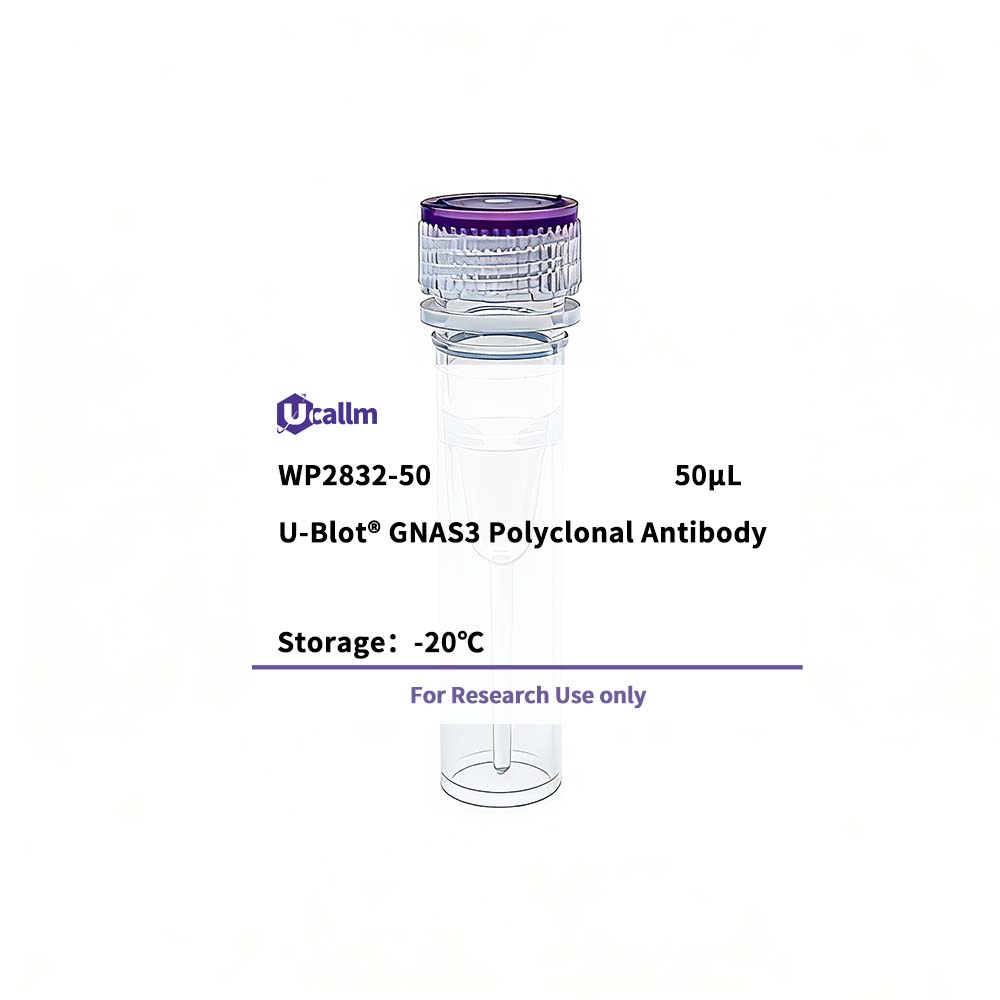
SKU: WP2832 Categories: ,

GNAS3 Polyclonal Antibody

Price range: $268.00 through $328.00

SKU: WP2832-100
Enter the quantity you would like, or drag the panel to find the quantity and price that best for you
Bulk QuoteAuthorize OEM & ODM

Product details

Background:

This locus has a highly complex imprinted expression pattern. It gives rise to maternally, paternally, and biallelically expressed transcripts that are derived from four alternative promoters and 5' exons. Some transcripts contain a differentially methylated region (DMR) at their 5' exons, and this DMR is commonly found in imprinted genes and correlates with transcript expression. An antisense transcript is produced from an overlapping locus on the opposite strand. One of the transcripts produced from this locus, and the antisense transcript, are paternally expressed noncoding RNAs, and may regulate imprinting in this region. In addition, one of the transcripts contains a second overlapping ORF, which encodes a structurally unrelated protein – Alex. Alternative splicing of downstream exons is also observed, which results in different forms of the stimulatory G-protein alpha subunit, a key


Specifications

Size50μL/100μL
TargetGNAS3
ReactivityHuman, Mouse, Rat
ApplicationsWB, ELISA
MW(Calculated)
MW(Observed)26kD
Host SpeciesRabbit
IsotypeIgG
Conjugate/ModificationUnmodified
Recommended Dilution RatioWB 1:500-2000; ELISA 1:5000-20000
FormulationLiquid in PBS containing 50% glycerol,0.5% BSA and 0.02% sodium azide.
PurificationThe antibody was affinity-purified from rabbit antiserum by affinity-chromatography using epitope-specific immunogen.
Storage-15°C to -25°C/1 year(Do not lower than -25°C)
Concentration1 mg/ml
ClonalityPolyclonal
Clone Number
ImmunogenSynthesized peptide derived from human protein . at AA range: 171-220
SpecificityGNAS3 Polyclonal Antibody detects endogenous levels of protein.
Gene NameGNAS GNAS1
Protein NameNeuroendocrine secretory protein 55 (NESP55) [Cleaved into: LHAL tetrapeptide; GPIPIRRH peptide]
Other Name
SpeciesHuman
Gene ID2778
UniprotO95467,
Species.1Mouse
Gene ID.1
Uniprot.1Q9Z0F1,
Species.2Rat
Gene ID.2
Uniprot.2Q792G6
Cellular LocalizationCytoplasmic vesicle, secretory vesicle . Secreted . Neuroendocrine secretory granules. .
Tissue ExpressionAdipocyte,Bone marrow,Brain,Breast,Liver,Muscle,Pancreas,Retina,
Signaling_pathwayCellular Processes >> Cellular community - eukaryotes >> Gap junction;Organismal Systems >> Immune system >> Platelet activation;Organismal Systems >> Endocrine system >> Insulin secretion;Organismal Systems >> Endocrine system >> Glucagon signaling pathway;Organismal Systems >> Endocrine system >> GnRH signaling pathway;Organismal Systems >> Endocrine system >> Estrogen signaling pathway;Organismal Systems >> Endocrine system >> Oxytocin signaling pathway;Organismal Systems >> Endocrine system >> Relaxin signaling pathway;Organismal Systems >> Endocrine system >> Growth hormone synthesis, secretion and action;Organismal Systems >> Endocrine system >> Aldosterone synthesis and secretion;Organismal Systems >> Circulatory system >> Adrenergic signaling in cardiomyocytes;Organismal Systems >> Circulatory system >> Vascular smooth muscle contraction;Organismal Systems >> Nervous system >> Glutamatergic synapse;Organismal Systems >> Nervous system >> Dopaminergic synapse;Organismal Systems >> Sensory system >> Inflammatory mediator regulation of TRP channels;Human Diseases >> Cancer: overview >> Pathways in cancer;Human Diseases >> Neurodegenerative disease >> Parkinson disease;Environmental Information Processing >> Signal transduction >> Rap1 signaling pathway;Environmental Information Processing >> Signal transduction >> Calcium signaling pathway;Environmental Information Processing >> Signal transduction >> Phospholipase D signaling pathway;Environmental Information Processing >> Signal transduction >> cAMP signaling pathway
Research Areas
FunctionCaution:The sequence shown here is derived from an Ensembl automatic analysis pipeline and should be considered as preliminary data.,Disease:Defects in GNAS are a cause of ACTH-independent macronodular adrenal hyperplasia (AIMAH) [MIM:219080]; also known as adrenal Cushing syndrome due to AIMAH. AIMAH is an endogenous form of adrenal Cushing syndrome characterized by multiple bilateral adrenocortical nodules that cause a striking enlargement of the adrenal glands.,Disease:Defects in GNAS are the cause of a subset of growth hormone secreting pituitary tumors (somatotrophinoma) [MIM:102200].,Disease:Defects in GNAS are the cause of Albright hereditary osteodystrophy (AHO) [MIM:103580]. AHO is an autosomal dominant disorder characterized by a short stature, brachydactyly, subcutaneous ossifications. AHO is often associated with pseudohypoparathyoidism, hypocalcemia, and elevated PTH levels. The expression or the activity of GNAS is reduced in AHO.,Disease:Defects in GNAS are the cause of GNAS hyperfunction [MIM:139320]. This condition is characterized by increased trauma-related bleeding tendency, prolonged bleeding time, brachydactyly and mental retardation. Both the XLas isoforms and the ALEX protein are mutated which strongly reduces the interaction between them and this may allow unimpeded activation of the XLas isoforms.,Disease:Defects in GNAS are the cause of McCune-Albright syndrome (MAS) [MIM:174800]. MAS is characterized by polyostotic fibrous dysplasia, cafe-au-lait lesions, and a variety of endocrine disorders, including precocious puberty, hyperthyroidism, hypercortisolism, growth hormone excess, and hyperprolactinemia. The mutations producing MAS lead to constitutive activation of GS alpha.,Disease:Defects in GNAS are the cause of progressive osseous heteroplasia (POH) [MIM:166350]. POH is a rare autosomal dominant disorder characterized by extensive dermal ossification during childhood, followed by disabling and widespread heterotopic ossification of skeletal muscle and deep connective tissue.,Disease:Defects in GNAS are the cause of pseudohypoparathyroidism type 1A (PHP1A) [MIM:103580]. Pseudohypoparathyroidism is a term applied to a heterogeneous group of disorders whose common feature is resistance to parathyroid hormone.,Disease:Defects in GNAS may be a cause of colorectal cancer (CRC) [MIM:114500].,Disease:Genetic variations in GNAS are the cause of pseudohypoparathyroidism type 1B (PHP1B) [MIM:603233]. PHP1B is characterized by parathyroid hormone (PTH)-resistant hypocalcemia and hyperphosphatemia. Patients affected with PHP1B have normal activity of the product of GNAS, lack developmental defects characteristic of AHO, and typically show no other endocrine abnormalities besides resistance to PTH. Most affected individuals have defects in methylation of the gene. In some cases microdeletions involving the STX16 appear to cause loss of methylation at exon A/B of GNAS, resulting in PHP1B. Paternal uniparental isodisomy have also been observed.,Function:Guanine nucleotide-binding proteins (G proteins) are involved as modulators or transducers in various transmembrane signaling systems. The G(s) protein is involved in hormonal regulation of adenylate cyclase: it activates the cyclase in response to beta-adrenergic stimuli.,Function:Guanine nucleotide-binding proteins (G proteins) are involved as modulators or transducers in various transmembrane signaling systems. The G(s) protein is involved in hormonal regulation of adenylate cyclase: it activates the cyclase in response to beta-adrenergic stimuli. XLas isoforms interact with the same set of receptors as Gnas isoforms.,Function:May inhibit the adenylyl cyclase-stimulating activity of guanine nucleotide-binding protein G(s) subunit alpha which is produced from the same locus in a different open reading frame.,miscellaneous:The GNAS locus is imprinted in a complex manner, giving rise to distinct paternally, maternally and biallelically expressed proteins. The XLas isoforms are paternally derived, the Gnas isoforms are biallelically derived and the Nesp55 isoforms are maternally derived.,miscellaneous:This protein is produced by a bicistronic gene which also produces guanine nucleotide-binding protein G(s) subunit alpha from an overlapping reading frame.,miscellaneous:This protein is produced by a bicistronic gene which also produces the ALEX protein from an overlapping reading frame.,PTM:Binds keratan sulfate chains.,PTM:May be proteolytically processed to give rise to a number of active peptides.,similarity:Belongs to the ALEX family.,similarity:Belongs to the G-alpha family. G(s) subfamily.,similarity:Belongs to the NESP55 family.,subcellular location:Neuroendocrine secretory granules.,subcellular location:Predominantly associated with cell membrane ruffles.,subunit:G proteins are composed of 3 units; alpha, beta and gamma. The alpha chain contains the guanine nucleotide binding site.,subunit:G proteins are composed of 3 units; alpha, beta and gamma. The alpha chain contains the guanine nucleotide binding site. Interacts through its N-terminal region with ALEX which is produced from the same locus in a different open reading frame. This interaction may inhibit its adenylyl cyclase-stimulating activity.,subunit:Interacts with the N-terminal region of the XLas isoforms of guanine nucleotide-binding protein G(s) subunit alpha.,
Please login to post questions
Back to Top
Product has been added to your cart

