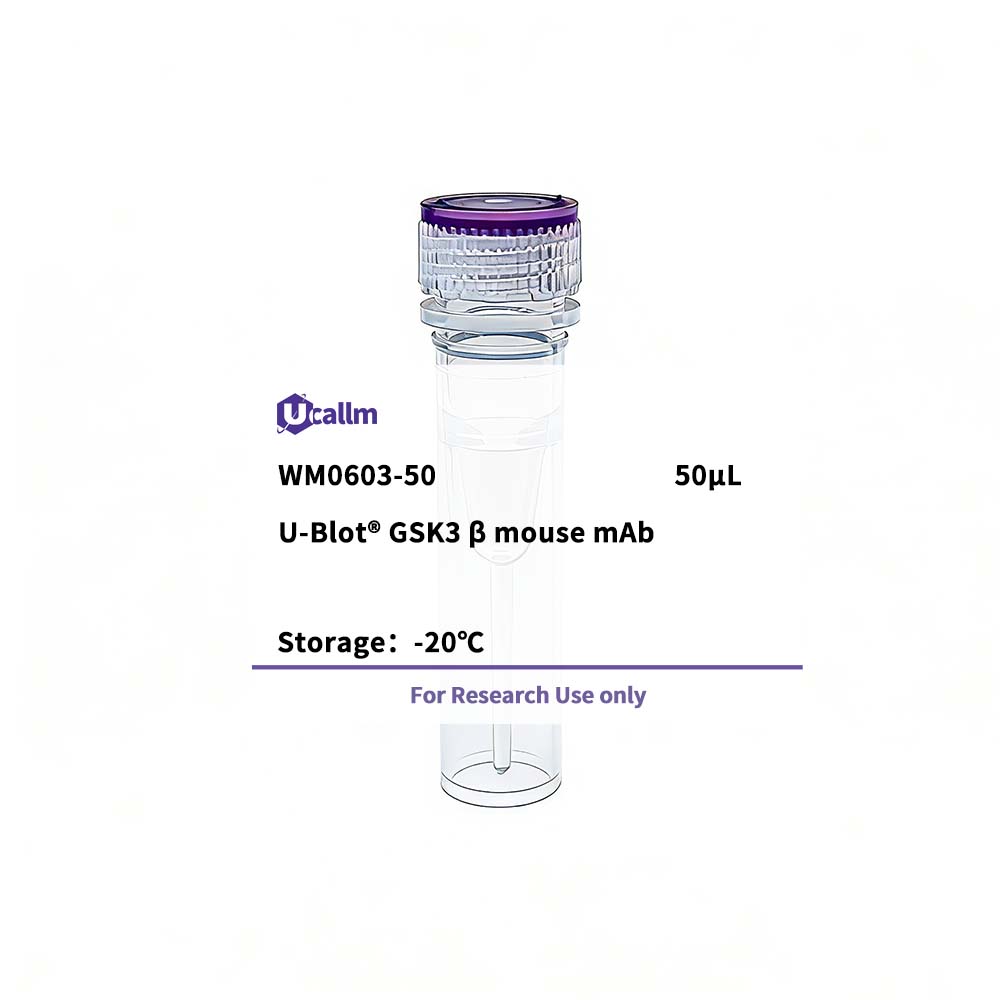
SKU: WM0603 Categories: ,

GSK3 β mouse mAb

Price range: $268.00 through $328.00

SKU: WM0603-50
Enter the quantity you would like, or drag the panel to find the quantity and price that best for you
Bulk QuoteAuthorize OEM & ODM

Product details

Background:
The protein encoded by this gene is a serine-threonine kinase, belonging to the glycogen synthase kinase subfamily. It is involved in energy metabolism, neuronal cell development, and body pattern formation. Polymorphisms in this gene have been implicated in modifying risk of Parkinson disease, and studies in mice show that overexpression of this gene may be relevant to the pathogenesis of Alzheimer disease. Alternatively spliced transcript variants encoding different isoforms have been found for this gene.[provided by RefSeq, Sep 2009],


Specifications

Size50μL/100μL
TargetGSK3β
ReactivityHuman, Mouse
ApplicationsWB, IF, IP
MW(Calculated)
MW(Observed)46kD
Host SpeciesMouse
Isotype
Conjugate/ModificationUnmodified
Recommended Dilution RatioWB 1:1000; ICC 1:200; IF 1:50-200
FormulationLiquid in PBS containing 50% glycerol, 0.5% BSA and 0.02% sodium azide.
PurificationThe antibody was affinity-purified from mouse ascites by affinity-chromatography using epitope-specific immunogen.
Storage-15°C to -25°C/1 year(Do not lower than -25°C)
Concentration
ClonalityMonoclonal
Clone Number4A9
ImmunogenPurified recombinant GSK3β protein fragments expressed in E.coli.
SpecificityThis antibody detects endogenous levels of GSK3β and does not cross-react with related proteins.
Gene NameGSK3B
Protein Name
Other NameGSK3B; / Glycogen synthase kinase-3 beta; / GSK-3 beta; / Serine/threonine-protein kinase GSK3B
SpeciesHuman
Gene ID2932
UniprotP49841,
Species.1Mouse
Gene ID.156637
Uniprot.1Q9WV60,
Species.2Rat
Gene ID.284027
Uniprot.2P18266
Cellular LocalizationCytoplasm . Nucleus . Cell membrane . The phosphorylated form shows localization to cytoplasm and cell membrane (PubMed:20937854). The MEMO1-RHOA-DIAPH1 signaling pathway controls localization of the phosphorylated form to the cell membrane (PubMed:20937854). .
Tissue ExpressionExpressed in testis, thymus, prostate and ovary and weakly expressed in lung, brain and kidney. Colocalizes with EIF2AK2/PKR and TAU in the Alzheimer disease (AD) brain.
Signaling_pathwayCellular Processes >> Cell growth and death >> Cell cycle;Cellular Processes >> Cellular community - eukaryotes >> Focal adhesion;Cellular Processes >> Cellular community - eukaryotes >> Signaling pathways regulating pluripotency of stem cells;Organismal Systems >> Immune system >> T cell receptor signaling pathway;Organismal Systems >> Immune system >> IL-17 signaling pathway;Organismal Systems >> Immune system >> B cell receptor signaling pathway;Organismal Systems >> Immune system >> Chemokine signaling pathway;Organismal Systems >> Endocrine system >> Insulin signaling pathway;Organismal Systems >> Endocrine system >> Prolactin signaling pathway;Organismal Systems >> Endocrine system >> Growth hormone synthesis, secretion and action;Organismal Systems >> Endocrine system >> Thyroid hormone signaling pathway;Organismal Systems >> Nervous system >> Dopaminergic synapse;Organismal Systems >> Nervous system >> Neurotrophin signaling pathway;Human Diseases >> Cancer: overview >> Pathways in cancer;Human Diseases >> Cancer: specific types >> Colorectal cancer;Human Diseases >> Cancer: specific types >> Hepatocellular carcinoma;Human Diseases >> Cancer: specific types >> Gastric cancer;Human Diseases >> Cancer: specific types >> Basal cell carcinoma;Human Diseases >> Cancer: specific types >> Prostate cancer;Human Diseases >> Cancer: specific types >> Endometrial cancer;Human Diseases >> Cancer: specific types >> Breast cancer;Human Diseases >> Neurodegenerative disease >> Alzheimer disease;Human Diseases >> Neurodegenerative disease >> Prion disease;Human Diseases >> Neurodegenerative disease >> Pathways of neurodegeneration - multiple diseases;Environmental Information Processing >> Signal transduction >> ErbB signaling pathway;Environmental Information Processing >> Signal transduction >> Wnt signaling pathway;Environmental Information Processing >> Signal transduction >> Hedgehog signaling pathway;Environmental Information Processing >> Signal transduction >> Hippo signaling pathway;Environmental Information Processing >> Signal transduction >> PI3K-Akt signaling pathway;Environmental Information Processing >> Signal transduction >> mTOR signaling pathway
Research Areas>>EGFR tyrosine kinase inhibitor resistance; / >>ErbB signaling pathway; / >>Chemokine signaling pathway; / >>Cell cycle; / >>mTOR signaling pathway; / >>PI3K-Akt signaling pathway; / >>Wnt signaling pathway; / >>Hedgehog signaling pathway; / >>Axon guidance; / >>Hippo signaling pathway; / >>Focal adhesion; / >>Signaling pathways regulating pluripotency of stem cells; / >>IL-17 signaling pathway; / >>T cell receptor signaling pathway; / >>B cell receptor signaling pathway; / >>Neurotrophin signaling pathway; / >>Dopaminergic synapse; / >>Insulin signaling pathway; / >>Melanogenesis; / >>Prolactin signaling pathway; / >>Thyroid hormone signaling pathway; / >>Insulin resistance; / >>Non-alcoholic fatty liver disease; / >>Cushing syndrome; / >>Growth hormone synthesis, secretion and action; / >>Alcoholic liver disease; / >>Alzheimer disease; / >>Prion disease; / >>Pathways of neurodegeneration - multiple diseases; / >>Shigellosis; / >>Yersinia infection; / >>Hepatitis C; / >>Measles; / >>Human cytomegalovirus infection; / >>Human papillomavirus infection; / >>Kaposi sarcoma-associated herpesvirus infection; / >>Pathways in cancer; / >>Colorectal cancer; / >>Endometrial cancer; / >>Prostate cancer; / >>Basal cell carcinoma; / >>Breast cancer; / >>Hepatocellular carcinoma; / >>Gastric cancer; / >>Diabetic cardiomyopathy; / >>Lipid and atherosclerosis
FunctionCatalytic activity:ATP + [tau protein] = ADP + [tau protein] phosphate.,enzyme regulation:Inhibited when phosphorylated by AKT1.,Function:Participates in the Wnt signaling pathway. Implicated in the hormonal control of several regulatory proteins including glycogen synthase, MYB and the transcription factor JUN. Phosphorylates JUN at sites proximal to its DNA-binding domain, thereby reducing its affinity for DNA. Phosphorylates MUC1 in breast cancer cells, and decreases the interaction of MUC1 with CTNNB1/beta-catenin.,PTM:Phosphorylated by AKT1 and ILK1.,similarity:Belongs to the protein kinase superfamily.,similarity:Belongs to the protein kinase superfamily. CMGC Ser/Thr protein kinase family. GSK-3 subfamily.,similarity:Contains 1 protein kinase domain.,subunit:Monomer (By similarity). Interacts with CABYR, MUC1, NIN and PRUNE.,tissue specificity:Expressed in testis, thymus, prostate and ovary and weakly expressed in lung, brain and kidney.,
Please login to post questions
Back to Top
Product has been added to your cart

