

U-Blot® HDAC1 Rabbit mAb
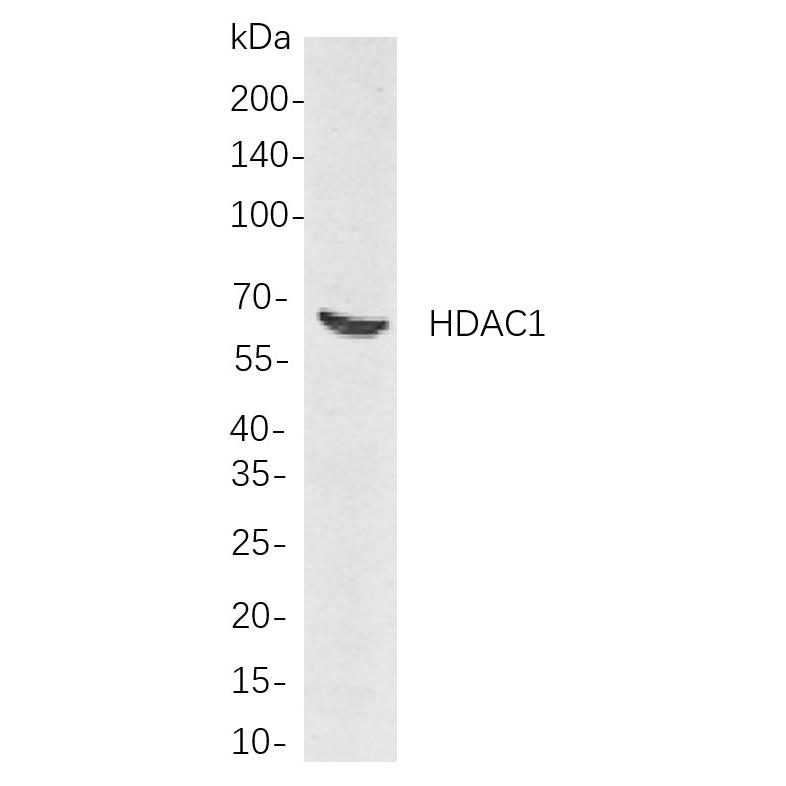
WR4215 Western blot analysis of lysates from K562 cells, using HDAC1 Rabbit mAb. The HRP-conjugated Goat anti-Rabbit IgG antibody (WS0002) was used to detect the antibody.
Price range: $268.00 through $328.00
Product details
Background:Histone acetylation and deacetylation, catalyzed by multisubunit complexes, play a key role in the regulation of eukaryotic gene expression. The protein encoded by this gene belongs to the histone deacetylase/acuc/apha family and is a component of the histone deacetylase complex. It also interacts with retinoblastoma tumor-suppressor protein and this complex is a key element in the control of cell proliferation and differentiation. Together with metastasis-associated protein-2, it deacetylates p53 and modulates its effect on cell growth and apoptosis. [provided by RefSeq, Jul 2008],
Specifications
| Size | 50μL/100μL |
| Target | HDAC1 |
| Reactivity | Human, Mouse, Rat |
| Applications | WB, IHC, IF, ELISA |
| MW(Calculated) | 55kD |
| MW(Observed) | 62kD |
| Host Species | Rabbit |
| Isotype | IgG,Kappa |
| Conjugate/Modification | Unmodified |
| Recommended Dilution Ratio | IHC 1:4000-1:10000; WB 1:1000-1:5000; IF 1:200-1:1000; ELISA 1:5000-1:20000; / Note: For IHC, we suggest antigen retrieval with TE buffer pH 9.0 (Cat#WT1004) |
| Formulation | PBS, 50% glycerol, 0.05% Proclin 300, 0.05%BSA |
| Purification | Recombinant Antibody expressed in animal component-free (ACF) media, purified via Protein A affinity chromatography. |
| Storage | -15°C to -25°C/1 year(Do not lower than -25°C) |
| Concentration | |
| Clonality | Monoclonal |
| Clone Number | RM0390R |
| Immunogen | The specific immunogen used to produce this antibody is proprietary information. |
| Specificity | Endogenous |
| Gene Name | HDAC1 |
| Protein Name | Histone deacetylase 1 |
| Other Name | HDAC1; / RPD3L1; / Histone deacetylase 1; / HD1 |
| Species | Human |
| Gene ID | 3065 |
| Uniprot | Q13547, |
| Species.1 | Mouse |
| Gene ID.1 | 433759 |
| Uniprot.1 | O09106, |
| Species.2 | Rat |
| Gene ID.2 | 297893 |
| Uniprot.2 | Q4QQW4 |
| Cellular Localization | Nucleus |
| Tissue Expression | Ubiquitous, with higher levels in heart, pancreas and testis, and lower levels in kidney and brain. |
| Signaling_pathway | Cellular Processes >> Cell growth and death >> Cell cycle;Organismal Systems >> Immune system >> Neutrophil extracellular trap formation;Organismal Systems >> Endocrine system >> Thyroid hormone signaling pathway;Organismal Systems >> Aging >> Longevity regulating pathway - multiple species;Human Diseases >> Cancer: overview >> Pathways in cancer;Human Diseases >> Cancer: overview >> Transcriptional misregulation in cancer;Human Diseases >> Cancer: overview >> MicroRNAs in cancer;Human Diseases >> Cancer: specific types >> Chronic myeloid leukemia;Human Diseases >> Neurodegenerative disease >> Huntington disease;Environmental Information Processing >> Signal transduction >> Notch signaling pathway;Environmental Information Processing >> Signal transduction >> TGF-beta signaling pathway;Genetic Information Processing >> Chromosome >> ATP-dependent chromatin remodeling |
| Research Areas | >>Cell cycle; / >>Longevity regulating pathway - multiple species; / >>Notch signaling pathway; / >>Neutrophil extracellular trap formation; / >>Thyroid hormone signaling pathway; / >>Huntington disease; / >>Amphetamine addiction; / >>Alcoholism; / >>Human papillomavirus infection; / >>Epstein-Barr virus infection; / >>Pathways in cancer; / >>Transcriptional misregulation in cancer; / >>Viral carcinogenesis; / >>MicroRNAs in cancer; / >>Chronic myeloid leukemia |
| Function | Catalytic activity:Hydrolysis of an N(6)-acetyl-lysine residue of a histone to yield a deacetylated histone.,Function:Responsible for the deacetylation of lysine residues on the N-terminal part of the core histones (H2A, H2B, H3 and H4). Histone deacetylation gives a tag for epigenetic repression and plays an important role in transcriptional regulation, cell cycle progression and developmental events. Histone deacetylases act via the formation of large multiprotein complexes.,PTM:Phosphorylation on Ser-421 and Ser-423 promotes enzymatic activity and interactions with NuRD and SIN3 complexes.,PTM:Sumoylated on Lys-444 and Lys-476; which promotes enzymatic activity. Desumoylated by SENP1.,similarity:Belongs to the histone deacetylase family. Type 1 subfamily.,subunit:Part of the core histone deacetylase (HDAC) complex composed of HDAC1, HDAC2, RBBP4 and RBBP7. The core complex associates with MTA2, MBD2, MBD3, MTA1L1, CHD3 and CHD4 to form the nucleosome remodeling and histone deacetylation (NuRD) complex, or with SIN3, SAP18 and SAP30 to form the SIN3 HDAC complex. Component of a BHC histone deacetylase complex that contains HDAC1, HDAC2, HMG20B/BRAF35, AOF2/LSD1, RCOR1/CoREST and PHF21A/BHC80. The BHC complex may also contain ZMYM2, ZNF217, ZMYM3, GSE1 and GTF2I. Associates with the 9-1-1 complex; interacts with HUS1. Found in a complex with DNMT3A and HDAC7. Interacts with BCOR, BRMS1L, DAXX, DNMT1, EP300, HCFC1, NFE4, PCAF, PHB2, MIER1, KDM4A, MINT, NRIP1, PRDM6, RERE, SETDB1, SUV39H1, TGIF, TGIF2, UHRF1, UHRF2 and ZNF541. Interacts with the non-histone region of H2AFY. Interacts with HDAC9. Component of a mSin3A corepressor complex that contains SIN3A, SAP130, SUDS3/SAP45, ARID4B/SAP180, HDAC1 and HDAC2. Interacts with BANP, CBFA2T3 and KDM5B. Interacts with SAP30L. Interacts with E4F1. Interacts with KFL1 (By similarity). Interacts with SV40 large T antigen.,tissue specificity:Ubiquitous, with higher levels in heart, pancreas and testis, and lower levels in kidney and brain., |
Please login to post questions
Related products





