SKU: WR4381 Categories: ,

U-Blot® HDAC4 Rabbit mAb

Price range: $268.00 through $328.00

SKU: WR4381-50
Enter the quantity you would like, or drag the panel to find the quantity and price that best for you
Bulk QuoteAuthorize OEM & ODM

Product details

Background:Histones play a critical role in transcriptional regulation, cell cycle progression, and developmental events. Histone acetylation/deacetylation alters chromosome structure and affects transcription factor access to DNA. The protein encoded by this gene belongs to class II of the histone deacetylase/acuc/apha family. It possesses histone deacetylase activity and represses transcription when tethered to a promoter. This protein does not bind DNA directly, but through transcription factors MEF2C and MEF2D. It seems to interact in a multiprotein complex with RbAp48 and HDAC3. [provided by RefSeq, Jul 2008],

Specifications

Size50μL/100μL
TargetHDAC4
ReactivityHuman, Mouse, Rat
ApplicationsWB, IHC, IF, ELISA
MW(Calculated)119kD
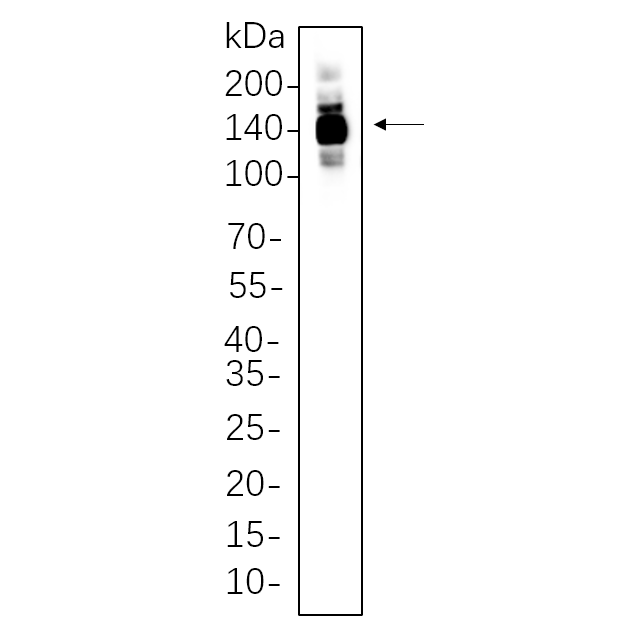
MW(Observed)140kD
Host SpeciesRabbit
IsotypeIgG,Kappa
Conjugate/ModificationUnmodified
Recommended Dilution RatioIHC 1:50-1:200; WB 1:2000-1:10000; IF 1:200-1:1000; ELISA 1:5000-1:20000; / Note: For IHC, we suggest antigen retrieval with TE buffer pH 9.0 (Cat#WT1004)
FormulationPBS, 50% glycerol, 0.05% Proclin 300, 0.05%BSA
PurificationRecombinant Antibody expressed in animal component-free (ACF) media, purified via Protein A affinity chromatography.
Storage-15°C to -25°C/1 year(Do not lower than -25°C)
Concentration
ClonalityMonoclonal
Clone NumberRM0600R
ImmunogenThe specific immunogen used to produce this antibody is proprietary information.
SpecificityEndogenous
Gene NameHDAC4
Protein NameHistone deacetylase 4
Other NameHDAC4; / KIAA0288; / Histone deacetylase 4; / HD4
SpeciesHuman
Gene ID9759
UniprotP56524,
Species.1Mouse
Gene ID.1208727
Uniprot.1Q6NZM9,
Species.2Rat
Gene ID.2363287
Uniprot.2Q99P99
Cellular LocalizationCytoplasm, Nucleus
Tissue ExpressionUbiquitous.
Signaling_pathwayOrganismal Systems >> Immune system >> Neutrophil extracellular trap formation;Human Diseases >> Cancer: overview >> MicroRNAs in cancer;Environmental Information Processing >> Signal transduction >> Apelin signaling pathway
Research Areas>>Apelin signaling pathway; / >>Neutrophil extracellular trap formation; / >>Alcoholism; / >>Viral carcinogenesis; / >>MicroRNAs in cancer
FunctionCatalytic activity:Hydrolysis of an N(6)-acetyl-lysine residue of a histone to yield a deacetylated histone.,Domain:The nuclear export sequence mediates the shuttling between the nucleus and the cytoplasm.,Function:Responsible for the deacetylation of lysine residues on the N-terminal part of the core histones (H2A, H2B, H3 and H4). Histone deacetylation gives a tag for epigenetic repression and plays an important role in transcriptional regulation, cell cycle progression and developmental events. Histone deacetylases act via the formation of large multiprotein complexes. Involved in muscle maturation via its interaction with the myocyte enhancer factors such as MEF2A, MEF2C and MEF2D.,PTM:Phosphorylated by CaMK4 at Ser-246, Ser-467 and Ser-632. Phosphorylation at other residues is required for the interaction with 14-3-3.,PTM:Sumoylation on Lys-559 is promoted by the E3 SUMO-protein ligase RANBP2, and prevented by phosphorylation by CaMK4.,similarity:Belongs to the histone deacetylase family. Type 2 subfamily.,subcellular location:Shuttles between the nucleus and the cytoplasm. Upon muscle cells differentiation, it accumulates in the nuclei of myotubes, suggesting a positive role of nuclear HDAC4 in muscle differentiation. The export to cytoplasm depends on the interaction with a 14-3-3 chaperone protein and is due to its phosphorylation at Ser-246, Ser-467 and Ser-632 by CaMK4. The nuclear localization probably depends on sumoylation.,subunit:Interacts with HDAC7 (By similarity). Homodimer. Homodimerization via its N-terminal domain. Interacts with MEF2C, AHRR, and NR2C1. Interacts with a 14-3-3 chaperone protein in a phosphorylation dependent manner. Interacts with BTBD14B (By similarity). Interacts with KDM5B.,tissue specificity:Ubiquitous.,
Please login to post questions

Back to Top
Product has been added to your cart



