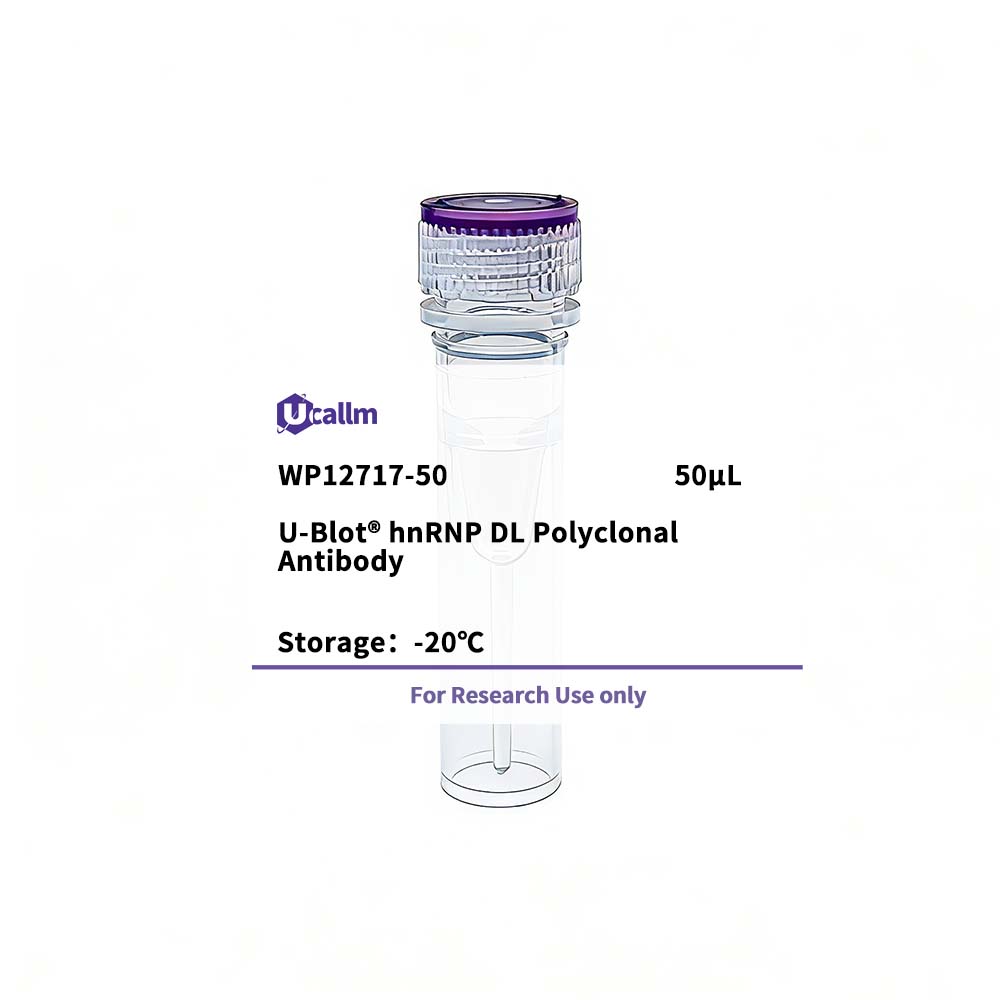
SKU: WP12717 Categories: ,

hnRNP DL Polyclonal Antibody

Price range: $268.00 through $328.00

SKU: WP12717-100
Enter the quantity you would like, or drag the panel to find the quantity and price that best for you
Bulk QuoteAuthorize OEM & ODM

Product details

Background:

heterogeneous nuclear ribonucleoprotein D like(HNRNPDL) Homo sapiens This gene belongs to the subfamily of ubiquitously expressed heterogeneous nuclear ribonucleoproteins (hnRNPs). The hnRNPs are RNA binding proteins and they complex with heterogeneous nuclear RNA (hnRNA). These proteins are associated with pre-mRNAs in the nucleus and appear to influence pre-mRNA processing and other aspects of mRNA metabolism and transport. While all of the hnRNPs are present in the nucleus, some seem to shuttle between the nucleus and the cytoplasm. The hnRNP proteins have distinct nucleic acid binding properties. The protein encoded by this gene has two RRM domains that bind to RNAs. Three alternatively spliced transcript variants have been described for this gene. One of the variants is probably not translated because the transcript is a candidate for nonsense-mediated mRNA decay. The protein isoforms encoded by this gene are similar to its family member

Specifications

Size50μL/100μL
TargethnRNP DL
ReactivityHuman, Mouse, Rat
ApplicationsIHC, IF, ELISA
MW(Calculated)46kD
MW(Observed)
Host SpeciesRabbit
IsotypeIgG
Conjugate/ModificationUnmodified
Recommended Dilution RatioIHC 1:100-1:300; ELISA 1:20000; IF 1:50-200 / Note: For IHC, we suggest antigen retrieval with TE buffer pH 9.0 (Cat#WT1004)
FormulationLiquid in PBS containing 50% glycerol, 0.5% BSA and 0.02% sodium azide.
PurificationThe antibody was affinity-purified from rabbit antiserum by affinity-chromatography using epitope-specific immunogen.
Storage-15°C to -25°C/1 year(Do not lower than -25°C)
Concentration1 mg/ml
ClonalityPolyclonal
Clone Number
ImmunogenThe antiserum was produced against synthesized peptide derived from human HNRPDL. AA range:241-290
SpecificityhnRNP DL Polyclonal Antibody detects endogenous levels of hnRNP DL protein.
Gene NameHNRPDL
Protein NameHeterogeneous nuclear ribonucleoprotein D-like
Other NameHNRPDL; / JKTBP; / Heterogeneous nuclear ribonucleoprotein D-like; / hnRNP D-like; / hnRNP DL; / AU-rich element RNA-binding factor; / JKT41-binding protein; / Protein laAUF1
SpeciesHuman
Gene ID9987
UniprotO14979,
Species.1Mouse
Gene ID.1
Uniprot.1Q9Z130,
Species.2Rat
Gene ID.2305178
Uniprot.2Q3SWU3
Cellular LocalizationNucleus . Cytoplasm . Shuttles between the nucleus and the cytoplasm in a TNPO1-dependent manner. .
Tissue ExpressionExpressed in heart, brain, placenta, lung, liver, skeletal muscle, kidney, pancreas, spleen, thymus, prostate, testis, ovary, small intestine, colon and leukocytes. Expressed in myeloid leukemia, gastric adenocarcinoma, cervical carcinoma, hepatoma, fibrosarcoma, colon adenocarcinoma, epidermoid carcinoma, osteosarcoma and urinary bladder carcinoma cells.
Signaling_pathway
Research Areas
FunctionFunction:Acts as a transcriptional regulator. Promotes transcription repression. Promotes transcription activation in differentiated myotubes (By similarity). Binds to double- and single-stranded DNA sequences. Binds to the transcription suppressor CATR sequence of the COX5B promoter (By similarity). Binds with high affinity to RNA molecules that contain AU-rich elements (AREs) found within the 3'-UTR of many proto-oncogenes and cytokine mRNAs. Binds both to nuclear and cytoplasmic poly(A) mRNAs. Binds to poly(G) and poly(A), but not to poly(U) or poly(C) RNA homopolymers. Binds to the 5'-ACUAGC-3' RNA consensus sequence.,induction:Up-regulated by 12-O-tetradecanoylphorbol 13-acetate (TPA) in macrophages and retinoic acid (RA) in granulocytes (at protein level). Down-regulated by interleukin-4 (IL-4).,PTM:Dimethylation of Arg-408 is probably of the asymmetric type.,similarity:Contains 2 RRM (RNA recognition motif) domains.,subcellular location:Shuttles between the nucleus and the cytoplasm in a TNPO1-dependent manner.,subunit:Interacts with ZNF148 (By similarity). Interacts with TNPO1.,tissue specificity:Expressed in heart, brain, placenta, lung, liver, skeletal muscle, kidney, pancreas, spleen, thymus, prostate, testis, ovary, small intestine, colon and leukocytes. Expressed in myeloid leukemia, gastric adenocarcinoma, cervical carcinoma, hepatoma, fibrosarcoma, colon adenocarcinoma, epidermoid carcinoma, osteosarcoma and urinary bladder carcinoma cells.,
Please login to post questions
Back to Top
Product has been added to your cart
