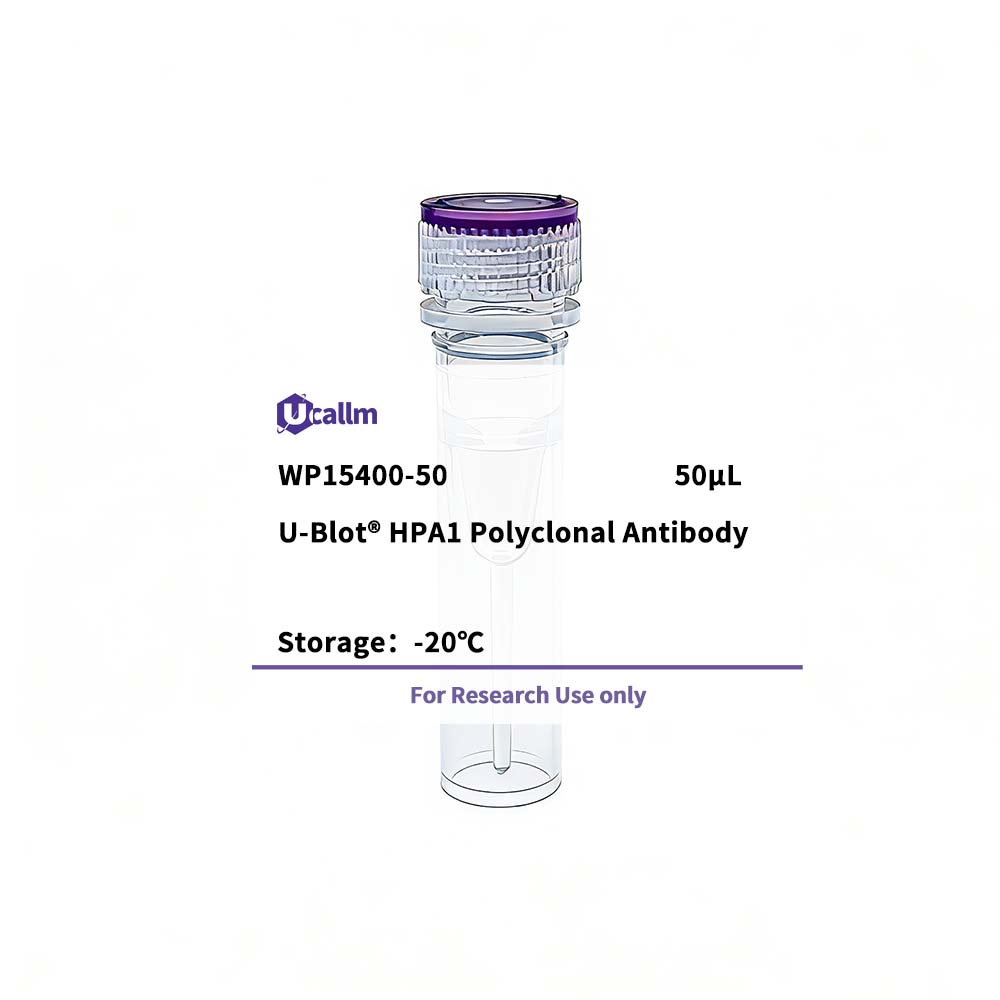
SKU: WP15400 Categories: ,

HPA1 Polyclonal Antibody

Price range: $268.00 through $328.00

SKU: WP15400-100
Enter the quantity you would like, or drag the panel to find the quantity and price that best for you
Bulk QuoteAuthorize OEM & ODM

Product details

Background:

Heparan sulfate proteoglycans are major components of the basement membrane and extracellular matrix. The protein encoded by this gene is an enzyme that cleaves heparan sulfate proteoglycans to permit cell movement through remodeling of the extracellular matrix. In addition, this cleavage can release bioactive molecules from the extracellular matrix. Several transcript variants encoding different isoforms have been found for this gene. [provided by RefSeq, Sep 2011],

Specifications

Size50μL/100μL
TargetHPA1
ReactivityHuman, Mouse, Rat
ApplicationsWB, IHC, IF, ELISA
MW(Calculated)
MW(Observed)62kD
Host SpeciesRabbit
IsotypeIgG
Conjugate/ModificationUnmodified
Recommended Dilution RatioWB 1:500-1:2000; IHC: 1:100-1:300; ELISA 1:20000; IF 1:50-200 / Note: For IHC, we suggest antigen retrieval with TE buffer pH 9.0 (Cat#WT1004)
FormulationLiquid in PBS containing 50% glycerol, 0.5% BSA and 0.02% sodium azide.
PurificationThe antibody was affinity-purified from rabbit antiserum by affinity-chromatography using epitope-specific immunogen.
Storage-15°C to -25°C/1 year(Do not lower than -25°C)
Concentration1 mg/ml
ClonalityPolyclonal
Clone Number
ImmunogenThe antiserum was produced against synthesized peptide derived from the Internal region of human HPSE. AA range:241-290
SpecificityHPA1 Polyclonal Antibody detects endogenous levels of HPA1 protein.
Gene NameHPSE
Protein NameHeparanase
Other NameHPSE; / HEP; / HPA; / HPA1; / HPR1; / HPSE1; / HSE1; / Heparanase; / Endo-glucoronidase; / Heparanase-1; / Hpa1
SpeciesHuman
Gene ID10855
UniprotQ9Y251,
Species.1Mouse
Gene ID.1
Uniprot.1Q6YGZ1
Species.2
Gene ID.2
Uniprot.2
Cellular LocalizationLysosome membrane; Peripheral membrane protein. Secreted. Nucleus. Proheparanase is secreted via vesicles of the Golgi. Interacts with cell membrane heparan sulfate proteoglycans (HSPGs). Endocytosed and accumulates in endosomes. Transferred to lysosomes where it is proteolytically cleaved to produce the active enzyme. Under certain stimuli, transferred to the cell surface. Associates with lipid rafts. Colocalizes with SDC1 in endosomal/lysosomal vesicles. Accumulates in perinuclear lysosomal vesicles. Heparin retains proheparanase in the extracellular medium (By similarity). .
Tissue ExpressionHighly expressed in placenta and spleen and weakly expressed in lymph node, thymus, peripheral blood leukocytes, bone marrow, endothelial cells, fetal liver and tumor tissues. Also expressed in hair follicles, specifically in both Henle's and Huxley's layers of inner the root sheath (IRS) at anagen phase.
Signaling_pathway
Research Areas>>Glycosaminoglycan degradation; / >>Metabolic pathways; / >>Proteoglycans in cancer
Functionenzyme regulation:Inhibited by EDTA, laminarin sulfate and, to a lower extent, by heparin and sulfamin and activated by calcium and magnesium.,Function:Endoglycosidase which is a cell surface and extracellular matrix-degrading enzyme. Cleaves heparan sulfate proteoglycans (HSPGs) into heparan sulfate side chains and core proteoglycans. Also implicated in the extravasation of leukocytes and tumor cell lines. Due to its contribution to metastasis and angiogenesis, it is considered to be a potential target for anti-cancer therapies.,PTM:N-glycosylated. Glycosylation of the 50 kDa subunit appears to be essential for its solubility.,PTM:Proteolytically processed. The cleavage of the 65 kDa form leads to the generation of a linker peptide, 8 kDa and 50 kDa product. The active form, the 8/50 kDa heterodimer, is resistant to degradation. Complete removal of the linker peptide appears to be a prerequisite to the complete activation of the enzyme.,similarity:Belongs to the glycosyl hydrolase 79 family.,subcellular location:Secreted, internalised and transferred to late endosomes/lysosomes as a proheparanase. In lysosomes, it is processed into the active form, the heparanase. The uptake or internalisation of proheparanase is mediated by HSPGs. Heparin appears to be a competitor and retain proheparanase in the extracellular medium.,subunit:The active heterodimer is composed of the 8 and 50 kDa subunits, the proteolytic products.,tissue specificity:Highly expressed in placenta and spleen and weakly expressed in lymph node, thymus, peripheral blood leukocytes, bone marrow, endothelial cells, fetal liver and tumor tissues.,
Please login to post questions
Back to Top
Product has been added to your cart

