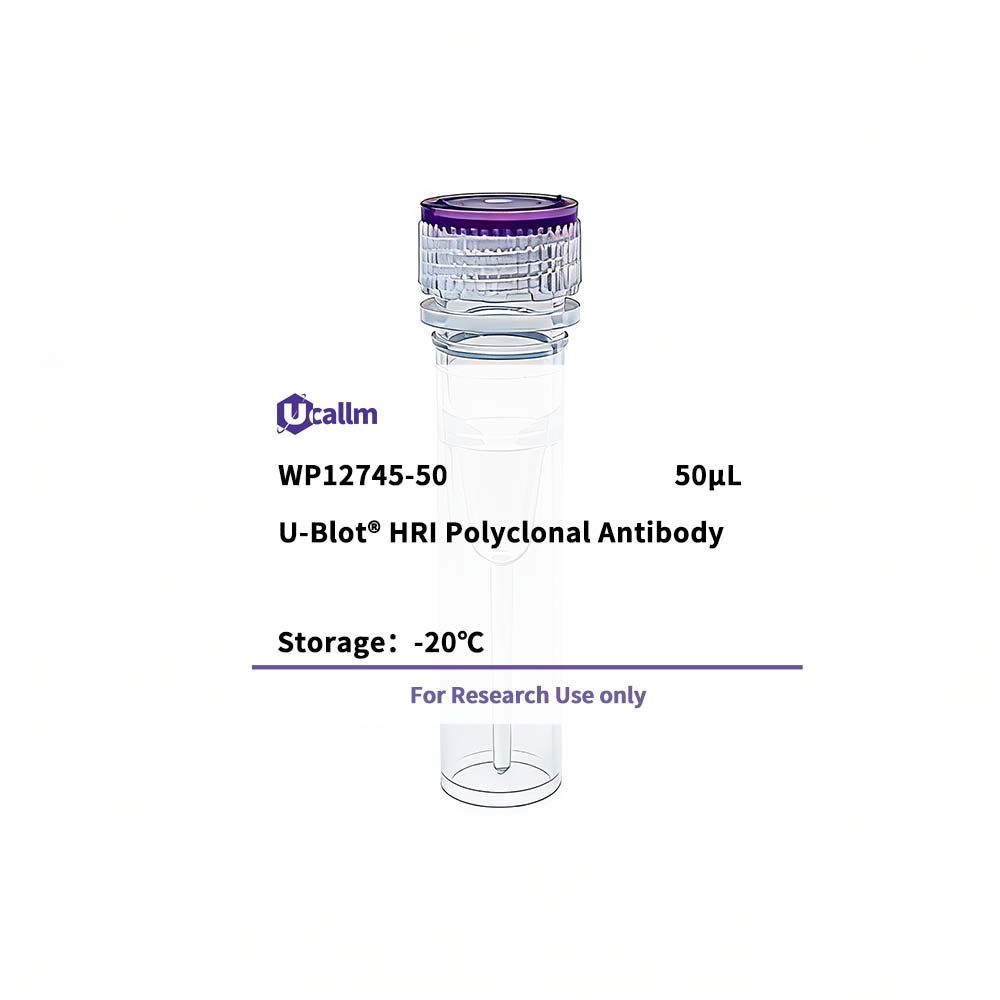
SKU: WP12745 Categories: ,

HRI Polyclonal Antibody

Price range: $268.00 through $328.00

SKU: WP12745-100
Enter the quantity you would like, or drag the panel to find the quantity and price that best for you
Bulk QuoteAuthorize OEM & ODM

Product details

Background:

The protein encoded by this gene acts at the level of translation initiation to downregulate protein synthesis in response to stress. The encoded protein is a kinase that can be inactivated by hemin. Two transcript variants encoding different isoforms have been found for this gene. [provided by RefSeq, Aug 2008],


Specifications

Size50μL/100μL
TargetHRI
ReactivityHuman, Mouse, Monkey
ApplicationsWB, IHC, IF, ELISA
MW(Calculated)
MW(Observed)71kD
Host SpeciesRabbit
IsotypeIgG
Conjugate/ModificationUnmodified
Recommended Dilution RatioWB 1:500-1:2000; IHC: 1:100-300; ELISA 1:20000; IF 1:100-300; Not yet tested in other applications. / Note: For IHC, we suggest antigen retrieval with TE buffer pH 9.0 (Cat#WT1004)
FormulationLiquid in PBS containing 50% glycerol, 0.5% BSA and 0.02% sodium azide.
PurificationThe antibody was affinity-purified from rabbit antiserum by affinity-chromatography using epitope-specific immunogen.
Storage-15°C to -25°C/1 year(Do not lower than -25°C)
Concentration1 mg/ml
ClonalityPolyclonal
Clone Number
ImmunogenThe antiserum was produced against synthesized peptide derived from human EIF2AK1. AA range:571-620
SpecificityHRI Polyclonal Antibody detects endogenous levels of HRI protein.
Gene NameEIF2AK1
Protein NameEukaryotic translation initiation factor 2-alpha kinase 1
Other NameEIF2AK1; / HRI; / KIAA1369; / Eukaryotic translation initiation factor 2-alpha kinase 1; / Heme-controlled repressor; / HCR; / Heme-regulated eukaryotic initiation factor eIF-2-alpha kinase; / Heme-regulated inhibitor; / Hemin-sensitive initiation factor 2
SpeciesHuman
Gene ID27102
UniprotQ9BQI3,
Species.1Mouse
Gene ID.115467
Uniprot.1Q9Z2R9
Species.2
Gene ID.2
Uniprot.2
Cellular Localizationcytoplasm,
Tissue ExpressionExpressed predominantly in erythroid cells (PubMed:20071449). Expressed at much lower levels in hepatocytes (at protein level) (PubMed:20071449).
Signaling_pathway
Research Areas>>Protein processing in endoplasmic reticulum; / >>Hepatitis C; / >>Measles; / >>Herpes simplex virus 1 infection
FunctionCatalytic activity:ATP + a protein = ADP + a phosphoprotein.,enzyme regulation:Hemin inactivates EIF2AK1 by promoting the formation of a disulfide-linked homodimer. Binding of nitric oxide (NO) to the heme iron in the N-terminal heme-binding domain activates the kinase activity, while binding of carbon monoxide (CO) suppresses kinase activity.,Function:Mediates down-regulation of protein synthesis in response to various stress conditions by the phosphorylation of EIF2S1 at 'Ser-48' and 'Ser-51'. Protein synthesis is inhibited at the level of initiation.,miscellaneous:Can bind 2 molecules of heme per polypeptide chain.,PTM:Activated by autophosphorylation; phosphorylated predominantly on serine and threonine residues, but also on tyrosine residues.,similarity:Belongs to the protein kinase superfamily.,similarity:Belongs to the protein kinase superfamily. Ser/Thr protein kinase family. GCN2 subfamily.,similarity:Contains 1 protein kinase domain.,similarity:Contains 2 HRM (heme regulatory motif) repeats.,subunit:Synthesized in an inactive form that binds to the N-terminal domain of CDC37. Has to be associated with a multiprotein complex containing Hsp90, CDC37 and PPP5C for maturation and activation by autophosphorylation. The phosphatase PPP5C modulates this activation. Homodimer; non-covalently bound in the absence of hemin. Converted to an inactive disulfide linked homodimer in the presence of hemin.,tissue specificity:Detected in heart, brain, placenta, lung, liver, skeletal muscle, pancreas, kidney, spleen, muscle and stomach.,
Please login to post questions
Back to Top
Product has been added to your cart
