SKU: WP12778 Categories: ,

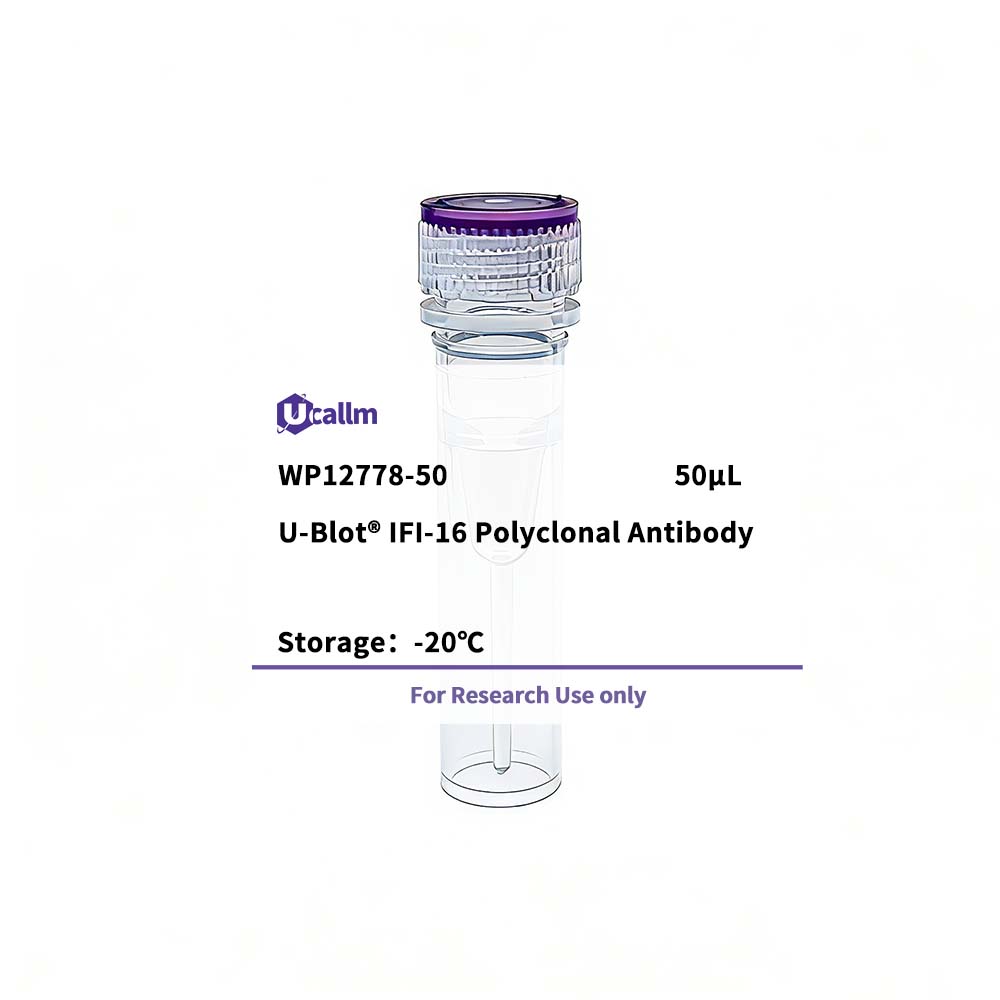
IFI-16 Polyclonal Antibody

Price range: $268.00 through $328.00

SKU: WP12778-100
Enter the quantity you would like, or drag the panel to find the quantity and price that best for you
Bulk QuoteAuthorize OEM & ODM

Product details

Background:

This gene encodes a member of the HIN-200 (hematopoietic interferon-inducible nuclear antigens with 200 amino acid repeats) family of cytokines. The encoded protein contains domains involved in DNA binding, transcriptional regulation, and protein-protein interactions. The protein localizes to the nucleoplasm and nucleoli, and interacts with p53 and retinoblastoma-1. It modulates p53 function, and inhibits cell growth in the Ras/Raf signaling pathway. Alternatively spliced transcript variants encoding different isoforms have been found for this gene. [provided by RefSeq, Apr 2011],


Specifications

Size50μL/100μL
TargetIFI-16
ReactivityHuman
ApplicationsWB, ELISA
MW(Calculated)
MW(Observed)88kD
Host SpeciesRabbit
IsotypeIgG
Conjugate/ModificationUnmodified
Recommended Dilution RatioWB 1:500-1:2000; ELISA 1:40000; Not yet tested in other applications.
FormulationLiquid in PBS containing 50% glycerol, 0.5% BSA and 0.02% sodium azide.
PurificationThe antibody was affinity-purified from rabbit antiserum by affinity-chromatography using epitope-specific immunogen.
Storage-15°C to -25°C/1 year(Do not lower than -25°C)
Concentration1 mg/ml
ClonalityPolyclonal
Clone Number
ImmunogenThe antiserum was produced against synthesized peptide derived from human IFI16. AA range:731-780
SpecificityIFI-16 Polyclonal Antibody detects endogenous levels of IFI-16 protein.
Gene NameIFI16
Protein NameGamma-interferon-inducible protein 16
Other NameIFI16; / IFNGIP1; / Gamma-interferon-inducible protein 16; / Ifi-16; / Interferon-inducible myeloid differentiation transcriptional activator
SpeciesHuman
Gene ID3428
UniprotQ16666
Species.1
Gene ID.1
Uniprot.1
Species.2
Gene ID.2
Uniprot.2
Cellular LocalizationNucleus. Cytoplasm. Cellular distribution is dependent on the acetylation status of the multipartite nuclear localization signal (NLS); NLS acetylation promotes cytoplasmic localization. Localizes in the nucleus during human herpes simplex virus 1 (HHV-1) infection.
Tissue ExpressionExpressed in peripheral blood leukocytes, fibroblasts and lymphoid cells. Present in myeloid precursors (CD34+) and throughout monocyte development, but its expression is down-regulated in erythroid and polymorphonuclear precursor cells. Present in prostate, ovary and breast (at protein level).
Signaling_pathwayOrganismal Systems >> Immune system >> NOD-like receptor signaling pathway;Organismal Systems >> Immune system >> Cytosolic DNA-sensing pathway
Research Areas>>NOD-like receptor signaling pathway
FunctionFunction:May function as a transcriptional repressor. Could have a role in the regulation of hematopoeitic differentiation through activation of unknown target genes. Controls cellular proliferation by modulating the functions of cell cycle regulatory factors including p53/TP53 and the retinoblastoma protein. May be involved in the senescence of prostate epithelial cells.,induction:Strongly induced by gamma interferon and, to a lesser extent, by alpha interferon. In HL-60 cells, maximum induction by gamma-interferon occurs within 12 hours whereas, for alpha-interferon, only 10-fold induction was observed after 36 hours. Induced in vitro by dimethylsulfoxide, retinoic acid and 1,25 dihydroxyvitamin D3.,PTM:Isoform 3 seems to show a minor degree of complex carbohydrate addition.,PTM:Phosphorylated on Ser and Thr.,sequence Caution:Intron retention.,similarity:Belongs to the HIN-200 family.,similarity:Contains 1 DAPIN domain.,similarity:Contains 2 HIN-200 domains.,subunit:Isoform 1, isoform 2 and isoform 3 can homo- and hetero-dimerize. Binds double-stranded DNA and cell cycle regulatory factors including p53 and the retinoblastoma protein.,tissue specificity:Expressed in peripheral blood leukocytes, fibroblasts and lymphoid cells. Present in myeloid precursors (CD34+) and throughout monocyte development, but its expression is down-regulated in erythroid and polymorphonuclear precursor cells. Present in prostate, ovary and breast (at protein level).,
Please login to post questions
Back to Top
Product has been added to your cart
