SKU: WP12784 Categories: ,

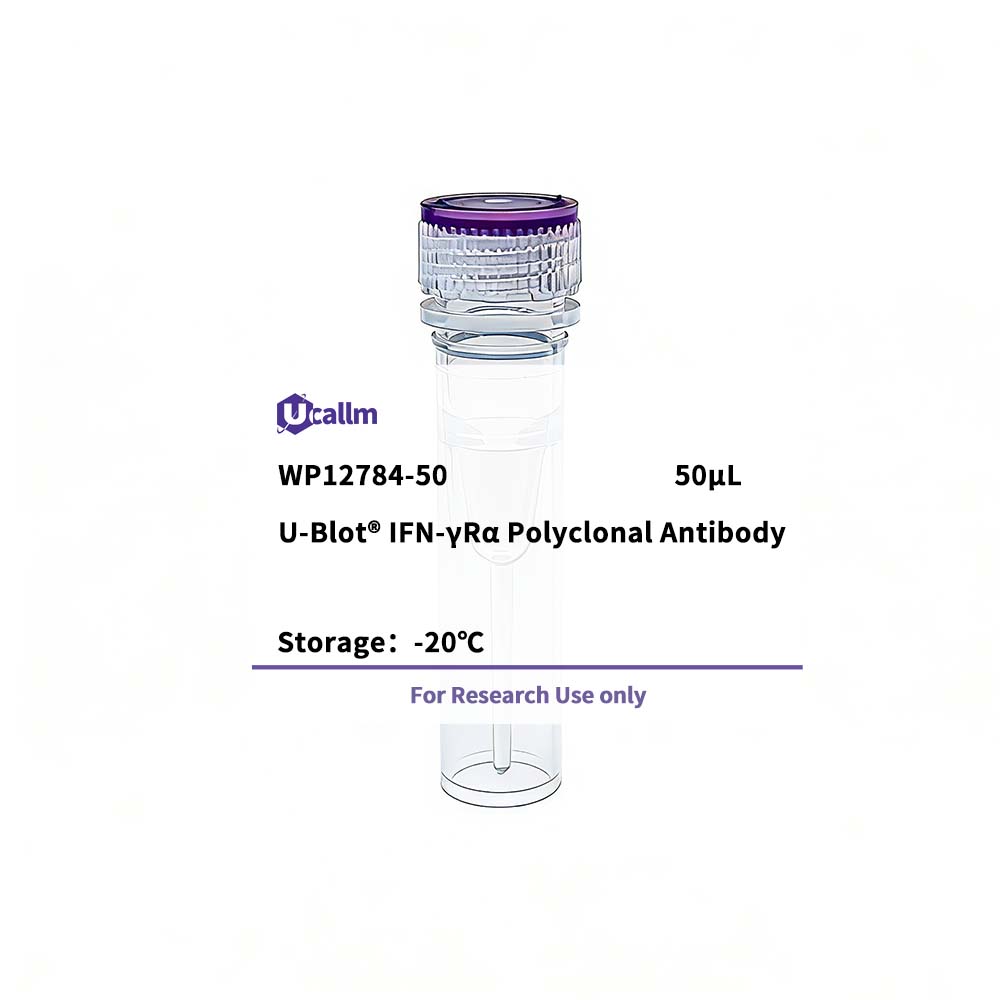
IFN-γRα Polyclonal Antibody

Price range: $268.00 through $328.00

SKU: WP12784-100
Enter the quantity you would like, or drag the panel to find the quantity and price that best for you
Bulk QuoteAuthorize OEM & ODM

Product details

Background:

This gene (IFNGR1) encodes the ligand-binding chain (alpha) of the gamma interferon receptor. Human interferon-gamma receptor is a heterodimer of IFNGR1 and IFNGR2. A genetic variation in IFNGR1 is associated with susceptibility to Helicobacter pylori infection. In addition, defects in IFNGR1 are a cause of mendelian susceptibility to mycobacterial disease, also known as familial disseminated atypical mycobacterial infection. [provided by RefSeq, Jul 2008],

Specifications

Size50μL/100μL
TargetIFNGR1
ReactivityHuman, Mouse, Rat, Monkey
ApplicationsWB, IHC, IF, ELISA
MW(Calculated)
MW(Observed)83kD
Host SpeciesRabbit
IsotypeIgG
Conjugate/ModificationUnmodified
Recommended Dilution RatioWB 1:500-1:2000; IHC 1:100-1:300; IF 1:200-1:1000; ELISA 1:40000; Not yet tested in other applications. / Note: For IHC, we suggest antigen retrieval with TE buffer pH 9.0 (Cat#WT1004)
FormulationLiquid in PBS containing 50% glycerol, 0.5% BSA and 0.02% sodium azide.
PurificationThe antibody was affinity-purified from rabbit antiserum by affinity-chromatography using epitope-specific immunogen.
Storage-15°C to -25°C/1 year(Do not lower than -25°C)
Concentration1 mg/ml
ClonalityPolyclonal
Clone Number
ImmunogenThe antiserum was produced against synthesized peptide derived from human Interferon-gamma Receptor alpha chain. AA range:431-480
SpecificityIFNGR1 Polyclonal Antibody detects endogenous levels of IFN-γRα protein.
Gene NameIFNGR1
Protein NameInterferon gamma receptor 1
Other NameIFNGR1; / Interferon gamma receptor 1; / IFN-gamma receptor 1; / IFN-gamma-R1; / CDw119; / CD antigen CD119
SpeciesHuman
Gene ID3459
UniprotP15260,
Species.1Mouse
Gene ID.115979
Uniprot.1P15261
Species.2
Gene ID.2
Uniprot.2
Cellular LocalizationCell membrane; Single-pass type I membrane protein .
Tissue ExpressionBlood,Liver,Prostate,
Signaling_pathwayCellular Processes >> Cell growth and death >> Necroptosis;Organismal Systems >> Immune system >> Natural killer cell mediated cytotoxicity;Organismal Systems >> Immune system >> Th1 and Th2 cell differentiation;Organismal Systems >> Immune system >> Th17 cell differentiation;Organismal Systems >> Development and regeneration >> Osteoclast differentiation;Human Diseases >> Cancer: overview >> Pathways in cancer;Human Diseases >> Cancer: overview >> PD-L1 expression and PD-1 checkpoint pathway in cancer;Human Diseases >> Immune disease >> Inflammatory bowel disease;Environmental Information Processing >> Signal transduction >> JAK-STAT signaling pathway;Environmental Information Processing >> Signal transduction >> HIF-1 signaling pathway;Environmental Information Processing >> Signaling molecules and interaction >> Cytokine-cytokine receptor interaction
Research Areas>>Cytokine-cytokine receptor interaction; / >>HIF-1 signaling pathway; / >>Necroptosis; / >>Osteoclast differentiation; / >>JAK-STAT signaling pathway; / >>Natural killer cell mediated cytotoxicity; / >>Th1 and Th2 cell differentiation; / >>Th17 cell differentiation; / >>Leishmaniasis; / >>Chagas disease; / >>Toxoplasmosis; / >>Tuberculosis; / >>Influenza A; / >>Kaposi sarcoma-associated herpesvirus infection; / >>Herpes simplex virus 1 infection; / >>Pathways in cancer; / >>PD-L1 expression and PD-1 checkpoint pathway in cancer; / >>Inflammatory bowel disease
FunctionDisease:Defects in IFNGR1 are a cause of mendelian susceptibility to mycobacterial disease (MSMD) [MIM:209950]; also known as familial disseminated atypical mycobacterial infection. This rare condition confers predisposition to illness caused by moderately virulent mycobacterial species, such as Bacillus Calmette-Guerin (BCG) vaccine and environmental non-tuberculous mycobacteria, and by the more virulent Mycobacterium tuberculosis. Other microorganisms rarely cause severe clinical disease in individuals with susceptibility to mycobacterial infections, with the exception of Salmonella which infects less than 50% of these individuals. The pathogenic mechanism underlying MSMD is the impairment of interferon-gamma mediated immunity whose severity determines the clinical outcome. Some patients die of overwhelming mycobacterial disease with lepromatous-like lesions in early childhood, whereas others develop, later in life, disseminated but curable infections with tuberculoid granulomas. MSMD is a genetically heterogeneous disease with autosomal recessive, autosomal dominant or X-linked inheritance.,Function:Receptor for interferon gamma. Two receptors bind one interferon gamma dimer.,online information:IFNGR1 mutation db,polymorphism:A genetic variation in the IFNGR1 gene is associated with susceptibility to Helicobacter pylori infection [MIM:600263].,PTM:Phosphorylated at Ser/Thr residues.,similarity:Belongs to the type II cytokine receptor family.,similarity:Contains 2 fibronectin type-III domains.,similarity:Contains 2 Ig-like C2-type (immunoglobulin-like) domains.,subunit:Monomer.,
Please login to post questions
Back to Top
Product has been added to your cart