

IKKα Monoclonal Antibody
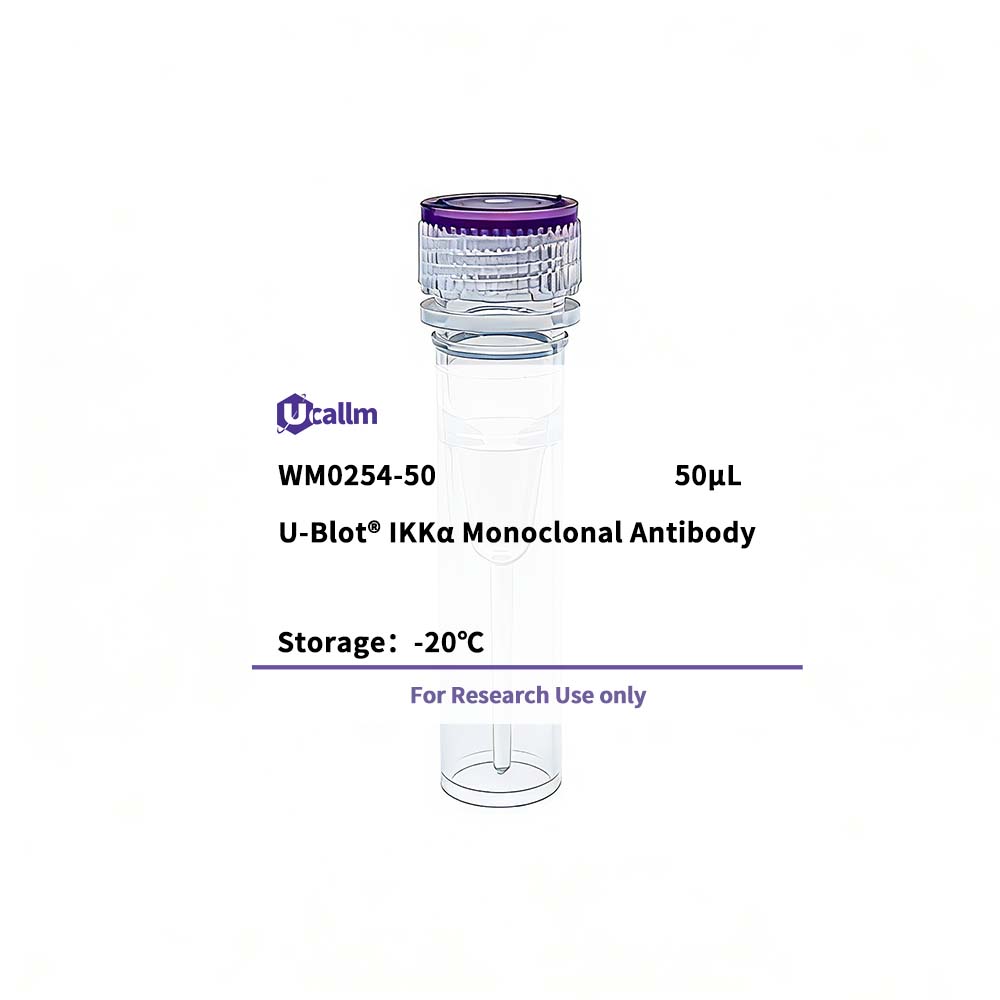
Ucallm_WM0254-50
Price range: $268.00 through $328.00
Product details
Background:
This gene encodes a member of the serine/threonine protein kinase family. The encoded protein, a component of a cytokine-activated protein complex that is an inhibitor of the essential transcription factor NF-kappa-B complex, phosphorylates sites that trigger the degradation of the inhibitor via the ubiquination pathway, thereby activating the transcription factor. [provided by RefSeq, Jul 2008],
Specifications
| Size | 50μL/100μL |
| Target | IKKα |
| Reactivity | Human |
| Applications | WB, IF, FC, ELISA |
| MW(Calculated) | 85kD |
| MW(Observed) | |
| Host Species | Mouse |
| Isotype | |
| Conjugate/Modification | Unmodified |
| Recommended Dilution Ratio | WB 1:500-1:2000; IF 1:200-1:1000; Flow Cyt 1:200-1:400; ELISA 1:10000; Not yet tested in other applications. |
| Formulation | Liquid in PBS containing 50% glycerol, 0.5% BSA and 0.02% sodium azide. |
| Purification | Affinity purification |
| Storage | -15°C to -25°C/1 year(Do not lower than -25°C) |
| Concentration | |
| Clonality | Monoclonal |
| Clone Number | 16H5 |
| Immunogen | Purified recombinant fragment of human IKK-α expressed in E. Coli. |
| Specificity | IKK-α Monoclonal Antibody detects endogenous levels of IKK-α protein. |
| Gene Name | CHUK |
| Protein Name | Inhibitor of nuclear factor kappa-B kinase subunit alpha |
| Other Name | CHUK; / IKKA; / TCF16; / Inhibitor of nuclear factor kappa-B kinase subunit alpha; / I-kappa-B kinase alpha; / IKK-A; / IKK-alpha; / IkBKA; / IkappaB kinase; / Conserved helix-loop-helix ubiquitous kinase; / I-kappa-B kinase 1; / IKK1; / Nuclear factor NF-kappa-B |
| Species | Human |
| Gene ID | 1147 |
| Uniprot | O15111, |
| Species.1 | Mouse |
| Gene ID.1 | |
| Uniprot.1 | Q60680 |
| Species.2 | |
| Gene ID.2 | |
| Uniprot.2 | |
| Cellular Localization | Cytoplasm . Nucleus . Shuttles between the cytoplasm and the nucleus. |
| Tissue Expression | Widely expressed. |
| Signaling_pathway | Cellular Processes >> Cell growth and death >> Apoptosis;Organismal Systems >> Immune system >> Toll-like receptor signaling pathway;Organismal Systems >> Immune system >> NOD-like receptor signaling pathway;Organismal Systems >> Immune system >> RIG-I-like receptor signaling pathway;Organismal Systems >> Immune system >> Cytosolic DNA-sensing pathway;Organismal Systems >> Immune system >> T cell receptor signaling pathway;Organismal Systems >> Immune system >> Th1 and Th2 cell differentiation;Organismal Systems >> Immune system >> Th17 cell differentiation;Organismal Systems >> Immune system >> IL-17 signaling pathway;Organismal Systems >> Immune system >> B cell receptor signaling pathway;Organismal Systems >> Immune system >> Chemokine signaling pathway;Organismal Systems >> Endocrine system >> Adipocytokine signaling pathway;Organismal Systems >> Development and regeneration >> Osteoclast differentiation;Human Diseases >> Cancer: overview >> Pathways in cancer;Human Diseases >> Cancer: overview >> PD-L1 expression and PD-1 checkpoint pathway in cancer;Human Diseases >> Cancer: specific types >> Pancreatic cancer;Human Diseases >> Cancer: specific types >> Acute myeloid leukemia;Human Diseases >> Cancer: specific types >> Chronic myeloid leukemia;Human Diseases >> Cancer: specific types >> Prostate cancer;Human Diseases >> Cancer: specific types >> Small cell lung cancer;Human Diseases >> Neurodegenerative disease >> Alzheimer disease;Environmental Information Processing >> Signal transduction >> MAPK signaling pathway;Environmental Information Processing >> Signal transduction >> Ras signaling pathway;Environmental Information Processing >> Signal transduction >> NF-kappa B signaling pathway;Environmental Information Processing >> Signal transduction >> TNF signaling pathway;Environmental Information Processing >> Signal transduction >> FoxO signaling pathway;Environmental Information Processing >> Signal transduction >> PI3K-Akt signaling pathway;Environmental Information Processing >> Signal transduction >> mTOR signaling pathway |
| Research Areas | >>Antifolate resistance; / >>MAPK signaling pathway; / >>Ras signaling pathway; / >>Chemokine signaling pathway; / >>NF-kappa B signaling pathway; / >>FoxO signaling pathway; / >>mTOR signaling pathway; / >>PI3K-Akt signaling pathway; / >>Apoptosis; / >>Osteoclast differentiation; / >>Toll-like receptor signaling pathway; / >>NOD-like receptor signaling pathway; / >>RIG-I-like receptor signaling pathway; / >>Cytosolic DNA-sensing pathway; / >>C-type lectin receptor signaling pathway; / >>IL-17 signaling pathway; / >>Th1 and Th2 cell differentiation; / >>Th17 cell differentiation; / >>T cell receptor signaling pathway; / >>B cell receptor signaling pathway; / >>TNF signaling pathway; / >>Adipocytokine signaling pathway; / >>Alcoholic liver disease; / >>Alzheimer disease; / >>Epithelial cell signaling in Helicobacter pylori infection; / >>Pathogenic Escherichia coli infection; / >>Shigellosis; / >>Salmonella infection; / >>Yersinia infection; / >>Chagas disease; / >>Toxoplasmosis; / >>Hepatitis C; / >>Hepatitis B; / >>Measles; / >>Human cytomegalovirus infection; / >>Influenza A; / >>Human papillomavirus infection; / >>Human T-cell leukemia virus 1 infection; / >>Kaposi sarcoma-associated herpesvirus infection; / >>Herpes simplex virus 1 infection; / >>Epstein-Barr virus infection; / >>Human immunodeficiency virus 1 infection; / >>Coronavirus disease - COVID-19; / >>Pathways in cancer; / >>Chemical carcinogenesis - reactive oxygen species; / >>Pancreatic cancer; / >>Prostate cancer; / >>Chronic myeloid leukemia; / >>Acute myeloid leukemia; / >>Small cell lung cancer; / >>PD-L1 expression and PD-1 checkpoint pathway in cancer; / >>Lipid and atherosclerosis; / >>Fluid shear stress and atherosclerosis |
| Function | Catalytic activity:ATP + [I-kappa-B protein] = ADP + [I-kappa-B phosphoprotein].,enzyme regulation:Activated when phosphorylated and inactivated when dephosphorylated.,Function:Acts as part of the IKK complex in the conventional pathway of NF-kappa-B activation and phosphorylates inhibitors of NF-kappa-B thus leading to the dissociation of the inhibitor/NF-kappa-B complex and ultimately the degradation of the inhibitor. As part of the non-canonical pathway of NF-kappa-B activation, the MAP3K14-activated CHUK/IKKA homodimer phosphorylates NFKB2/p100 associated with RelB, inducing its proteolytic processing to NFKB2/p52 and the formation of NF-kappa-B RelB-p52 complexes. Also phosphorylates NCOA3. Phosphorylates 'Ser-10' of histone H3 at NF-kappa-B-regulated promoters during inflammatory responses triggered by cytokines.,PTM:Phosphorylated by MAP3K14/NIK, AKT and to a lesser extent by MEKK1, and dephosphorylated by PP2A. Autophosphorylated.,similarity:Belongs to the protein kinase superfamily.,similarity:Belongs to the protein kinase superfamily. Ser/Thr protein kinase family. I-kappa-B kinase subfamily.,similarity:Contains 1 protein kinase domain.,subcellular location:Shuttles between the cytoplasm and the nucleus.,subunit:Component of the I-kappa-B-kinase (IKK) core complex consisting of CHUK, IKBKB and IKBKG; probably four alpha/CHUK-beta/IKBKB dimers are associated with four gamma/IKBKG subunits. The IKK core complex seems to associate with regulatory or adapter proteins to form a IKK-signalosome holo-complex. Part of a complex composed of NCOA2, NCOA3, CHUK/IKKA, IKBKB, IKBKG and CREBBP. Part of a 70-90 kDa complex at least consisting of CHUK/IKKA, IKBKB, NFKBIA, RELA, IKBKAP and MAP3K14. Directly interacts with IKK-gamma/NEMO and TRPC4AP (By similarity). May interact with TRAF2. Interacts with NALP2. May interact with MAVS/IPS1.,tissue specificity:Widely expressed., |
Please login to post questions
Related products




