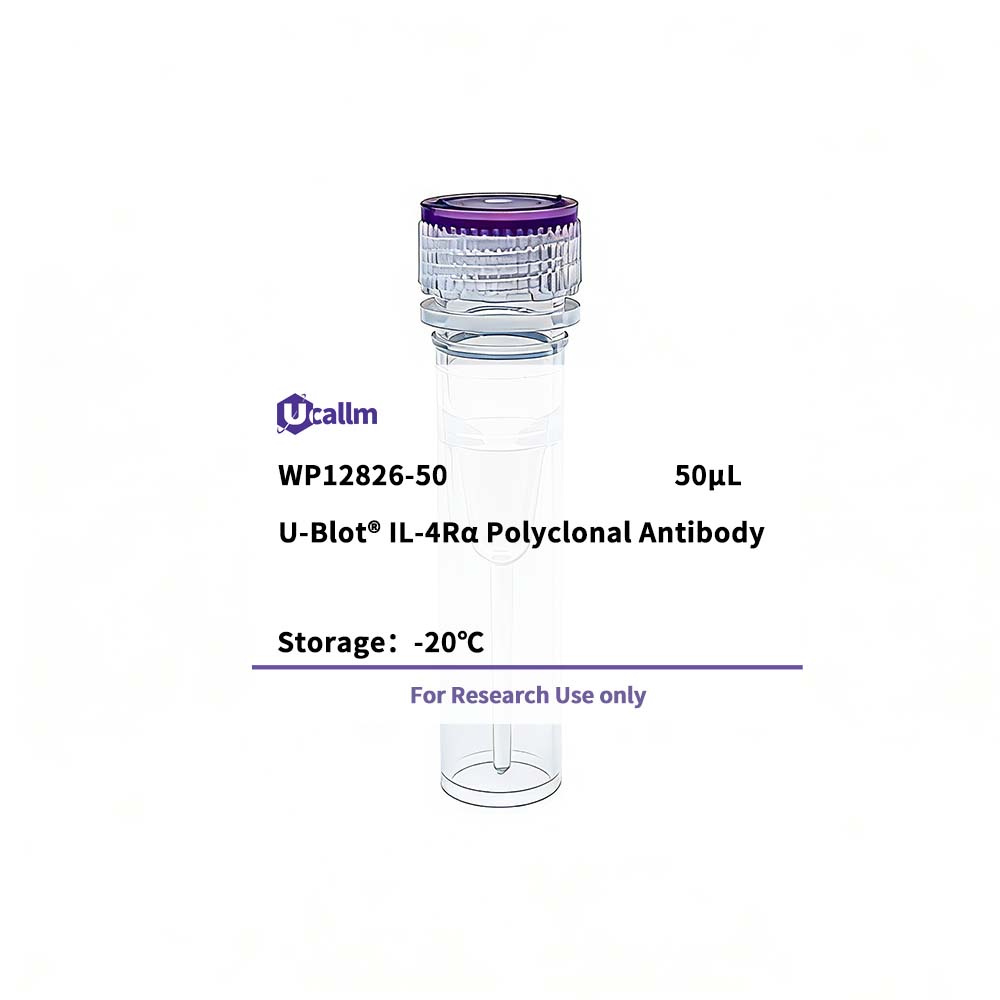
SKU: WP12826 Categories: ,

IL-4Rα Polyclonal Antibody

Price range: $268.00 through $328.00

SKU: WP12826-100
Enter the quantity you would like, or drag the panel to find the quantity and price that best for you
Bulk QuoteAuthorize OEM & ODM

Product details

Background:

This gene encodes the alpha chain of the interleukin-4 receptor, a type I transmembrane protein that can bind interleukin 4 and interleukin 13 to regulate IgE production. The encoded protein also can bind interleukin 4 to promote differentiation of Th2 cells. A soluble form of the encoded protein can be produced by proteolysis of the membrane-bound protein, and this soluble form can inhibit IL4-mediated cell proliferation and IL5 upregulation by T-cells. Allelic variations in this gene have been associated with atopy, a condition that can manifest itself as allergic rhinitis, sinusitus, asthma, or eczema. Polymorphisms in this gene are also associated with resistance to human immunodeficiency virus type-1 infection. Alternate splicing results in multiple transcript variants. [provided by RefSeq, Apr 2012],


Specifications

Size50μL/100μL
TargetIL-4R/CD124
ReactivityHuman, Mouse
ApplicationsWB, IF, ELISA
MW(Calculated)
MW(Observed)90kD
Host SpeciesRabbit
IsotypeIgG
Conjugate/ModificationUnmodified
Recommended Dilution RatioWB 1:500-1:2000; IF 1:200-1:1000; ELISA 1:20000; Not yet tested in other applications.
FormulationLiquid in PBS containing 50% glycerol, 0.5% BSA and 0.02% sodium azide.
PurificationThe antibody was affinity-purified from rabbit antiserum by affinity-chromatography using epitope-specific immunogen.
Storage-15°C to -25°C/1 year(Do not lower than -25°C)
Concentration1 mg/ml
ClonalityPolyclonal
Clone Number
ImmunogenThe antiserum was produced against synthesized peptide derived from human IL-4R/CD124. AA range:463-512
SpecificityIL-4Rα Polyclonal Antibody detects endogenous levels of IL-4Rα protein.
Gene NameIL4R
Protein NameInterleukin-4 receptor subunit alpha
Other NameIL4R; / IL4RA; / 582J2.1; / Interleukin-4 receptor subunit alpha; / IL-4 receptor subunit alpha; / IL-4R subunit alpha; / IL-4R-alpha; / IL-4RA; / CD antigen CD124
SpeciesHuman
Gene ID3566
UniprotP24394,
Species.1Mouse
Gene ID.116190
Uniprot.1P16382
Species.2
Gene ID.2
Uniprot.2
Cellular LocalizationCell membrane; Single-pass type I membrane protein.; [Isoform 2]: Secreted.
Tissue ExpressionIsoform 1 and isoform 2 are highly expressed in activated T-cells.
Signaling_pathwayOrganismal Systems >> Immune system >> Hematopoietic cell lineage;Organismal Systems >> Immune system >> Th1 and Th2 cell differentiation;Organismal Systems >> Immune system >> Th17 cell differentiation;Human Diseases >> Cancer: overview >> Pathways in cancer;Human Diseases >> Immune disease >> Inflammatory bowel disease;Environmental Information Processing >> Signal transduction >> JAK-STAT signaling pathway;Environmental Information Processing >> Signal transduction >> PI3K-Akt signaling pathway;Environmental Information Processing >> Signaling molecules and interaction >> Cytokine-cytokine receptor interaction
Research Areas>>Cytokine-cytokine receptor interaction; / >>PI3K-Akt signaling pathway; / >>JAK-STAT signaling pathway; / >>Hematopoietic cell lineage; / >>Th1 and Th2 cell differentiation; / >>Th17 cell differentiation; / >>Pathways in cancer; / >>Inflammatory bowel disease
FunctionDomain:Contains 1 copy of a cytoplasmic motif that is referred to as the immunoreceptor tyrosine-based inhibitor motif (ITIM). This motif is involved in modulation of cellular responses. The phosphorylated ITIM motif can bind the SH2 domain of several SH2-containing phosphatases.,Domain:The box 1 motif is required for JAK interaction and/or activation.,Domain:The extracellular domain represents the IL4 binding protein (IL4BP).,Domain:The WSXWS motif appears to be necessary for proper protein folding and thereby efficient intracellular transport and cell-surface receptor binding.,Function:Receptor for both interleukin 4 and interleukin 13. Couples to the JAK1/2/3-STAT6 pathway. The IL4 response is involved in promoting Th2 differentiation. The IL4/IL13 responses are involved in regulating IgE production and, chemokine and mucus production at sites of allergic inflammmation. In certain cell types, can signal through activation of insulin receptor substrates, IRS1/IRS2.,Function:Soluble IL4R (sIL4R) inhibits IL4-mediated cell proliferation and IL5 up-regulation by T-cells.,online information:The Singapore human mutation and polymorphism database,polymorphism:Allelic variants in IL4RA are associated with a susceptibility to atopy, an immunological condition that can lead to clinical symptoms such as allergic rhinitis, sinusitis, asthma and eczema.,PTM:On IL4 binding, phosphorylated on C-terminal tyrosine residues. Phosphorylation on any one of tyrosine residues, Tyr-575, Tyr-603 or Tyr-631, is required for STAT6-induced gene induction.,PTM:The soluble form (sIL4R/IL4BP) can also be produced by proteolytic cleavage at the cell surface (shedding) by a metalloproteinase.,similarity:Belongs to the type I cytokine receptor family. Type 4 subfamily.,similarity:Contains 1 fibronectin type-III domain.,subunit:The functional IL4 receptor is formed by initial binding of IL4 to IL4R. Subsequent recruitment to the complex of the common gamma chain, in immune cells, creates a type I receptor and, in non-immune cells, of IL13RA1 forms a type II receptor. IL4R can also interact with the IL13/IL13RA1 complex to form a similar type II receptor. Interacts with PIK3C3 (By similarity). Interacts with the SH2-containing phosphatases, PTPN6/SHIP1, PTPN11/SHIP2 and INPP5D/SHIP (By similarity). Interacts with JAK1 through a Box 1-containing region. In Th1 cells, binds the N-terminal 50 amino acids of SOCS5, which inhibits JAK1 interaction, STAT6 activation and Th2 cell differentiation. SOCS5 interaction is independent of tyrosine phosphorylation.,tissue specificity:Both isoform 1 and isoform 2 are highly expressed in activated T-cells.,
Please login to post questions
Back to Top
Product has been added to your cart
