SKU: WR4592 Categories: ,

U-Blot® iNOS Rabbit mAb

Price range: $268.00 through $328.00

SKU: WR4592-50
Enter the quantity you would like, or drag the panel to find the quantity and price that best for you
Bulk QuoteAuthorize OEM & ODM

Product details

Background:Nitric oxide is a reactive free radical which acts as a biologic mediator in several processes, including neurotransmission and antimicrobial and antitumoral activities. This gene encodes a nitric oxide synthase which is expressed in liver and is inducible by a combination of lipopolysaccharide and certain cytokines. Three related pseudogenes are located within the Smith-Magenis syndrome region on chromosome 17. [provided by RefSeq, Jul 2008],

Specifications

Size50μL/100μL
TargetNOS2/iNOS
ReactivityHuman, Mouse, Rat
ApplicationsWB, IF, IP, ELISA, IHC
MW(Calculated)131kD
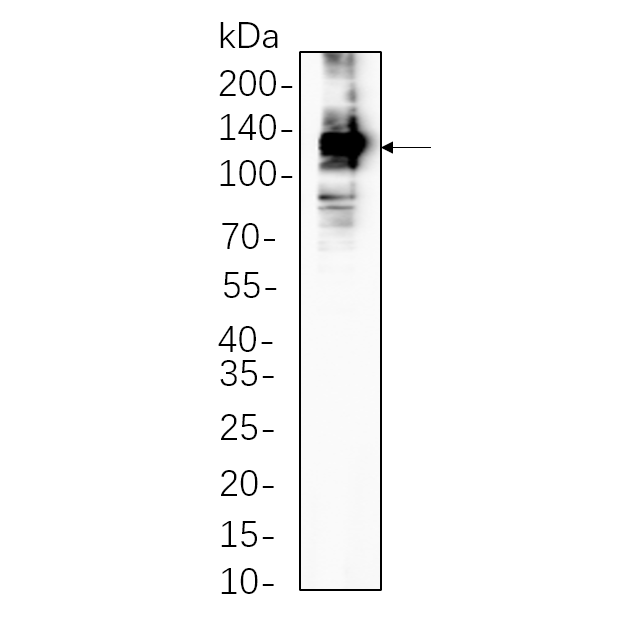
MW(Observed)131kD
Host SpeciesRabbit
IsotypeIgG,Kappa
Conjugate/ModificationUnmodified
Recommended Dilution RatioWB 1:2000-1:10000; IF 1:200-1:1000; ELISA 1:5000-1:20000; IP 1:50-1:200; IHC 1:100-1:400 / Note: For IHC, we suggest antigen retrieval with TE buffer pH 9.0 (Cat#WT1004)
FormulationPBS, 50% glycerol, 0.05% Proclin 300, 0.05%BSA
PurificationRecombinant Antibody expressed in animal component-free (ACF) media, purified via Protein A affinity chromatography.
Storage-15°C to -25°C/1 year(Do not lower than -25°C)
Concentration
ClonalityMonoclonal
Clone NumberRM0859R
ImmunogenThe specific immunogen used to produce this antibody is proprietary information.
SpecificityEndogenous
Gene NameNOS2, INOS
Protein NameNitric oxide synthase inducible
Other NameNOS2; / NOS2A; / Nitric oxide synthase; / inducible; / Hepatocyte NOS; / HEP-NOS; / Inducible NO synthase; / Inducible NOS; / iNOS; / NOS type II; / Peptidyl-cysteine S-nitrosylase NOS2
SpeciesHuman
Gene ID4843
UniprotP35228,
Species.1Mouse
Gene ID.118126
Uniprot.1P29477,
Species.2Rat
Gene ID.224599
Uniprot.2Q06518
Cellular LocalizationCytoplasm, cytosol . Localizes as discrete foci scattered throughout the cytosol and in the presence of SPSB1 and SPSB4, exhibits a more diffuse cytosolic localization. .
Tissue ExpressionExpressed in the liver, retina, bone cells and airway epithelial cells of the lung. Not expressed in the platelets. Expressed in chondrocytes (PubMed:7504305).
Signaling_pathwayCellular Processes >> Transport and catabolism >> Peroxisome;Organismal Systems >> Endocrine system >> Relaxin signaling pathway;Human Diseases >> Cancer: overview >> Pathways in cancer;Human Diseases >> Cancer: specific types >> Small cell lung cancer;Human Diseases >> Neurodegenerative disease >> Alzheimer disease;Human Diseases >> Neurodegenerative disease >> Amyotrophic lateral sclerosis;Human Diseases >> Neurodegenerative disease >> Pathways of neurodegeneration - multiple diseases;Environmental Information Processing >> Signal transduction >> Apelin signaling pathway;Environmental Information Processing >> Signal transduction >> HIF-1 signaling pathway;Environmental Information Processing >> Signal transduction >> Calcium signaling pathway
Research Areas>>Arginine biosynthesis; / >>Arginine and proline metabolism; / >>Metabolic pathways; / >>Calcium signaling pathway; / >>HIF-1 signaling pathway; / >>Peroxisome; / >>Apelin signaling pathway; / >>Relaxin signaling pathway; / >>Alzheimer disease; / >>Amyotrophic lateral sclerosis; / >>Pathways of neurodegeneration - multiple diseases; / >>Pertussis; / >>Leishmaniasis; / >>Chagas disease; / >>Toxoplasmosis; / >>Amoebiasis; / >>Tuberculosis; / >>Pathways in cancer; / >>Small cell lung cancer
FunctionCatalytic activity:L-arginine + n NADPH + n H(+) + m O(2) = citrulline + nitric oxide + n NADP(+).,cofactor:Binds 1 FAD.,cofactor:Binds 1 FMN.,cofactor:Heme group.,cofactor:Tetrahydrobiopterin (BH4). May stabilize the dimeric form of the enzyme.,enzyme regulation:Regulated by calcium/calmodulin. Aspirin inhibits expression and function of this enzyme and effects may be exerted at the level of translational/post-translational modification and directly on the catalytic activity.,Function:Produces nitric oxide (NO) which is a messenger molecule with diverse functions throughout the body. In macrophages, NO mediates tumoricidal and bactericidal actions.,induction:By endotoxins and cytokines.,online information:Nitric oxide synthase entry,similarity:Belongs to the NOS family.,similarity:Contains 1 FAD-binding FR-type domain.,similarity:Contains 1 flavodoxin-like domain.,subunit:Homodimer. Binds SLC9A3R1.,tissue specificity:Expressed in the liver, retina, bone cells and airway epithelial cells of the lung. Not expressed in the platelets.,
Please login to post questions

Back to Top
Product has been added to your cart
