


U-Blot® iNOS Rabbit mAb
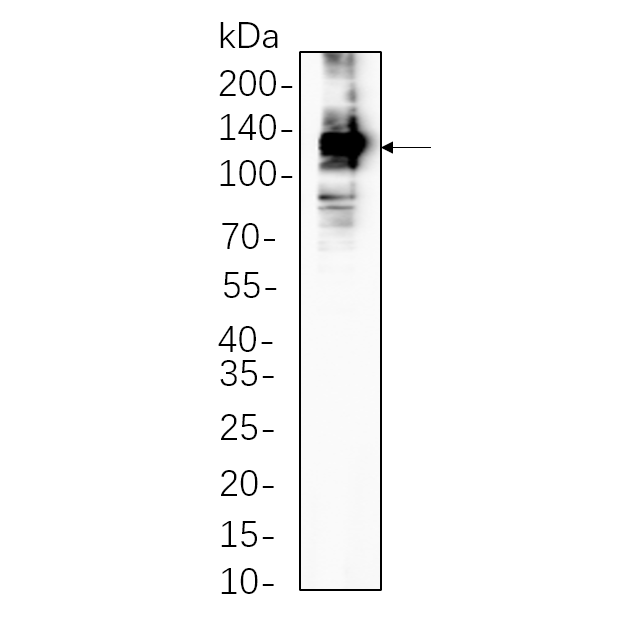
WR4592 RAW264.7 cell lysates were separated by 4-20% SDS-PAGE, and the membrane was blotted with primary antibody 1:1000. The HRP-conjugated Goat anti-Rabbit IgG(H + L) antibody was used to detect the antibody.
Price range: $268.00 through $328.00
Product details
Background:Nitric oxide is a reactive free radical which acts as a biologic mediator in several processes, including neurotransmission and antimicrobial and antitumoral activities. This gene encodes a nitric oxide synthase which is expressed in liver and is inducible by a combination of lipopolysaccharide and certain cytokines. Three related pseudogenes are located within the Smith-Magenis syndrome region on chromosome 17. [provided by RefSeq, Jul 2008],
Specifications
| Size | 50μL/100μL |
| Target | NOS2/iNOS |
| Reactivity | Human, Mouse, Rat |
| Applications | WB, IF, IP, ELISA, IHC |
| MW(Calculated) | 131kD |
| MW(Observed) | 131kD |
| Host Species | Rabbit |
| Isotype | IgG,Kappa |
| Conjugate/Modification | Unmodified |
| Recommended Dilution Ratio | WB 1:2000-1:10000; IF 1:200-1:1000; ELISA 1:5000-1:20000; IP 1:50-1:200; IHC 1:100-1:400 / Note: For IHC, we suggest antigen retrieval with TE buffer pH 9.0 (Cat#WT1004) |
| Formulation | PBS, 50% glycerol, 0.05% Proclin 300, 0.05%BSA |
| Purification | Recombinant Antibody expressed in animal component-free (ACF) media, purified via Protein A affinity chromatography. |
| Storage | -15°C to -25°C/1 year(Do not lower than -25°C) |
| Concentration | |
| Clonality | Monoclonal |
| Clone Number | RM0859R |
| Immunogen | The specific immunogen used to produce this antibody is proprietary information. |
| Specificity | Endogenous |
| Gene Name | NOS2, INOS |
| Protein Name | Nitric oxide synthase inducible |
| Other Name | NOS2; / NOS2A; / Nitric oxide synthase; / inducible; / Hepatocyte NOS; / HEP-NOS; / Inducible NO synthase; / Inducible NOS; / iNOS; / NOS type II; / Peptidyl-cysteine S-nitrosylase NOS2 |
| Species | Human |
| Gene ID | 4843 |
| Uniprot | P35228, |
| Species.1 | Mouse |
| Gene ID.1 | 18126 |
| Uniprot.1 | P29477, |
| Species.2 | Rat |
| Gene ID.2 | 24599 |
| Uniprot.2 | Q06518 |
| Cellular Localization | Cytoplasm, cytosol . Localizes as discrete foci scattered throughout the cytosol and in the presence of SPSB1 and SPSB4, exhibits a more diffuse cytosolic localization. . |
| Tissue Expression | Expressed in the liver, retina, bone cells and airway epithelial cells of the lung. Not expressed in the platelets. Expressed in chondrocytes (PubMed:7504305). |
| Signaling_pathway | Cellular Processes >> Transport and catabolism >> Peroxisome;Organismal Systems >> Endocrine system >> Relaxin signaling pathway;Human Diseases >> Cancer: overview >> Pathways in cancer;Human Diseases >> Cancer: specific types >> Small cell lung cancer;Human Diseases >> Neurodegenerative disease >> Alzheimer disease;Human Diseases >> Neurodegenerative disease >> Amyotrophic lateral sclerosis;Human Diseases >> Neurodegenerative disease >> Pathways of neurodegeneration - multiple diseases;Environmental Information Processing >> Signal transduction >> Apelin signaling pathway;Environmental Information Processing >> Signal transduction >> HIF-1 signaling pathway;Environmental Information Processing >> Signal transduction >> Calcium signaling pathway |
| Research Areas | >>Arginine biosynthesis; / >>Arginine and proline metabolism; / >>Metabolic pathways; / >>Calcium signaling pathway; / >>HIF-1 signaling pathway; / >>Peroxisome; / >>Apelin signaling pathway; / >>Relaxin signaling pathway; / >>Alzheimer disease; / >>Amyotrophic lateral sclerosis; / >>Pathways of neurodegeneration - multiple diseases; / >>Pertussis; / >>Leishmaniasis; / >>Chagas disease; / >>Toxoplasmosis; / >>Amoebiasis; / >>Tuberculosis; / >>Pathways in cancer; / >>Small cell lung cancer |
| Function | Catalytic activity:L-arginine + n NADPH + n H(+) + m O(2) = citrulline + nitric oxide + n NADP(+).,cofactor:Binds 1 FAD.,cofactor:Binds 1 FMN.,cofactor:Heme group.,cofactor:Tetrahydrobiopterin (BH4). May stabilize the dimeric form of the enzyme.,enzyme regulation:Regulated by calcium/calmodulin. Aspirin inhibits expression and function of this enzyme and effects may be exerted at the level of translational/post-translational modification and directly on the catalytic activity.,Function:Produces nitric oxide (NO) which is a messenger molecule with diverse functions throughout the body. In macrophages, NO mediates tumoricidal and bactericidal actions.,induction:By endotoxins and cytokines.,online information:Nitric oxide synthase entry,similarity:Belongs to the NOS family.,similarity:Contains 1 FAD-binding FR-type domain.,similarity:Contains 1 flavodoxin-like domain.,subunit:Homodimer. Binds SLC9A3R1.,tissue specificity:Expressed in the liver, retina, bone cells and airway epithelial cells of the lung. Not expressed in the platelets., |
Please login to post questions
Related products





