SKU: WR4203 Categories: ,

U-Blot® IRF3 Rabbit mAb

Price range: $268.00 through $328.00

SKU: WR4203-50
Enter the quantity you would like, or drag the panel to find the quantity and price that best for you
Bulk QuoteAuthorize OEM & ODM

Product details

Background:This gene encodes a member of the interferon regulatory transcription factor (IRF) family. The encoded protein is found in an inactive cytoplasmic form that upon serine/threonine phosphorylation forms a complex with CREBBP. This complex translocates to the nucleus and activates the transcription of interferons alpha and beta, as well as other interferon-induced genes. Alternatively spliced transcript variants encoding multiple isoforms have been observed for this gene. [provided by RefSeq, Nov 2011],

Specifications

Size50μL/100μL
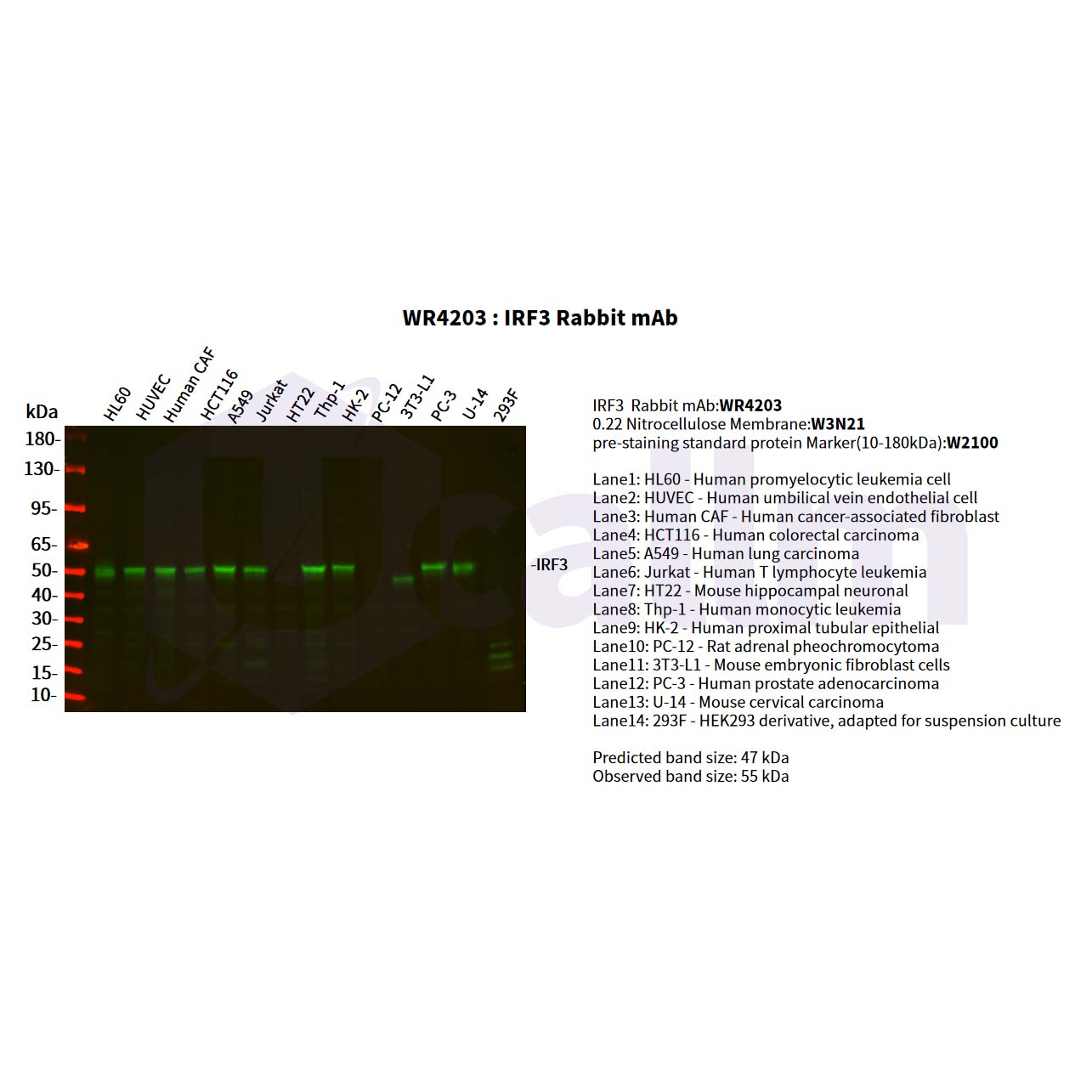
TargetIRF3
ReactivityHuman, Mouse, Rat, Pig
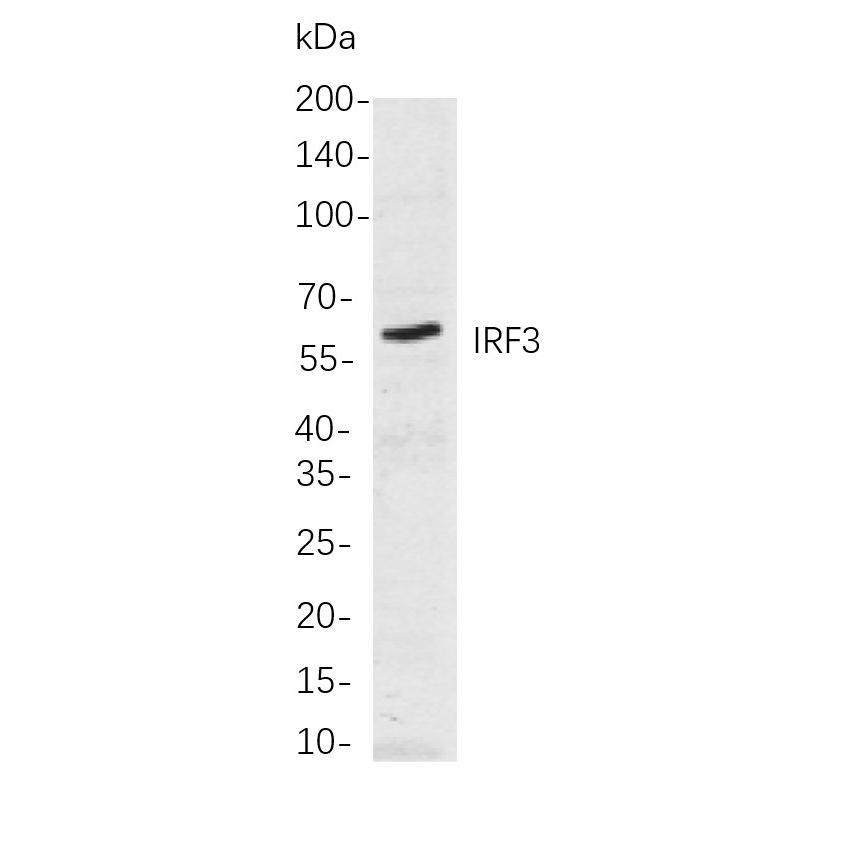
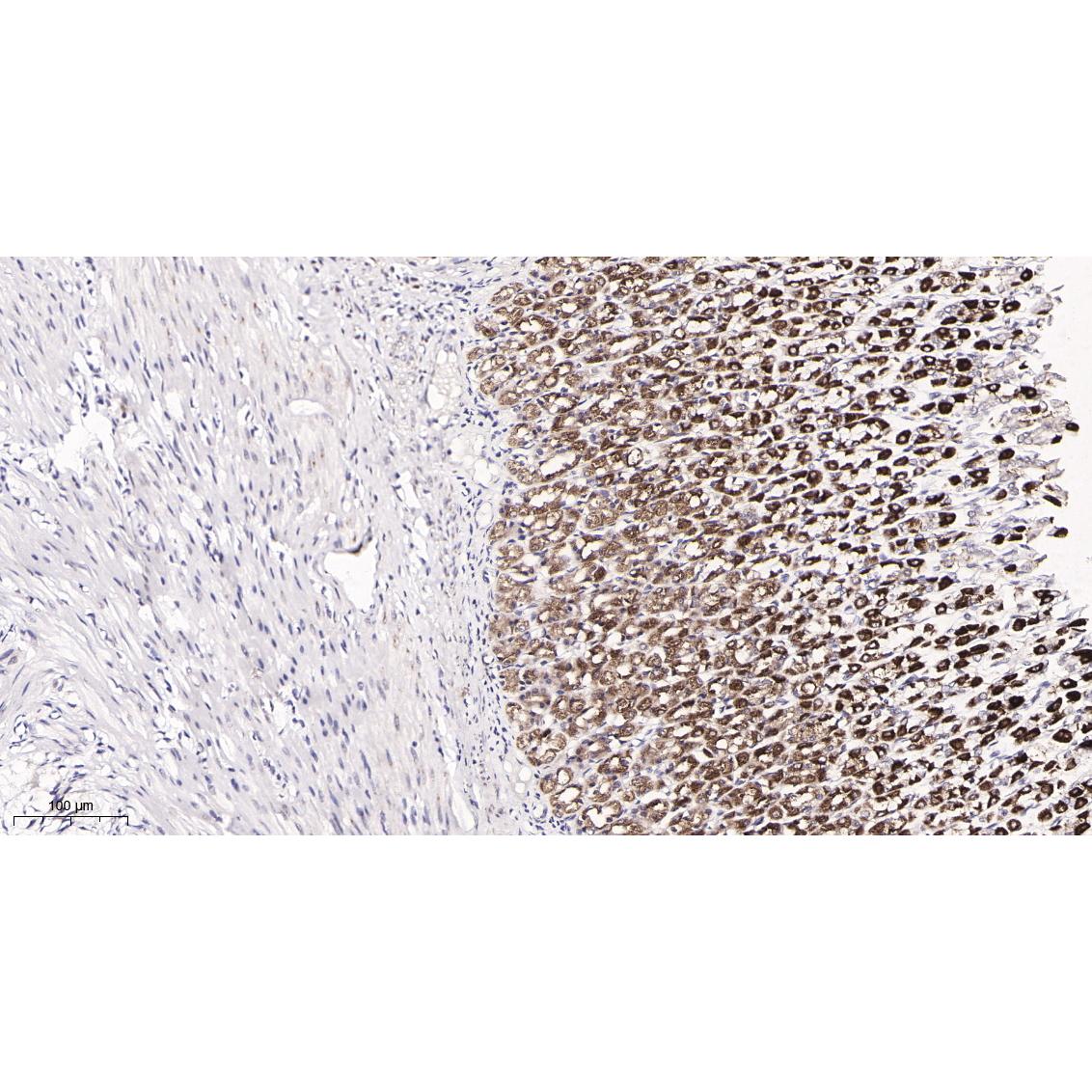
ApplicationsWB, IHC, IF, ELISA
MW(Calculated)47kD
MW(Observed)55kD
Host SpeciesRabbit
IsotypeIgG,Kappa
Conjugate/ModificationUnmodified
Recommended Dilution RatioIHC 1:200-1:1000; WB 1:500-1:2000; IF 1:200-1:1000; ELISA 1:5000-1:20000; / Note: For IHC, we suggest antigen retrieval with TE buffer pH 9.0 (Cat#WT1004)
FormulationPBS, 50% glycerol, 0.05% Proclin 300, 0.05%BSA
PurificationRecombinant Antibody expressed in animal component-free (ACF) media, purified via Protein A affinity chromatography.
Storage-15°C to -25°C/1 year(Do not lower than -25°C)
Concentration
ClonalityMonoclonal
Clone NumberRM0376R
ImmunogenThe specific immunogen used to produce this antibody is proprietary information.
SpecificityEndogenous
Gene NameIRF3
Protein NameInterferon regulatory factor 3
Other NameIRF3; / Interferon regulatory factor 3; / IRF-3
SpeciesHuman
Gene ID3661
UniprotQ14653,
Species.1Mouse
Gene ID.154131
Uniprot.1P70671
Species.2
Gene ID.2
Uniprot.2
Cellular LocalizationCytoplasm, Nucleus
Tissue ExpressionExpressed constitutively in a variety of tissues.
Signaling_pathwayOrganismal Systems >> Immune system >> Toll-like receptor signaling pathway;Organismal Systems >> Immune system >> NOD-like receptor signaling pathway;Organismal Systems >> Immune system >> RIG-I-like receptor signaling pathway;Organismal Systems >> Immune system >> Cytosolic DNA-sensing pathway
Research Areas>>Toll-like receptor signaling pathway; / >>NOD-like receptor signaling pathway; / >>RIG-I-like receptor signaling pathway; / >>Cytosolic DNA-sensing pathway; / >>Alcoholic liver disease; / >>Shigellosis; / >>Pertussis; / >>Yersinia infection; / >>Hepatitis C; / >>Hepatitis B; / >>Measles; / >>Human cytomegalovirus infection; / >>Influenza A; / >>Human papillomavirus infection; / >>Kaposi sarcoma-associated herpesvirus infection; / >>Herpes simplex virus 1 infection; / >>Epstein-Barr virus infection; / >>Human immunodeficiency virus 1 infection; / >>Coronavirus disease - COVID-19; / >>Viral carcinogenesis; / >>Lipid and atherosclerosis
FunctionFunction:Mediates interferon-stimulated response element (ISRE) promoter activation. Functions as a molecular switch for antiviral activity. DsRNA generated during the course of an viral infection leads to IRF3 phosphorylation on the C-terminal serine/threonine cluster. This induces a conformational change, leading to its dimerization, nuclear localization and association with CREB binding protein (CREBBP) to form dsRNA-activated factor 1 (DRAF1), a complex which activates the transcription of genes under the control of ISRE. The complex binds to the IE and PRDIII regions on the IFN-alpha and IFN-beta promoters respectively. IRF-3 does not have any transcription activation domains.,PTM:Constitutively phosphorylated on many serines residues. C-terminal serine/threonine cluster is phosphorylated in response of induction by IKBKE and TBK1. Ser-385 and Ser-386 may be specifically phosphorylated in response to induction. An alternate model propose that the five serine/threonine residues between 396 and 405 are phosphorylated in response to a viral infection. Phosphorylation, and subsequent activation of IRF3 is inhibited by vaccinia virus protein E3.,similarity:Belongs to the IRF family.,similarity:Contains 1 tryptophan pentad repeat DNA-binding domain.,subcellular location:Shuttles between cytoplasmic and nuclear compartments, with export being the prevailing effect. When activated, IRF3 interaction with CREBBP prevents its export to the cytoplasm.,subunit:Homodimer; phosphorylation-induced. Interacts with CREBBP. May interact with MAVS. Interacts with IKBKE and TBK1. Interacts with TICAM1 and TICAM2. Interacts with rotavirus A NSP1 (via C-terminus); this interaction leads to the proteasome-dependent degradation of IRF3.,tissue specificity:Expressed constitutively in a variety of tissues.,
Please login to post questions

Back to Top
Product has been added to your cart
