

Product details
Background:This gene encodes a protein which is phosphorylated by insulin receptor tyrosine kinase. Mutations in this gene are associated with type II diabetes and susceptibility to insulin resistance. [provided by RefSeq, Nov 2009],

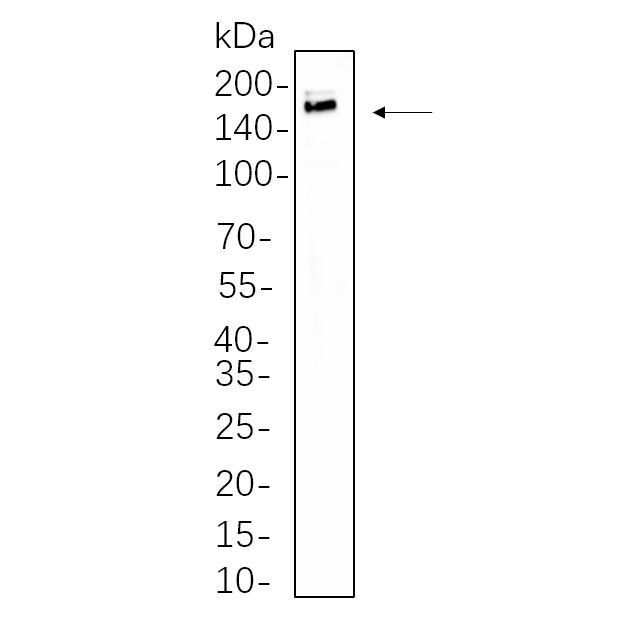
Price range: $268.00 through $328.00
Background:This gene encodes a protein which is phosphorylated by insulin receptor tyrosine kinase. Mutations in this gene are associated with type II diabetes and susceptibility to insulin resistance. [provided by RefSeq, Nov 2009],
| Size | 50μL/100μL |
| Target | IRS-1 |
| Reactivity | Human, Mouse, Rat, Pig |
| Applications | WB, IHC, IF, IP, ELISA |
| MW(Calculated) | 131kD |
| MW(Observed) | 180kD |
| Host Species | Rabbit |
| Isotype | IgG,Kappa |
| Conjugate/Modification | Unmodified |
| Recommended Dilution Ratio | IHC 1:400-1:1000; WB 1:2000-1:10000; IF 1:200-1:1000; ELISA 1:5000-1:20000; IP 1:50-1:200; / Note: For IHC, we suggest antigen retrieval with TE buffer pH 9.0 (Cat#WT1004) |
| Formulation | PBS, 50% glycerol, 0.05% Proclin 300, 0.05%BSA |
| Purification | Recombinant Antibody expressed in animal component-free (ACF) media, purified via Protein A affinity chromatography. |
| Storage | -15°C to -25°C/1 year(Do not lower than -25°C) |
| Concentration | |
| Clonality | Monoclonal |
| Clone Number | RM0765R |
| Immunogen | The specific immunogen used to produce this antibody is proprietary information. |
| Specificity | Endogenous |
| Gene Name | IRS1 |
| Protein Name | Insulin receptor substrate 1 |
| Other Name | IRS1; / Insulin receptor substrate 1; / IRS-1 |
| Species | Human |
| Gene ID | 3667 |
| Uniprot | P35568, |
| Species.1 | Mouse |
| Gene ID.1 | 16367 |
| Uniprot.1 | P35569, |
| Species.2 | Rat |
| Gene ID.2 | 25467 |
| Uniprot.2 | P35570 |
| Cellular Localization | nucleus,cytoplasm,cytosol,plasma membrane,insulin receptor complex,caveola,intracellular membrane-bounded organelle, |
| Tissue Expression | Epithelium,Eye,Skeletal muscle, |
| Signaling_pathway | Cellular Processes >> Transport and catabolism >> Autophagy - animal;Organismal Systems >> Endocrine system >> Insulin signaling pathway;Organismal Systems >> Endocrine system >> Adipocytokine signaling pathway;Organismal Systems >> Endocrine system >> Growth hormone synthesis, secretion and action;Organismal Systems >> Nervous system >> Neurotrophin signaling pathway;Organismal Systems >> Aging >> Longevity regulating pathway;Organismal Systems >> Aging >> Longevity regulating pathway - multiple species;Human Diseases >> Cancer: overview >> MicroRNAs in cancer;Human Diseases >> Neurodegenerative disease >> Alzheimer disease;Environmental Information Processing >> Signal transduction >> FoxO signaling pathway;Environmental Information Processing >> Signal transduction >> cGMP-PKG signaling pathway;Environmental Information Processing >> Signal transduction >> PI3K-Akt signaling pathway;Environmental Information Processing >> Signal transduction >> AMPK signaling pathway;Environmental Information Processing >> Signal transduction >> mTOR signaling pathway |
| Research Areas | >>cGMP-PKG signaling pathway; / >>FoxO signaling pathway; / >>Autophagy - animal; / >>mTOR signaling pathway; / >>PI3K-Akt signaling pathway; / >>AMPK signaling pathway; / >>Longevity regulating pathway; / >>Longevity regulating pathway - multiple species; / >>Neurotrophin signaling pathway; / >>Insulin signaling pathway; / >>Adipocytokine signaling pathway; / >>Regulation of lipolysis in adipocytes; / >>Type II diabetes mellitus; / >>Insulin resistance; / >>Non-alcoholic fatty liver disease; / >>Growth hormone synthesis, secretion and action; / >>Aldosterone-regulated sodium reabsorption; / >>Alzheimer disease; / >>MicroRNAs in cancer; / >>Diabetic cardiomyopathy |
| Function | Disease:Polymorphisms in IRS1 may be involved in the etiology of non-insulin-dependent diabetes mellitus (NIDDM) [MIM:125853].,Function:May mediate the control of various cellular processes by insulin. When phosphorylated by the insulin receptor binds specifically to various cellular proteins containing SH2 domains such as phosphatidylinositol 3-kinase p85 subunit or GRB2. Activates phosphatidylinositol 3-kinase when bound to the regulatory p85 subunit.,polymorphism:The Arg-971 polymorphism impairs the ability of insulin to stimulate glucose transport, glucose transporter translocation, and glycogen synthesis by affecting the PI3K/AKT1/GSK3 signaling pathway. The polymorphism at Arg-971 may contribute to the in vivo insulin resistance observed in carriers of this variant. Arg-971 could contribute to the risk for atherosclerotic cardiovascular diseases associated with non-insulin-dependent diabetes mellitus (NIDDM) by producing a cluster of insulin resistance-related metabolic abnormalities. In insulin-stimulated human endothelial cells from carriers of the Arg-971 polymorphism, genetic impairment of the IRS1/PI3K/PDPK1/AKT1 insulin signaling cascade results in impaired insulin-stimulated nitric oxide (NO) release and suggested that this may be a mechanism through which the Arg-971 polymorphism contributes to the genetic predisposition to develop endothelial dysfunction and cardiovascular disease. The Arg-971 polymorphism not only reduces phosphorylation of the substrate but allows IRS1 to act as an inhibitor of PI3K, producing global insulin resistance.,PTM:Phosphorylation of Tyr-896 is required for GRB2-binding.,PTM:Serine phosphorylation of IRS1 is a mechanism for insulin resistance. Ser-312 phosphorylation inhibits insulin action through disruption of IRS1 interaction with the insulin receptor.,similarity:Contains 1 IRS-type PTB domain.,similarity:Contains 1 PH domain.,subunit:Interacts with the NPXY motif of tyrosine-phosphorylated IGF1R and INSR via the PTB domain. Binds to phosphatidylinositol 3-kinase p85 subunit via the phosphorylated YXXM motifs. Binds ROCK1. Binds to UBTF and PIK3CA in nuclear extracts (By similarity). Interacts with SOCS7., |





