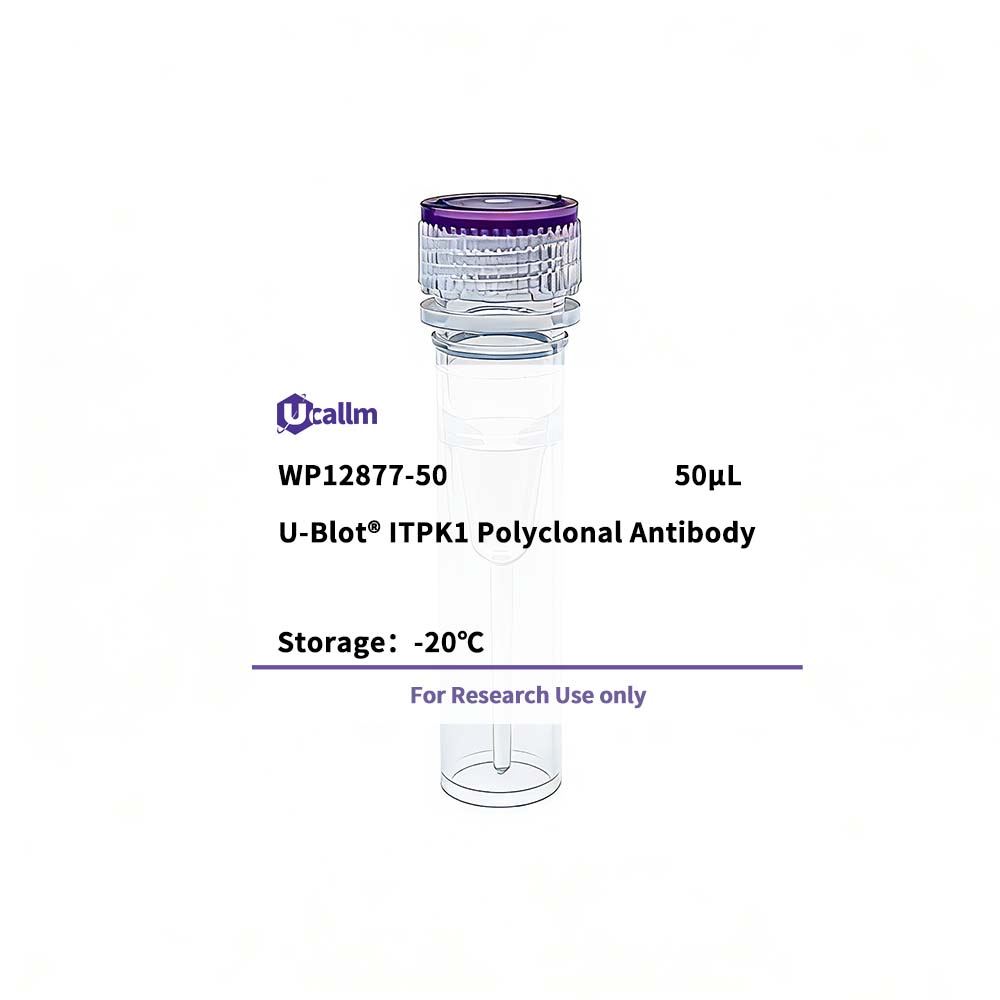
SKU: WP12877 Categories: ,

ITPK1 Polyclonal Antibody

Price range: $268.00 through $328.00

SKU: WP12877-100
Enter the quantity you would like, or drag the panel to find the quantity and price that best for you
Bulk QuoteAuthorize OEM & ODM

Product details

Background:

This gene encodes an enzyme that belongs to the inositol 1, 3, 4-trisphosphate 5/6-kinase family. This enzyme regulates the synthesis of inositol tetraphosphate, and downstream products, inositol pentakisphosphate and inositol hexakisphosphate. Inositol metabolism plays a role in the development of the neural tube. Disruptions in this gene are thought to be associated with neural tube defects. A pseudogene of this gene has been identified on chromosome X. [provided by RefSeq, Jul 2016],


Specifications

Size50μL/100μL
TargetITPK1
ReactivityHuman, Mouse
ApplicationsWB, ELISA, IHC
MW(Calculated)
MW(Observed)50kD
Host SpeciesRabbit
IsotypeIgG
Conjugate/ModificationUnmodified
Recommended Dilution RatioWB 1:500-2000; IHC 1:50-300; ELISA 1:2000-20000 / Note: For IHC, we suggest antigen retrieval with TE buffer pH 9.0 (Cat#WT1004)
FormulationLiquid in PBS containing 50% glycerol, 0.5% BSA and 0.02% sodium azide.
PurificationThe antibody was affinity-purified from rabbit antiserum by affinity-chromatography using epitope-specific immunogen.
Storage-15°C to -25°C/1 year(Do not lower than -25°C)
Concentration1 mg/ml
ClonalityPolyclonal
Clone Number
ImmunogenThe antiserum was produced against synthesized peptide derived from human ITPK1. AA range:81-130
SpecificityITPK1 Polyclonal Antibody detects endogenous levels of ITPK1 protein.
Gene NameITPK1
Protein NameInositol-tetrakisphosphate 1-kinase
Other NameITPK1; / Inositol-tetrakisphosphate 1-kinase; / Inositol 1; / 3,4-trisphosphate 5/6-kinase; / Inositol-triphosphate 5/6-kinase; / Ins; / 1,3,4; / P; / 3; / 5/6-kinase
SpeciesHuman
Gene ID3705
UniprotQ13572,
Species.1Mouse
Gene ID.1217837
Uniprot.1Q8BYN3
Species.2
Gene ID.2
Uniprot.2
Cellular Localizationintracellular,cytosol,apical plasma membrane,
Tissue ExpressionExpressed in brain > heart > skeletal muscle = kidney = pancreas = liver = placenta > lung. In brain, it is expressed in cerebellum, cerebral cortex, medulla, spinal cord, occipital lobe, frontal lobe, temporal lobe and putamen.
Signaling_pathway
Research Areas>>Inositol phosphate metabolism; / >>Metabolic pathways; / >>Phosphatidylinositol signaling system
FunctionCatalytic activity:ATP + 1D-myo-inositol 1,3,4-trisphosphate = ADP + 1D-myo-inositol 1,3,4,5-tetrakisphosphate.,Catalytic activity:ATP + 1D-myo-inositol 1,3,4-trisphosphate = ADP + 1D-myo-inositol 1,3,4,6-tetrakisphosphate.,Catalytic activity:ATP + 1D-myo-inositol 3,4,5,6-tetrakisphosphate = ADP + 1D-myo-inositol 1,3,4,5,6-pentakisphosphate.,Caution:PubMed:11533064 detected some protein kinase activity and ability to phosphorylate transcription factors c-jun/JUN and ATF2. However, PubMed:15762844 showed that it does not have protein kinase activity.,cofactor:Binds 2 magnesium ions per subunit.,Function:Kinase that can phosphorylate various inositol polyphosphate such as Ins(3,4,5,6)P4 or Ins(1,3,4)P3. Phosphorylates Ins(3,4,5,6)P4 at position 1 to form Ins(1,3,4,5,6)P5. This reaction is thought to have regulatory importance, since Ins(3,4,5,6)P4 is an inhibitor of plasma membrane Ca(2+)-activated Cl(-) channels, while Ins(1,3,4,5,6)P5 is not. Also phosphorylates Ins(1,3,4)P3 on O-5 and O-6 to form Ins(1,3,4,6)P4, an essential molecule in the hexakisphosphate (InsP6) pathway. Also acts as an inositol polyphosphate phosphatase that dephosphorylate Ins(1,3,4,5)P4 and Ins(1,3,4,6)P4 to Ins(1,3,4)P3, and Ins(1,3,4,5,6)P5 to Ins(3,4,5,6)P4. May also act as an isomerase that interconverts the inositol tetraphosphate isomers Ins(1,3,4,5)P4 and Ins(1,3,4,6)P4 in the presence of ADP and magnesium. Probably acts as the rate-limiting enzyme of the InsP6 pathway. Modifies TNF-alpha-induced apoptosis by interfering with the activation of TNFRSF1A-associated death domain.,similarity:Belongs to the ITPK1 family.,similarity:Contains 1 ATP-grasp domain.,subunit:Monomer. Interacts with CSN1.,tissue specificity:Expressed in brain > heart > skeletal muscle = kidney = pancreas = liver = placenta > lung. In brain, it is expressed in cerebellum, cerebral cortex, medulla, spinal cord, occipital lobe, frontal lobe, temporal lobe and putamen.,
Please login to post questions
Back to Top
Product has been added to your cart
