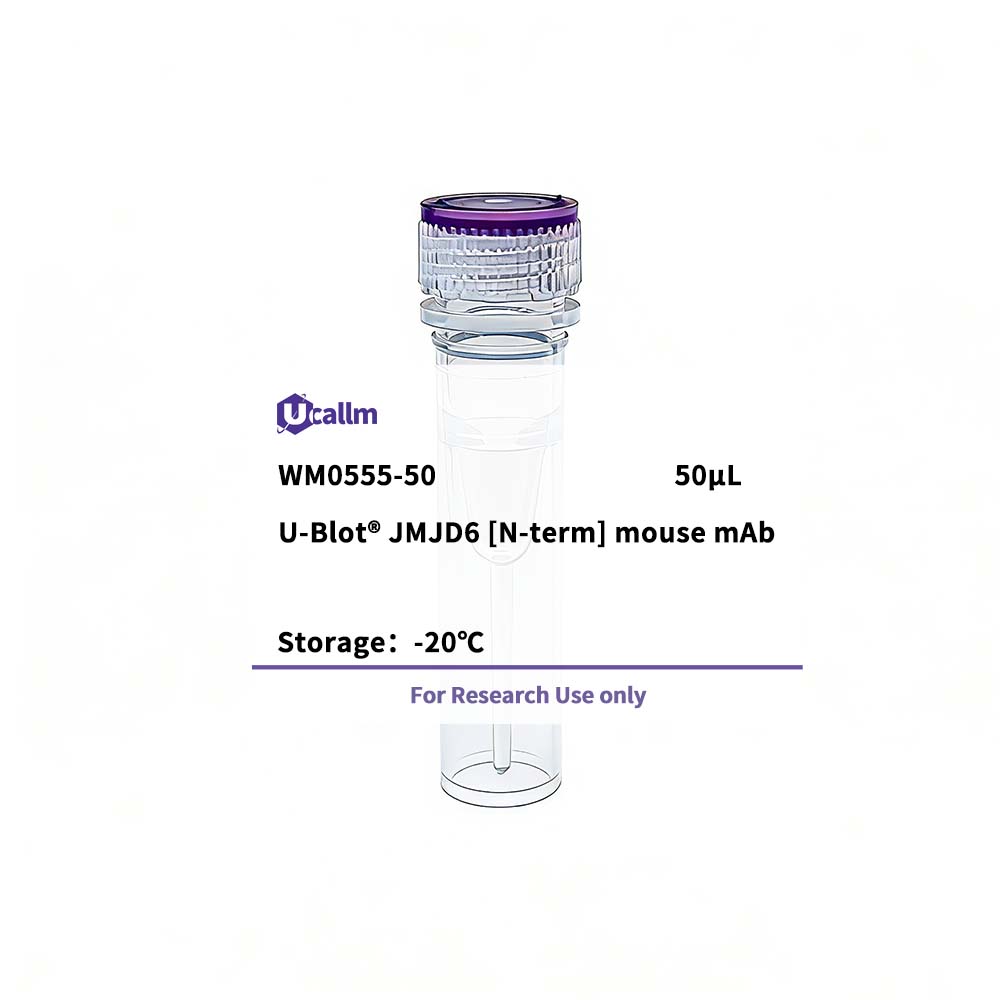
SKU: WM0555 Categories: ,

JMJD6 [N-term] mouse mAb

Price range: $268.00 through $328.00

SKU: WM0555-50
Enter the quantity you would like, or drag the panel to find the quantity and price that best for you
Bulk QuoteAuthorize OEM & ODM

Product details

Background:
This gene encodes a nuclear protein with a JmjC domain. JmjC domain-containing proteins are predicted to function as protein hydroxylases or histone demethylases. This protein was first identified as a putative phosphatidylserine receptor involved in phagocytosis of apoptotic cells; however, subsequent studies have indicated that it does not directly function in the clearance of apoptotic cells, and questioned whether it is a true phosphatidylserine receptor. Multiple transcript variants encoding different isoforms have been found for this gene. [provided by RefSeq, Jul 2008],

Specifications

Size50μL/100μL
TargetPSR
ReactivityHuman
ApplicationsWB, ICC
MW(Calculated)
MW(Observed)62kD
Host SpeciesMouse
Isotype
Conjugate/ModificationUnmodified
Recommended Dilution RatioWB 1:1000; ICC 1:200
FormulationLiquid in PBS containing 50% glycerol, 0.5% BSA and 0.02% sodium azide.
PurificationThe antibody was affinity-purified from mouse ascites by affinity-chromatography using epitope-specific immunogen.
Storage-15°C to -25°C/1 year(Do not lower than -25°C)
Concentration
ClonalityMonoclonal
Clone Number12D9
ImmunogenPurified recombinant human JMJD6(N-terminus) fragments expressed in E.coli.
SpecificityThis antibody detects endogenous levels of JMJD6(N-terminus) and does not cross-react with related proteins.
Gene Namejmjd6
Protein Name
Other NameApoptotic cell clearance receptor; / Bifunctional arginine demethylase and lysyl-hydroxylase JMJD6; / Histone arginine demethylase JMJD6; / JmjC domain-containing protein 6; / JMJD 6; / JMJD6; / JMJD6_HUMAN; / Jumonji domain containing 6; / Jumonji domain-containing protein 6; / KIAA0585; / Lysyl-hydroxylase JMJD6; / Peptide-lysine 5-dioxygenase JMJD6; / Phosphatidylserine receptor; / Protein PTDSR; / PSR; / PTDSR 1; / PTDSR; / PTDSR1.
SpeciesHuman
Gene ID23210
UniprotQ6NYC1
Species.1
Gene ID.1
Uniprot.1
Species.2
Gene ID.2
Uniprot.2
Cellular LocalizationNucleus, nucleoplasm . Nucleus, nucleolus . Cytoplasm . Mainly found throughout the nucleoplasm outside of regions containing heterochromatic DNA, with some localization in nucleolus. During mitosis, excluded from the nucleus and reappears in the telophase of the cell cycle. .
Tissue ExpressionHighly expressed in the heart, skeletal muscle and kidney. Expressed at moderate or low level in brain, placenta, lung, liver, pancreas, spleen, thymus, prostate, testis and ovary. Up-regulated in many patients with chronic pancreatitis. Expressed in nursing thymic epithelial cells.
Signaling_pathway
Research Areas
FunctionCaution:Was initially thought to constitute the phosphatidylserine receptor, a receptor that mediates recognition of phosphatidylserine, a specific marker only present at the surface of apoptotic cells. Phosphatidylserine receptor probably participates in apoptotic cell phagocytosis. This protein was identified using phage display expressing mAb 217, an antibody that specifically recognizes phosphatidylserine receptor. However, its nuclear localization and the fact that mAb 217 antibody still recognizes the phosphatidylserine receptor in mice lacking JMJD6, strongly suggest that it does not constitute the receptor for phosphatidylserine and is not involved in apoptotic cell removal.,Domain:The nuclear localization signal motifs are necessary and sufficient to target it into the nucleus.,Function:Arginine demethylase which demethylates histone H3 at 'Arg-2' (H3R2me) and histone H4 at 'Arg-3' (H4R3me). Required for differentiation of multiple organs during embryogenesis. Probably acts as a key regulator of hematopoietic differentiation. Seems to be necessary for the regulation of macrophage cytokine responses.,induction:Up-regulated upon cytokine treatment, but not upon TNF-alpha treatment.,similarity:Belongs to the PTDSR family.,similarity:Contains 1 JmjC domain.,tissue specificity:Highly expressed in the heart, skeletal muscle and kidney. Expressed at moderate or low level in brain, placenta, lung, liver, pancreas, spleen, thymus, prostate, testis and ovary. Up-regulated in many patients with chronic pancreatitis. Expressed in nursing thymic epithelial cells.,
Please login to post questions
Back to Top
Product has been added to your cart
