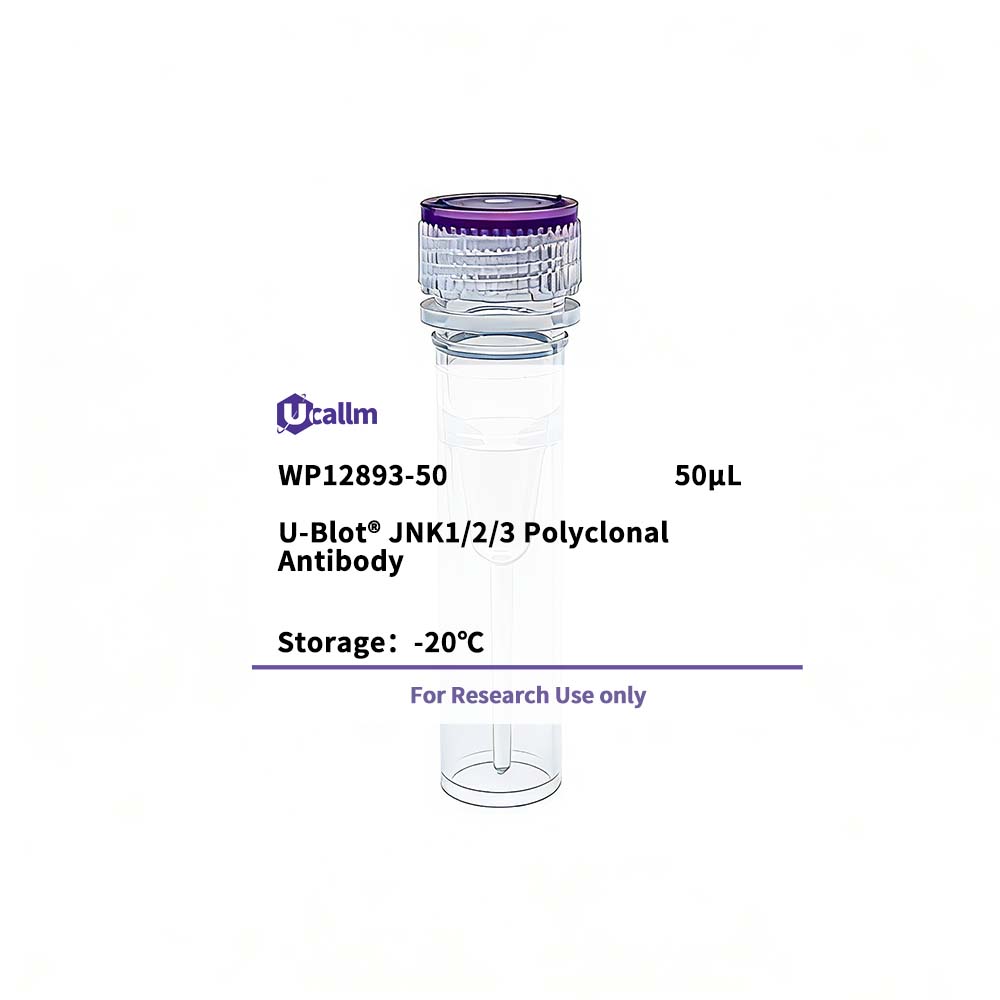
SKU: WP12893 Categories: ,

JNK1/2/3 Polyclonal Antibody

Price range: $268.00 through $328.00

SKU: WP12893-100
Enter the quantity you would like, or drag the panel to find the quantity and price that best for you
Bulk QuoteAuthorize OEM & ODM

Product details

Background:

The protein encoded by this gene is a member of the MAP kinase family. MAP kinases act as an integration point for multiple biochemical signals, and are involved in a wide variety of cellular processes such as proliferation, differentiation, transcription regulation and development. This kinase is activated by various cell stimuli, and targets specific transcription factors, and thus mediates immediate-early gene expression in response to cell stimuli. The activation of this kinase by tumor-necrosis factor alpha (TNF-alpha) is found to be required for TNF-alpha induced apoptosis. This kinase is also involved in UV radiation induced apoptosis, which is thought to be related to cytochrom c-mediated cell death pathway. Studies of the mouse counterpart of this gene suggested that this kinase play a key role in T cell proliferation, apoptosis and differentiation. Several alternatively spl


Specifications

Size50μL/100μL
TargetJNK1/2/3
ReactivityHuman, Mouse, Rat, Chicken(testedbyourcustomer), Fish, Pig
ApplicationsWB, IHC, IF, ELISA
MW(Calculated)
MW(Observed)46kD,54kD
Host SpeciesRabbit
IsotypeIgG
Conjugate/ModificationUnmodified
Recommended Dilution RatioWB 1:500-1:2000; IHC 1:100-1:300; IF 1:200-1:1000; ELISA 1:10000; Not yet tested in other applications. / Note: For IHC, we suggest antigen retrieval with TE buffer pH 9.0 (Cat#WT1004)
FormulationLiquid in PBS containing 50% glycerol, 0.5% BSA and 0.02% sodium azide.
PurificationThe antibody was affinity-purified from rabbit antiserum by affinity-chromatography using epitope-specific immunogen.
Storage-15°C to -25°C/1 year(Do not lower than -25°C)
Concentration1 mg/ml
ClonalityPolyclonal
Clone Number
ImmunogenThe antiserum was produced against synthesized peptide derived from human SAPK/JNK. AA range:166-215
SpecificityJNK1/2/3 Polyclonal Antibody detects endogenous levels of JNK1/2/3 protein.
Gene NameMAPK8/9/10
Protein NameMitogen-activated protein kinase 8/9/10
Other NameMAPK8; / JNK1; / PRKM8; / SAPK1; / SAPK1C; / Mitogen-activated protein kinase 8; / MAP kinase 8; / MAPK 8; / JNK-46; / Stress-activated protein kinase 1c; / SAPK1c; / Stress-activated protein kinase JNK1; / c-Jun N-terminal kinase 1; / MAPK9; / JNK2; / PRKM9; / SAPK1A; / Mi
SpeciesHuman
Gene ID5599;5601;5602
UniprotP45983;P45984;P53779,
Species.1Mouse
Gene ID.126419;26420,
Uniprot.1
Species.2Rat
Gene ID.2116554;50658;25272
Uniprot.2P49185;P49186;P49187
Cellular LocalizationCytoplasm . Nucleus . Cell junction, synapse . In the cortical neurons, predominantly cytoplasmic and associated with the Golgi apparatus and endosomal fraction. Increased neuronal activity increases phosphorylated form at synapses (By similarity). Colocalizes with POU5F1 in the nucleus. .
Tissue ExpressionBrain,Epithelium,Fetal brain,Lung,Pooled,Testis,
Signaling_pathwayCellular Processes >> Transport and catabolism >> Autophagy - animal;Cellular Processes >> Transport and catabolism >> Mitophagy - animal;Cellular Processes >> Cell growth and death >> Apoptosis;Cellular Processes >> Cell growth and death >> Apoptosis - multiple species;Cellular Processes >> Cell growth and death >> Necroptosis;Cellular Processes >> Cellular community - eukaryotes >> Focal adhesion;Cellular Processes >> Cellular community - eukaryotes >> Tight junction;Organismal Systems >> Immune system >> Toll-like receptor signaling pathway;Organismal Systems >> Immune system >> NOD-like receptor signaling pathway;Organismal Systems >> Immune system >> RIG-I-like receptor signaling pathway;Organismal Systems >> Immune system >> T cell receptor signaling pathway;Organismal Systems >> Immune system >> Th1 and Th2 cell differentiation;Organismal Systems >> Immune system >> Th17 cell differentiation;Organismal Systems >> Immune system >> IL-17 signaling pathway;Organismal Systems >> Immune system >> Fc epsilon RI signaling pathway;Organismal Systems >> Endocrine system >> Insulin signaling pathway;Organismal Systems >> Endocrine system >> Adipocytokine signaling pathway;Organismal Systems >> Endocrine system >> GnRH signaling pathway;Organismal Systems >> Endocrine system >> Prolactin signaling pathway;Organismal Systems >> Endocrine system >> Relaxin signaling pathway;Organismal Systems >> Endocrine system >> Growth hormone synthesis, secretion and action;Organismal Systems >> Nervous system >> Dopaminergic synapse;Organismal Systems >> Nervous system >> Neurotrophin signaling pathway;Organismal Systems >> Sensory system >> Inflammatory mediator regulation of TRP channels;Organismal Systems >> Development and regeneration >> Osteoclast differentiation;Human Diseases >> Cancer: overview >> Pathways in cancer;Human Diseases >> Cancer: specific types >> Colorectal cancer;Human Diseases >> Cancer: specific types >> Pancreatic cancer;Human Diseases >> Neurodegenerative disease >> Alzheimer disease;Human Diseases >> Neurodegenerative disease >> Parkinson disease;Human Diseases >> Neurodegenerative disease >> Huntington disease;Human Diseases >> Neurodegenerative disease >> Spinocerebellar ataxia;Human Diseases >> Neurodegenerative disease >> Prion disease;Human Diseases >> Neurodegenerative disease >> Pathways of neurodegeneration - multiple diseases;Environmental Information Processing >> Signal transduction >> MAPK signaling pathway;Environmental Information Processing >> Signal transduction >> ErbB signaling pathway;Environmental Information Processing >> Signal transduction >> Ras signaling pathway;Environmental Information Processing >> Signal transduction >> Wnt signaling pathway;Environmental Information Processing >> Signal transduction >> TNF signaling pathway;Environmental Information Processing >> Signal transduction >> FoxO signaling pathway;Environmental Information Processing >> Signal transduction >> Sphingolipid signaling pathway;Environmental Information Processing >> Signal transduction >> cAMP signaling pathway
Research Areas>>Endocrine resistance; / >>MAPK signaling pathway; / >>ErbB signaling pathway; / >>Ras signaling pathway; / >>cAMP signaling pathway; / >>FoxO signaling pathway; / >>Sphingolipid signaling pathway; / >>Mitophagy - animal; / >>Autophagy - animal; / >>Protein processing in endoplasmic reticulum; / >>Apoptosis; / >>Apoptosis - multiple species; / >>Necroptosis; / >>Wnt signaling pathway; / >>Osteoclast differentiation; / >>Focal adhesion; / >>Tight junction; / >>Toll-like receptor signaling pathway; / >>NOD-like receptor signaling pathway; / >>RIG-I-like receptor signaling pathway; / >>C-type lectin receptor signaling pathway; / >>IL-17 signaling pathway; / >>Th1 and Th2 cell differentiation; / >>Th17 cell differentiation; / >>T cell receptor signaling pathway; / >>Fc epsilon RI signaling pathway; / >>TNF signaling pathway; / >>Neurotrophin signaling pathway; / >>Retrograde endocannabinoid signaling; / >>Dopaminergic synapse; / >>Inflammatory mediator regulation of TRP channels; / >>Insulin signaling pathway; / >>GnRH signaling pathway; / >>Progesterone-mediated oocyte maturation; / >>Prolactin signaling pathway; / >>Adipocytokine signaling pathway; / >>Relaxin signaling pathway; / >>Type II diabetes mellitus; / >>Insulin resistance; / >>Non-alcoholic fatty liver disease; / >>AGE-RAGE signaling pathway in diabetic complications; / >>Growth hormone synthesis, secretion and action; / >>Alcoholic liver disease; / >>Alzheimer disease; / >>Parkinson disease; / >>Huntington disease; / >>Spinocerebellar ataxia; / >>Prion disease; / >>Pathways of neurodegeneration - multiple diseases; / >>Epithelial cell signaling in Helicobacter pylori infection; / >>Pathogenic Escherichia coli infection; / >>Shigellosis; / >>Salmonella infection; / >>Pertussis; / >>Yersinia infection; / >>Chagas disease; / >>Toxoplasmosis; / >>Tuberculosis; / >>Hepatitis B; / >>Measles; / >>Human T-cell leukemia virus 1 infection; / >>Kaposi sarcoma-associated herpesvirus infection; / >>Epstein-Barr virus infection; / >>Human immunodeficiency virus 1 infection; / >>Coronavirus disease - COVID-19; / >>Pathways in cancer; / >>Chemical carcinogenesis - reactive oxygen species; / >>Colorectal cancer; / >>Pancreatic cancer; / >>Choline metabolism in cancer; / >>Diabetic cardiomyopathy; / >>Lipid and atherosclerosis; / >>Fluid shear stress and atherosclerosis
FunctionCatalytic activity:ATP + a protein = ADP + a phosphoprotein.,cofactor:Magnesium.,Domain:The TXY motif contains the threonine and tyrosine residues whose phosphorylation activates the MAP kinases.,enzyme regulation:Activated by threonine and tyrosine phosphorylation by either of two dual specificity kinases, MAP2K4 and MAP2K7. Inhibited by dual specificity phosphatases, such as DUSP1.,Function:JNK1 isoforms display different binding patterns: beta-1 preferentially binds to c-Jun, whereas alpha-1, alpha-2, and beta-2 have a similar low level of binding to both c-Jun or ATF2. However, there is no correlation between binding and phosphorylation, which is achieved at about the same efficiency by all isoforms.,Function:Responds to activation by environmental stress and pro-inflammatory cytokines by phosphorylating a number of transcription factors, primarily components of AP-1 such as JUN, JDP2 and ATF2 and thus regulates AP-1 transcriptional activity. In T-cells, JNK1 and JNK2 are required for polarized differentiation of T-helper cells into Th1 cells (By similarity). Phosphorylates heat shock factor protein 4 (HSF4).,online information:C-Jun N-terminal kinases entry,PTM:Dually phosphorylated on Thr-183 and Tyr-185, which activates the enzyme.,similarity:Belongs to the protein kinase superfamily. CMGC Ser/Thr protein kinase family. MAP kinase subfamily.,similarity:Contains 1 protein kinase domain.,subunit:Binds to at least four scaffolding proteins, MAPK8IP1/JIP-1, MAPK8IP2/JIP-2, MAPK8IP3/JIP-3/JSAP1 and SPAG9/MAPK8IP4/JIP-4. These proteins also bind other components of the JNK signaling pathway. Interacts with TP53 and WWOX. Interacts with JAMP. Forms a complex with MAPK8IP1 and RGNEF (By similarity). Interacts with NFATC4.,
Please login to post questions
Back to Top
Product has been added to your cart

