

Product details
Background:
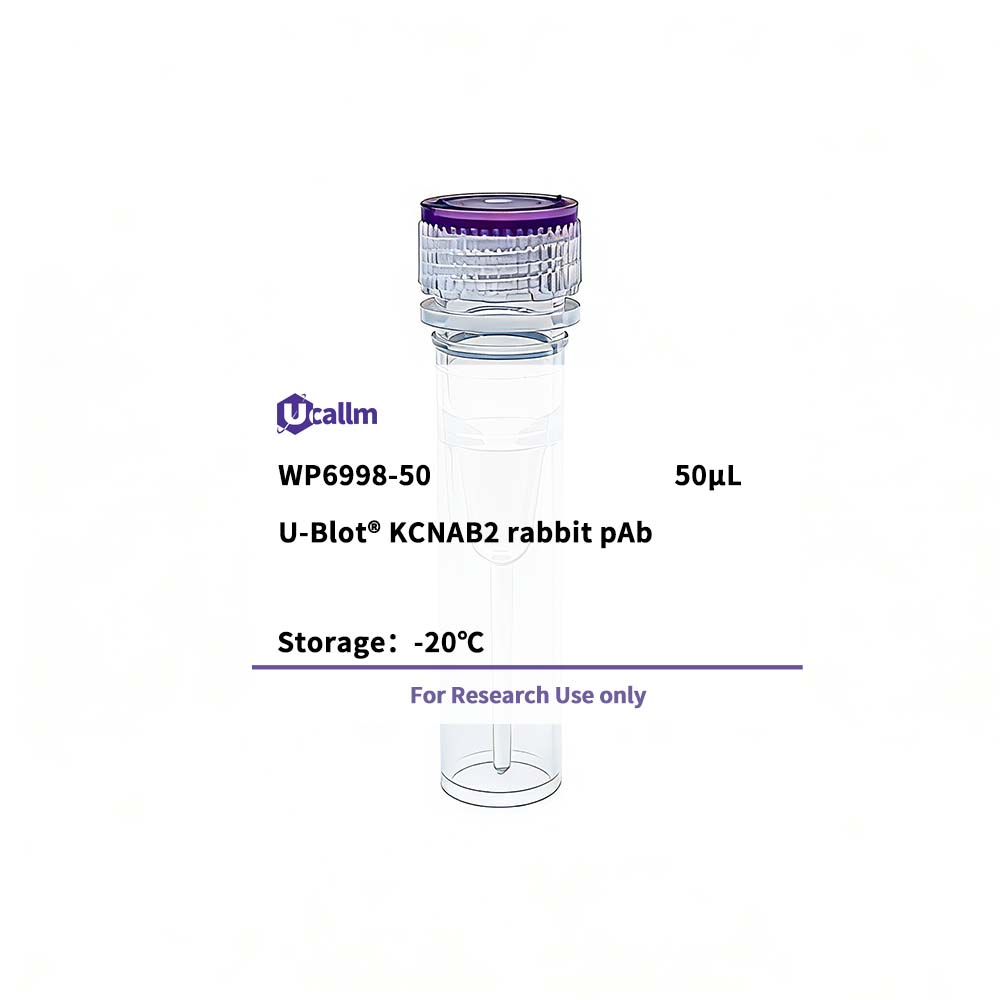
Price range: $268.00 through $328.00
Background:
| Size | 50μL/100μL |
| Target | KCNAB2 |
| Reactivity | Human, Mouse, Rat |
| Applications | WB |
| MW(Calculated) | 40kD |
| MW(Observed) | |
| Host Species | Rabbit |
| Isotype | IgG |
| Conjugate/Modification | Unmodified |
| Recommended Dilution Ratio | WB 1:500-2000 |
| Formulation | Liquid in PBS containing 50% glycerol, 0.5% BSA and 0.02% sodium azide. |
| Purification | The antibody was affinity-purified from rabbit antiserum by affinity-chromatography using epitope-specific immunogen. |
| Storage | -15°C to -25°C/1 year(Do not lower than -25°C) |
| Concentration | 1 mg/ml |
| Clonality | Polyclonal |
| Clone Number | |
| Immunogen | Synthesized peptide derived from human KCNAB2 |
| Specificity | This antibody detects endogenous levels of KCNAB2 at Human, Mouse,Rat |
| Gene Name | KCNAB2 KCNA2B KCNK2 |
| Protein Name | Voltage-gated potassium channel subunit beta-2 (K(+) channel subunit beta-2) (Kv-beta-2) (hKvbeta2) |
| Other Name | |
| Species | Human |
| Gene ID | 8514 |
| Uniprot | Q13303, |
| Species.1 | Mouse |
| Gene ID.1 | 16498 |
| Uniprot.1 | P62482, |
| Species.2 | Rat |
| Gene ID.2 | 29738 |
| Uniprot.2 | P62483 |
| Cellular Localization | Cytoplasm . Membrane; Peripheral membrane protein; Cytoplasmic side . Cell membrane; Peripheral membrane protein; Cytoplasmic side . Cell projection, axon . Cell junction, synapse, synaptosome . Cytoplasm, cytoskeleton . Recruited to the cytoplasmic side of the cell membrane via its interaction with pore-forming potassium channel alpha subunits. Associates with microtubules when unphosphorylated. . |
| Tissue Expression | Detected in myelinated nerve fibers in the spinal cord, in the juxtaparanodal region of the nodes of Ranvier, but also in the paranodal region (PubMed:11086297). Detected in hippocampus (at protein level) (PubMed:21357749). Detected in hippocampus (PubMed:7649300). |
| Signaling_pathway | |
| Research Areas | |
| Function | Cytoplasmic potassium channel subunit that modulates the characteristics of the channel-forming alpha-subunits . Contributes to the regulation of nerve signaling, and prevents neuronal hyperexcitability (By similarity). Promotes expression of the pore-forming alpha subunits at the cell membrane, and thereby increases channel activity (By similarity). Promotes potassium channel closure via a mechanism that does not involve physical obstruction of the channel pore . Promotes KCNA4 channel closure . Modulates the functional properties of KCNA5 (By similarity). Enhances KCNB2 channel activity (By similarity). Binds NADPH and has NADPH-dependent aldoketoreductase activity (By similarity). Has broad substrate specificity and can catalyze the reduction of methylglyoxal, 9,10-phenanthrenequinone, prostaglandin J2, 4-nitrobenzaldehyde, 4-nitroacetophenone and 4-oxo-trans-2-nonenal (in vitro) (By similarity). |





