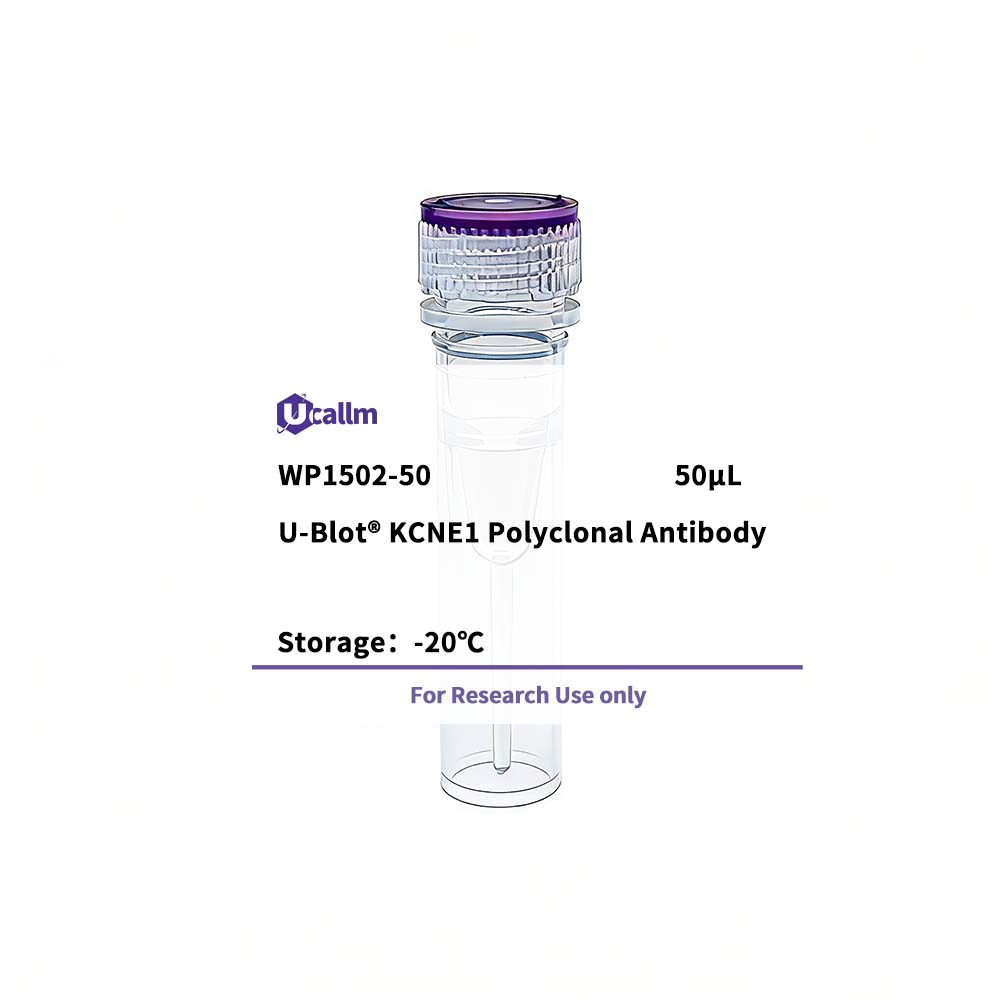
SKU: WP1502 Categories: ,

KCNE1 Polyclonal Antibody

Price range: $268.00 through $328.00

SKU: WP1502-100
Enter the quantity you would like, or drag the panel to find the quantity and price that best for you
Bulk QuoteAuthorize OEM & ODM

Product details

Background:

potassium voltage-gated channel subfamily E regulatory subunit 1(KCNE1) Homo sapiens The product of this gene belongs to the potassium channel KCNE family. Potassium ion channels are essential to many cellular functions and show a high degree of diversity, varying in their electrophysiologic and pharmacologic properties. This gene encodes a transmembrane protein known to associate with the product of the KVLQT1 gene to form the delayed rectifier potassium channel. Mutation in this gene are associated with both Jervell and Lange-Nielsen and Romano-Ward forms of long-QT syndrome. Alternatively spliced transcript variants encoding the same protein have been identified. [provided by RefSeq, Jul 2008],


Specifications

Size50μL/100μL
TargetKCNE1
ReactivityHuman, Mouse, Rat
ApplicationsWB, ELISA
MW(Calculated)
MW(Observed)14kD
Host SpeciesRabbit
IsotypeIgG
Conjugate/ModificationUnmodified
Recommended Dilution RatioWB 1:500-2000; ELISA 1:5000-20000
FormulationLiquid in PBS containing 50% glycerol,0.5% BSA and 0.02% sodium azide.
PurificationThe antibody was affinity-purified from rabbit antiserum by affinity-chromatography using epitope-specific immunogen.
Storage-15°C to -25°C/1 year(Do not lower than -25°C)
Concentration1 mg/ml
ClonalityPolyclonal
Clone Number
ImmunogenSynthesized peptide derived from human protein . at AA range: 40-120
SpecificityKCNE1 Polyclonal Antibody detects endogenous levels of protein.
Gene NameKCNE1
Protein NamePotassium voltage-gated channel subfamily E member 1 (Delayed rectifier potassium channel subunit IsK) (IKs producing slow voltage-gated potassium channel subunit beta Mink) (Minimal potassium channel)
Other Name
SpeciesHuman
Gene ID3753
UniprotP15382,
Species.1Mouse
Gene ID.1
Uniprot.1P23299,
Species.2Rat
Gene ID.2
Uniprot.2P15383
Cellular LocalizationCell membrane; Single-pass type I membrane protein . Apical cell membrane . Membrane raft . Colocalizes with KCNB1 at the plasma membrane (By similarity). Targets to the membrane raft when associated with KCNQ1 (PubMed:20533308). .
Tissue ExpressionExpressed in lung, kidney, testis, ovaries, small intestine, peripheral blood leukocytes. Expressed in the heart (PubMed:19219384). Not detected in pancreas, spleen, prostate and colon. Restrictively localized in the apical membrane portion of epithelial cells.
Signaling_pathwayOrganismal Systems >> Circulatory system >> Adrenergic signaling in cardiomyocytes
Research Areas>>Adrenergic signaling in cardiomyocytes
FunctionDisease:Defects in KCNE1 are the cause of Jervell and Lange-Nielsen syndrome type 2 (JLNS2) [MIM:612347]. JLNS2 is an autosomal recessive disorder characterized by congenital deafness, prolongation of the QT interval, syncopal attacks due to ventricular arrhythmias, and a high risk of sudden death.,Disease:Defects in KCNE1 are the cause of long QT syndrome type 5 (LQT5) [MIM:176261]. Long QT syndromes are heart disorders characterized by a prolonged QT interval on the ECG and polymorphic ventricular arrhythmias. They cause syncope and sudden death in response to exercise or emotional stress. KCNE1 mutants form channels that open slowly and close rapidly, thereby diminishing potassium currents.,Function:Ancillary protein that assembles as a beta subunit with a voltage-gated potassium channel complex of pore-forming alpha subunits. Modulates the gating kinetics and enhances stability of the channel complex.,Function:Ancillary protein that assembles as a beta subunit with a voltage-gated potassium channel complex of pore-forming alpha subunits. Modulates the gating kinetics and enhances stability of the channel complex. Assembled with KCNQ1/KVLQT1 is proposed to form the slowly activating delayed rectifier cardiac potassium (IKs) channel. The outward current reaches its steady state only after 50 seconds. Assembled with KCNH2/HERG may modulate the rapidly activating component of the delayed rectifying potassium current in heart (IKr).,online information:Congenital long QT syndrome website,online information:KCNE1 mutations page,PTM:Phosphorylation inhibits the potassium current.,sequence Caution:Translated as Cys.,similarity:Belongs to the potassium channel KCNE family.,subunit:Associates with KCNQ1/KVLQT1 and KCNH2/HERG.,tissue specificity:Expressed in heart, lung, kidney, testis, ovaries, small intestine, peripheral blood leukocytes. Not detected in pancreas, spleen, prostate and colon. Restrictively localized in the apical membrane portion of epithelial cells.,
Please login to post questions
Back to Top
Product has been added to your cart
