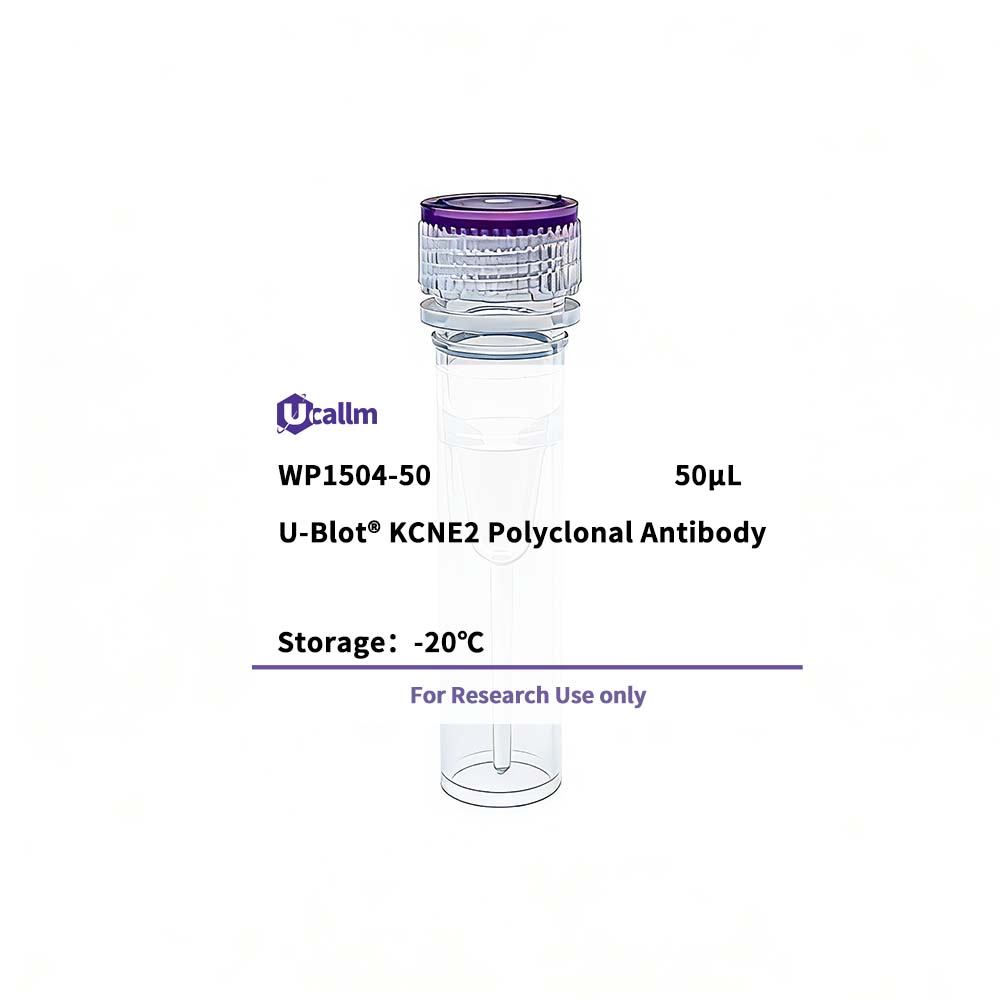
SKU: WP1504 Categories: ,

KCNE2 Polyclonal Antibody

Price range: $268.00 through $328.00

SKU: WP1504-100
Enter the quantity you would like, or drag the panel to find the quantity and price that best for you
Bulk QuoteAuthorize OEM & ODM

Product details

Background:

potassium voltage-gated channel subfamily E regulatory subunit 2(KCNE2) Homo sapiens Voltage-gated potassium (Kv) channels represent the most complex class of voltage-gated ion channels from both functional and structural standpoints. Their diverse functions include regulating neurotransmitter release, heart rate, insulin secretion, neuronal excitability, epithelial electrolyte transport, smooth muscle contraction, and cell volume. This gene encodes a member of the potassium channel, voltage-gated, isk-related subfamily. This member is a small integral membrane subunit that assembles with the KCNH2 gene product, a pore-forming protein, to alter its function. This gene is expressed in heart and muscle and the gene mutations are associated with cardiac arrhythmia. [provided by RefSeq, Jul 2008],

Specifications

Size50μL/100μL
TargetKCNE2
ReactivityHuman, Mouse, Rat
ApplicationsWB, ELISA
MW(Calculated)
MW(Observed)13kD
Host SpeciesRabbit
IsotypeIgG
Conjugate/ModificationUnmodified
Recommended Dilution RatioWB 1:500-2000; ELISA 1:5000-20000
FormulationLiquid in PBS containing 50% glycerol,0.5% BSA and 0.02% sodium azide.
PurificationThe antibody was affinity-purified from rabbit antiserum by affinity-chromatography using epitope-specific immunogen.
Storage-15°C to -25°C/1 year(Do not lower than -25°C)
Concentration1 mg/ml
ClonalityPolyclonal
Clone Number
ImmunogenSynthesized peptide derived from human protein . at AA range: 30-110
SpecificityKCNE2 Polyclonal Antibody detects endogenous levels of protein.
Gene NameKCNE2
Protein NamePotassium voltage-gated channel subfamily E member 2 (MinK-related peptide 1) (Minimum potassium ion channel-related peptide 1) (Potassium channel subunit beta MiRP1)
Other Name
SpeciesHuman
Gene ID9992
UniprotQ9Y6J6,
Species.1Mouse
Gene ID.1
Uniprot.1Q9D808,
Species.2Rat
Gene ID.2
Uniprot.2P63161
Cellular LocalizationCell membrane; Single-pass type I membrane protein . Colocalizes with KCNB1 at the plasma membrane. .
Tissue ExpressionHighly expressed in brain, heart, skeletal muscle, pancreas, placenta, kidney, colon and thymus. A small but significant expression is found in liver, ovary, testis, prostate, small intestine and leukocytes. Very low expression, nearly undetectable, in lung and spleen.
Signaling_pathway
Research Areas>>Gastric acid secretion
FunctionDisease:Defects in KCNE2 are the cause of familial atrial fibrillation type 4 (ATFB4) [MIM:611493]. Atrial fibrillation is a common disorder of cardiac rhythm that is hereditary in a small subgroup of patients. It is characterized by disorganized atrial electrical activity, progressive deterioration of atrial electromechanical function and ineffective pumping of blood into the ventricles. It can be associated with palpitations, syncope, thromboembolic stroke, and congestive heart failure.,Disease:Defects in KCNE2 are the cause of long QT syndrome type 6 (LQT6) [MIM:603796]. Long QT syndromes are heart disorders characterized by a prolonged QT interval on the ECG and polymorphic ventricular arrhythmias. They cause syncope and sudden death in response to exercise or emotional stress. KCNE2 mutants form channels that open slowly and close rapidly, thereby diminishing potassium currents.,Function:Ancillary protein that assembles as a beta subunit with a voltage-gated potassium channel complex of pore-forming alpha subunits. Modulates the gating kinetics and enhances stability of the channel complex.,Function:Ancillary protein that assembles as a beta subunit with a voltage-gated potassium channel complex of pore-forming alpha subunits. Modulates the gating kinetics and enhances stability of the channel complex. Associated with KCNH2/HERG is proposed to form the rapidly activating component of the delayed rectifying potassium current in heart (IKr). May associate with KCNQ2 and/or KCNQ3 and modulate the native M-type current. May associate with KCNQ1/KVLTQ1 and elicit a voltage-independent current. May associate with HCN1 and HCN2 and increase potassium current.,online information:KCNE2 mutations page,similarity:Belongs to the potassium channel KCNE family.,subunit:Associates with KCNH2/ERG1. May associate with KCNQ1/KVLQT1, KCNQ2 and KCNQ3. Associates with HCN1 and probably HCN2.,tissue specificity:Highly expressed in brain, heart, skeletal muscle, pancreas, placenta, kidney, colon and thymus. A small but significant expression is found in liver, ovary, testis, prostate, small intestine and leukocytes. Very low expression, nearly undetectable, in lung and spleen.,
Please login to post questions
Back to Top
Product has been added to your cart
