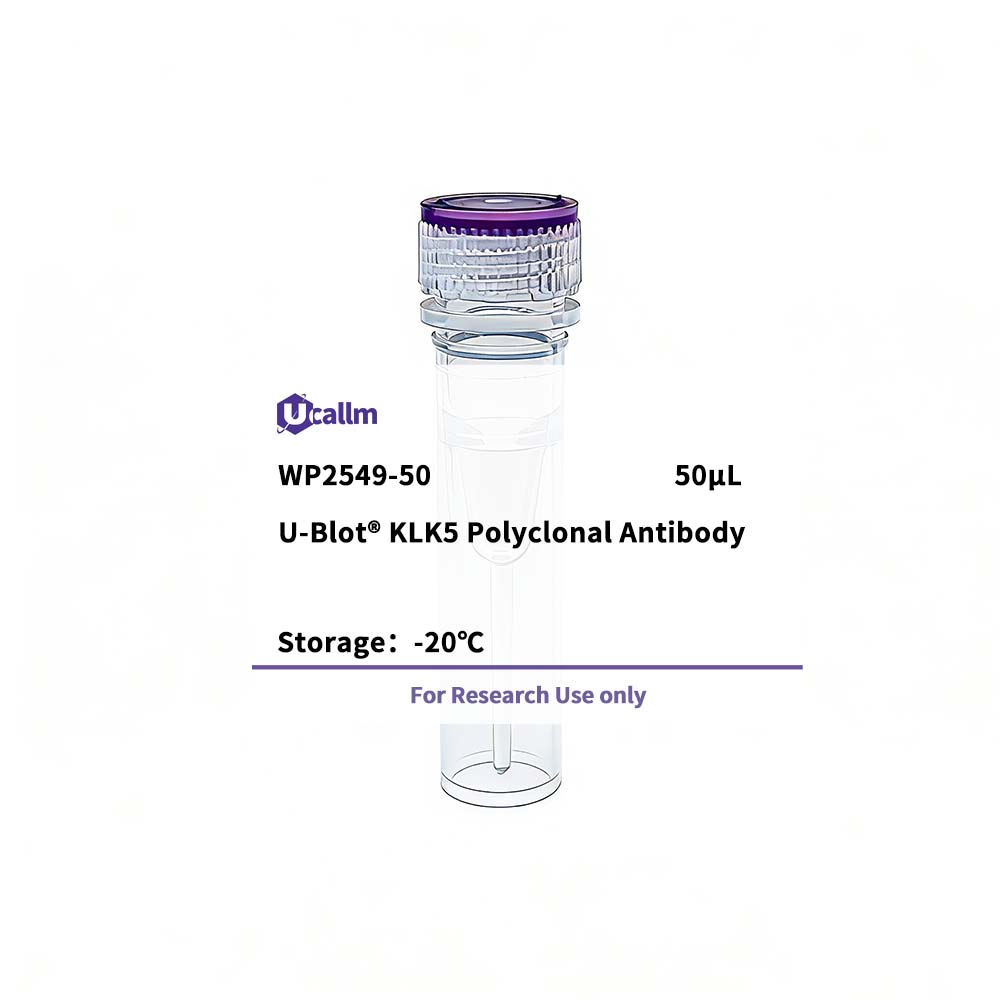
SKU: WP2549 Categories: ,

KLK5 Polyclonal Antibody

Price range: $268.00 through $328.00

SKU: WP2549-100
Enter the quantity you would like, or drag the panel to find the quantity and price that best for you
Bulk QuoteAuthorize OEM & ODM

Product details

Background:

Kallikreins are a subgroup of serine proteases having diverse physiological functions. Growing evidence suggests that many kallikreins are implicated in carcinogenesis and some have potential as novel cancer and other disease biomarkers. This gene is one of the fifteen kallikrein subfamily members located in a cluster on chromosome 19. Its expression is up-regulated by estrogens and progestins. The encoded protein is secreted and may be involved in desquamation in the epidermis. Alternative splicing results in multiple transcript variants encoding the same protein. [provided by RefSeq, Jul 2008],


Specifications

Size50μL/100μL
TargetKLK5
ReactivityHuman
ApplicationsWB, ELISA
MW(Calculated)
MW(Observed)32kD
Host SpeciesRabbit
IsotypeIgG
Conjugate/ModificationUnmodified
Recommended Dilution RatioWB 1:500-2000; ELISA 1:5000-20000
FormulationLiquid in PBS containing 50% glycerol,0.5% BSA and 0.02% sodium azide.
PurificationThe antibody was affinity-purified from rabbit antiserum by affinity-chromatography using epitope-specific immunogen.
Storage-15°C to -25°C/1 year(Do not lower than -25°C)
Concentration1 mg/ml
ClonalityPolyclonal
Clone Number
ImmunogenSynthesized peptide derived from part region of human protein
SpecificityKLK5 Polyclonal Antibody detects endogenous levels of protein.
Gene NameKLK5 SCTE UNQ570/PRO1132
Protein NameKallikrein-5 (Kallikrein-like protein 2) (KLK-L2) (Stratum corneum tryptic enzyme)
Other Name
SpeciesHuman
Gene ID25818
UniprotQ9Y337
Species.1
Gene ID.1
Uniprot.1
Species.2
Gene ID.2
Uniprot.2
Cellular LocalizationSecreted.
Tissue ExpressionExpressed in skin, breast, brain and testis. Expressed at the stratum granulosum of palmar skin.
Signaling_pathway
Research Areas
FunctionFunction:May be involved in desquamation.,similarity:Belongs to the peptidase S1 family.,similarity:Belongs to the peptidase S1 family. Kallikrein subfamily.,similarity:Contains 1 peptidase S1 domain.,tissue specificity:Expressed in skin, breast, brain and testis.,
Please login to post questions
Back to Top
Product has been added to your cart
