

KLOT Polyclonal Antibody
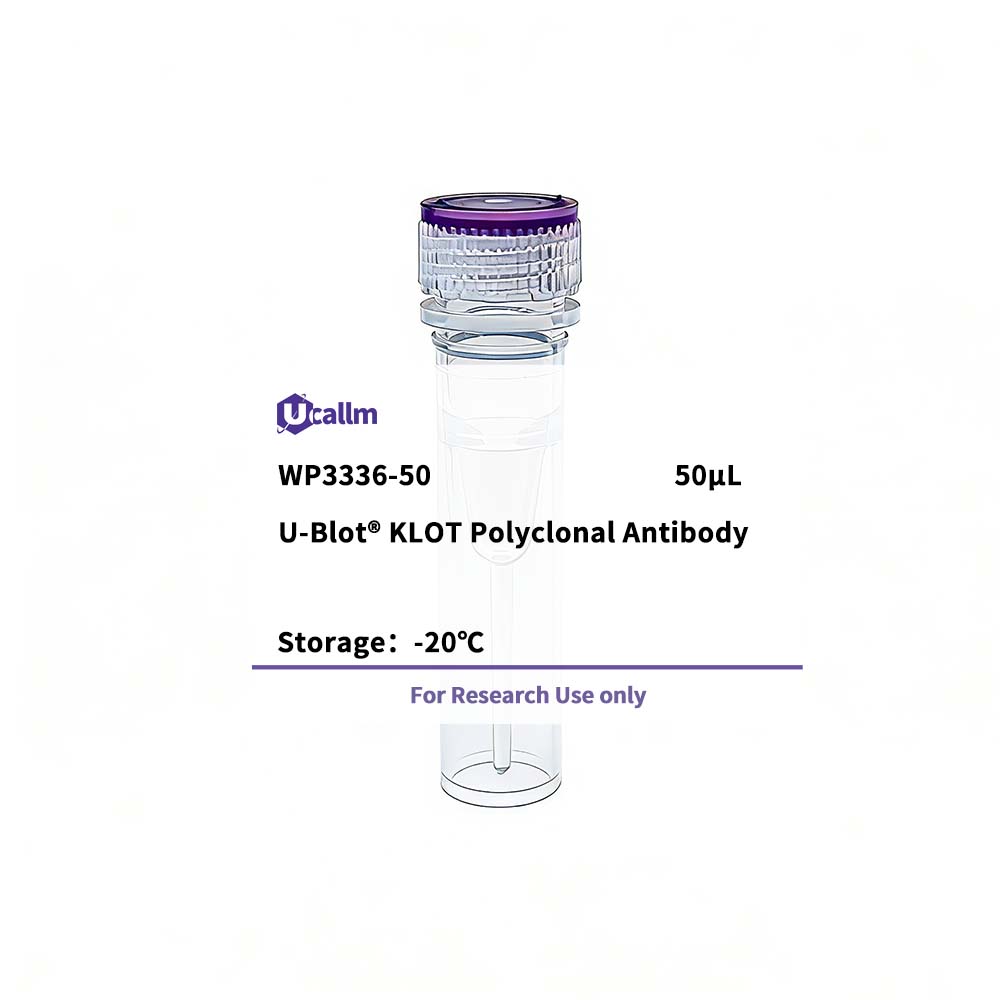
Ucallm_WP3336-50
Price range: $268.00 through $328.00
Product details
Background:
This gene encodes a type-I membrane protein that is related to beta-glucosidases. Reduced production of this protein has been observed in patients with chronic renal failure (CRF), and this may be one of the factors underlying the degenerative processes (e.g., arteriosclerosis, osteoporosis, and skin atrophy) seen in CRF. Also, mutations within this protein have been associated with ageing and bone loss. [provided by RefSeq, Jul 2008],
Specifications
| Size | 50μL/100μL |
| Target | KLOT |
| Reactivity | Human, Mouse, Rat |
| Applications | WB, ELISA |
| MW(Calculated) | |
| MW(Observed) | 111kD |
| Host Species | Rabbit |
| Isotype | IgG |
| Conjugate/Modification | Unmodified |
| Recommended Dilution Ratio | WB 1:500-2000; ELISA 1:5000-20000 |
| Formulation | Liquid in PBS containing 50% glycerol,0.5% BSA and 0.02% sodium azide. |
| Purification | The antibody was affinity-purified from rabbit antiserum by affinity-chromatography using epitope-specific immunogen. |
| Storage | -15°C to -25°C/1 year(Do not lower than -25°C) |
| Concentration | 1 mg/ml |
| Clonality | Polyclonal |
| Clone Number | |
| Immunogen | Synthesized peptide derived from part region of human protein AA range: 400-500 |
| Specificity | KLOT Polyclonal Antibody detects endogenous levels of protein. |
| Gene Name | KL |
| Protein Name | Klotho [Cleaved into: Klotho peptide] |
| Other Name | |
| Species | Human |
| Gene ID | 9365 |
| Uniprot | Q9UEF7, |
| Species.1 | Mouse |
| Gene ID.1 | |
| Uniprot.1 | O35082, |
| Species.2 | Rat |
| Gene ID.2 | |
| Uniprot.2 | Q9Z2Y9 |
| Cellular Localization | [Isoform 1]: Cell membrane; Single-pass type I membrane protein . Apical cell membrane; Single-pass type I membrane protein . Isoform 1 shedding leads to a soluble peptide. .; [Isoform 2]: Secreted .; [Klotho peptide]: Secreted . |
| Tissue Expression | Present in cortical renal tubules (at protein level). Soluble peptide is present in serum and cerebrospinal fluid. Expressed in kidney, placenta, small intestine and prostate. Down-regulated in renal cell carcinomas, hepatocellular carcinomas, and in chronic renal failure kidney. |
| Signaling_pathway | Organismal Systems >> Aging >> Longevity regulating pathway |
| Research Areas | >>Pentose and glucuronate interconversions; / >>Ascorbate and aldarate metabolism; / >>Metabolic pathways; / >>Longevity regulating pathway; / >>Parathyroid hormone synthesis, secretion and action; / >>Endocrine and other factor-regulated calcium reabsorption |
| Function | Catalytic activity:A beta-D-glucuronoside + H(2)O = D-glucuronate + an alcohol.,Disease:Defects in KL may be a cause of chronic renal failure complications.,Domain:Contains 2 glycosyl hydrolase 1 regions. However, the first region lacks the essential Glu active site residue at position 239, and the second one lacks the essential Glu active site residue at position 872.,Function:May have weak glycosidase activity towards glucuronylated steroids. However, it lacks essential active site Glu residues at positions 239 and 872, suggesting it may be inactive as a glycosidase in vivo. May be involved in the regulation of calcium and phosphorus homeostasis by inhibiting the synthesis of active vitamin D.,Function:The Klotho peptide generated by cleavage of the membrane-bound isoform may be an anti-aging circulating hormone which would extend life span by inhibiting insulin/IGF1 signaling.,online information:The thread of life -Issue 65 of December 2005,polymorphism:Homozygosity for KL-VS allele is associated with decreased longevity and increased cardiovascular disease risk.,PTM:N-glycosylated.,similarity:Belongs to the glycosyl hydrolase 1 family. Klotho subfamily.,subcellular location:Isoform 1 shedding leads to a soluble peptide.,subunit:Homodimer.,tissue specificity:Present in cortical renal tubules (at protein level). Soluble peptide is present in serum and cerebrospinal fluid. Expressed in kidney, placenta, small intestine and prostate. Down-regulated in renal cell carcinomas, hepatocellular carcinomas, and in chronic renal failure kidney., |
Please login to post questions
Related products




