SKU: WP12962 Categories: ,

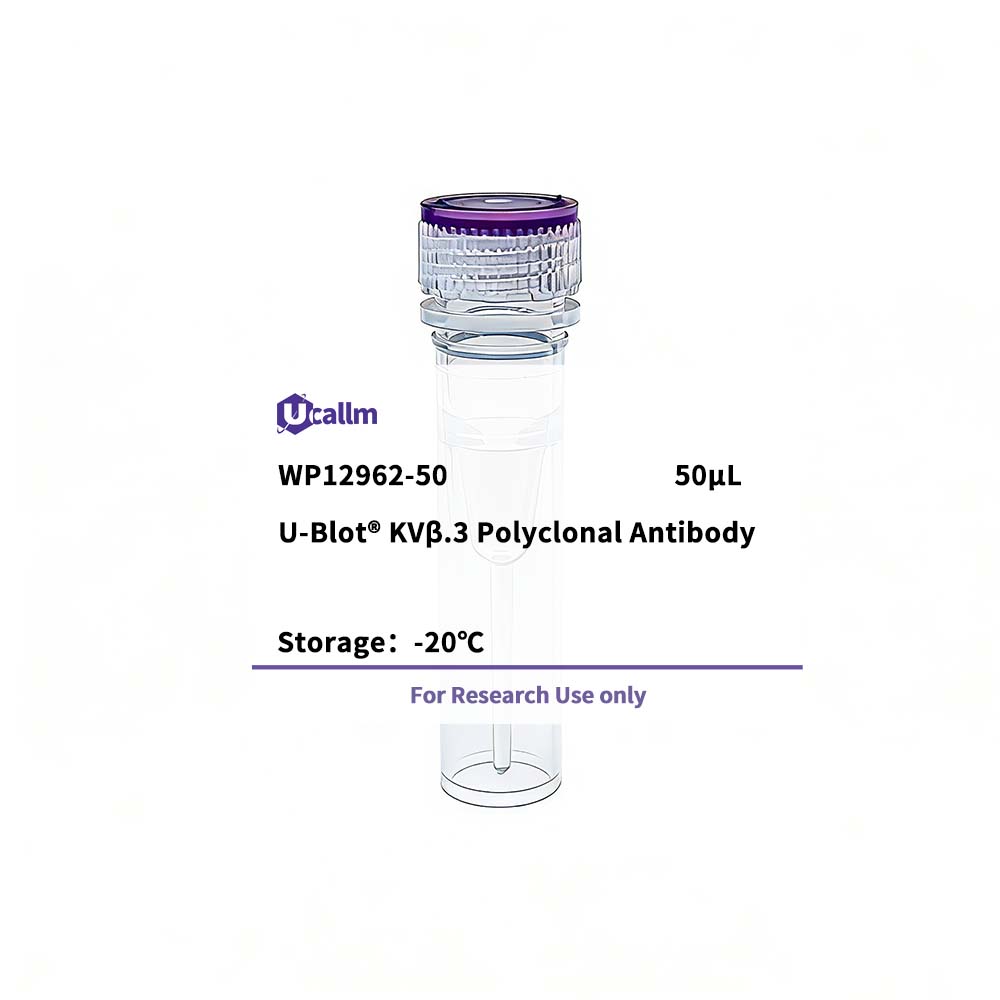
KVβ.3 Polyclonal Antibody

Price range: $268.00 through $328.00

SKU: WP12962-100
Enter the quantity you would like, or drag the panel to find the quantity and price that best for you
Bulk QuoteAuthorize OEM & ODM

Product details

Background:

This gene encodes a member of the potassium channel, voltage-gated, shaker-related subfamily. The encoded protein is one of the beta subunits, which are auxiliary proteins associating with functional Kv-alpha subunits. The encoded protein forms a heterodimer with the potassium voltage-gated channel, shaker-related subfamily, member 5 gene product and regulates the activity of the alpha subunit. [provided by RefSeq, May 2012],

Specifications

Size50μL/100μL
TargetKVβ.3
ReactivityHuman, Mouse, Rat
ApplicationsWB, IHC, IF, ELISA
MW(Calculated)
MW(Observed)45kD
Host SpeciesRabbit
IsotypeIgG
Conjugate/ModificationUnmodified
Recommended Dilution RatioWB 1:500-1:2000; IHC 1:100-1:300; ELISA 1:10000; IF 1:50-200 / Note: For IHC, we suggest antigen retrieval with TE buffer pH 9.0 (Cat#WT1004)
FormulationLiquid in PBS containing 50% glycerol, 0.5% BSA and 0.02% sodium azide.
PurificationThe antibody was affinity-purified from rabbit antiserum by affinity-chromatography using epitope-specific immunogen.
Storage-15°C to -25°C/1 year(Do not lower than -25°C)
Concentration1 mg/ml
ClonalityPolyclonal
Clone Number
ImmunogenThe antiserum was produced against synthesized peptide derived from human KCNAB3. AA range:293-342
SpecificityKVβ.3 Polyclonal Antibody detects endogenous levels of KVβ.3 protein.
Gene NameKCNAB3
Protein NameVoltage-gated potassium channel subunit beta-3
Other NameKCNAB3; / KCNA3B; / Voltage-gated potassium channel subunit beta-3; / K; / +; / channel subunit beta-3; / Kv-beta-3
SpeciesHuman
Gene ID9196
UniprotO43448,
Species.1Mouse
Gene ID.1
Uniprot.1P97382,
Species.2Rat
Gene ID.258981
Uniprot.2Q63494
Cellular LocalizationCytoplasm .
Tissue ExpressionBrain specific. Most prominent expression in cerebellum. Weaker signals detected in cortex, occipital lobe, frontal lobe and temporal lobe. Not detected in spinal cord, heart, lung, liver, kidney, pancreas, placenta and skeletal muscle.
Signaling_pathway
Research Areas
FunctionDomain:Alteration of functional properties of alpha subunit is mediated through N-terminal domain of beta subunit.,Function:Accessory potassium channel protein which modulates the activity of the pore-forming alpha subunit. Alters the functional properties of Kv1.5.,similarity:Belongs to the shaker potassium channel beta subunit family.,subunit:Forms heteromultimeric complex with alpha subunits.,tissue specificity:Brain specific. Most prominent expression in cerebellum. Weaker signals detected in cortex, occipital lobe, frontal lobe and temporal lobe. Not detected in spinal cord, heart, lung, liver, kidney, pancreas, placenta and skeletal muscle.,
Please login to post questions
Back to Top
Product has been added to your cart

