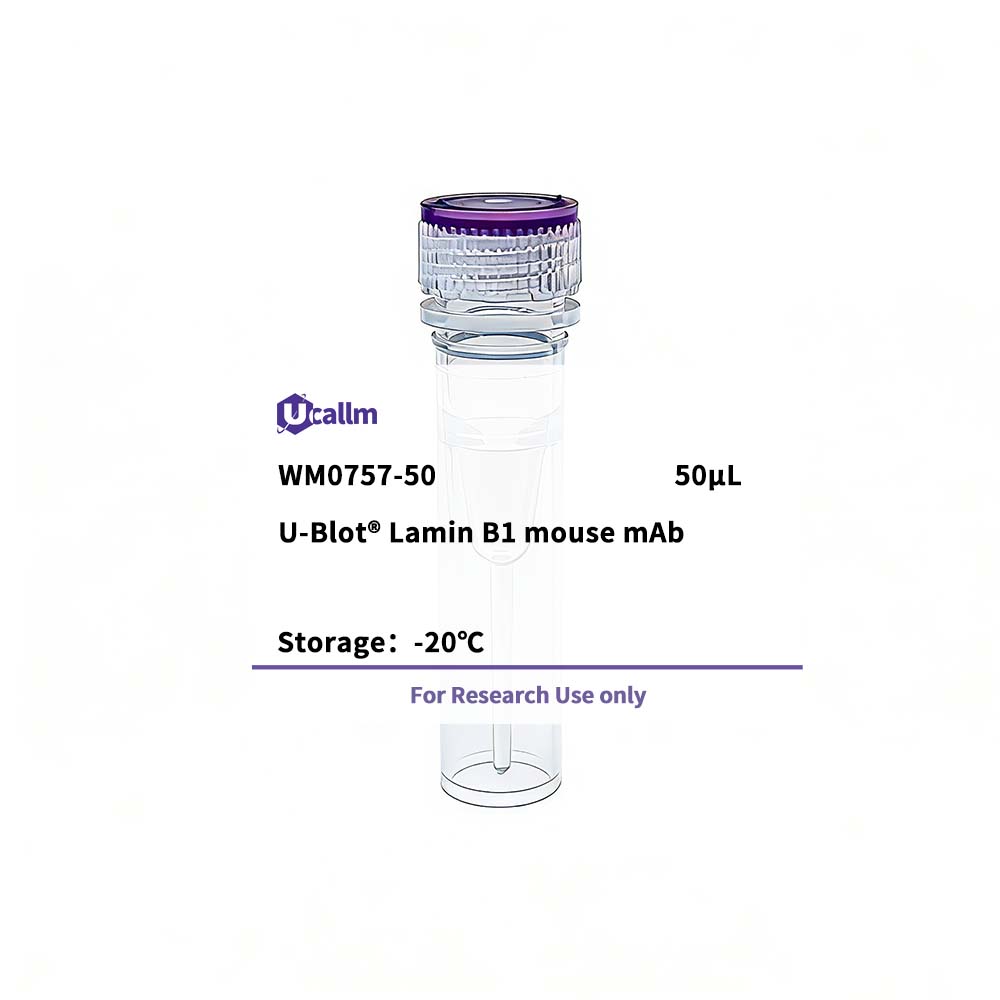
SKU: WM0757 Categories: ,

Lamin B1 mouse mAb

Price range: $268.00 through $328.00

SKU: WM0757-50
Enter the quantity you would like, or drag the panel to find the quantity and price that best for you
Bulk QuoteAuthorize OEM & ODM

Product details

Background:
lamin B1(LMNB1) Homo sapiens This gene encodes one of the two B-type lamin proteins and is a component of the nuclear lamina. A duplication of this gene is associated with autosomal dominant adult-onset leukodystrophy (ADLD). Alternative splicing results in multiple transcript variants. [provided by RefSeq, Dec 2015],

Specifications

Size50μL/100μL
TargetLamin B1
ReactivityHuman, Mouse, Monkey
ApplicationsWB, IF
MW(Calculated)
MW(Observed)68kD
Host SpeciesMouse
Isotype
Conjugate/ModificationUnmodified
Recommended Dilution RatioWB 1:500; IF 1:200-1:1000;
FormulationLiquid in PBS containing 50% glycerol, 0.5% BSA and 0.02% sodium azide.
PurificationThe antibody was affinity-purified from mouse ascites by affinity-chromatography using epitope-specific immunogen.
Storage-15°C to -25°C/1 year(Do not lower than -25°C)
Concentration
ClonalityMonoclonal
Clone Number19A3
ImmunogenRecombinant human Lamin B1 protein.
SpecificityThis antibody detects endogenous levels of Lamin B1 and does not cross-react with related proteins.
Gene NameLMNB1
Protein NameLamin-B1
Other NameADLD; / lamin B1; / Lamin-B1; / LMN; / LMN2; / LMNB; / Lmnb1; / LMNB1_HUMAN; / MGC111419; / OTTHUMP00000159218.
SpeciesHuman
Gene ID4001
UniprotP20700,
Species.1Mouse
Gene ID.116906
Uniprot.1P14733,
Species.2Rat
Gene ID.2116685
Uniprot.2P70615
Cellular LocalizationNucleus lamina .
Tissue ExpressionBrain,Cajal-Retzius cell,Epithelium,Eye,Fetal brain cortex,Ovarian carcinoma,Placenta,Uterus,
Signaling_pathwayCellular Processes >> Cell growth and death >> Apoptosis
Research Areas>>Apoptosis
FunctionDisease:Defects in LMNB1 are the cause of leukodystrophy demyelinating autosomal dominant adult-onset (ADLD) [MIM:169500]. ADLD is a slowly progressive and fatal demyelinating leukodystrophy, presenting in the fourth or fifth decade of life. Clinically characterized by early autonomic abnormalities, pyramidal and cerebellar dysfunction, and symmetric demyelination of the CNS. It differs from multiple sclerosis and other demyelinating disorders in that neuropathology shows preservation of oligodendroglia in the presence of subtotal demyelination and lack of astrogliosis.,Function:Lamins are components of the nuclear lamina, a fibrous layer on the nucleoplasmic side of the inner nuclear membrane, which is thought to provide a framework for the nuclear envelope and may also interact with chromatin.,miscellaneous:The structural integrity of the lamina is strictly controlled by the cell cycle, as seen by the disintegration and formation of the nuclear envelope in prophase and telophase, respectively.,PTM:B-type lamins undergo a series of modifications, such as farnesylation and phosphorylation. Increased phosphorylation of the lamins occurs before envelope disintegration and probably plays a role in regulating lamin associations.,similarity:Belongs to the intermediate filament family.,subunit:Interacts with lamin-associated polypeptides IA, IB and 2.,
Please login to post questions
Back to Top
Product has been added to your cart



