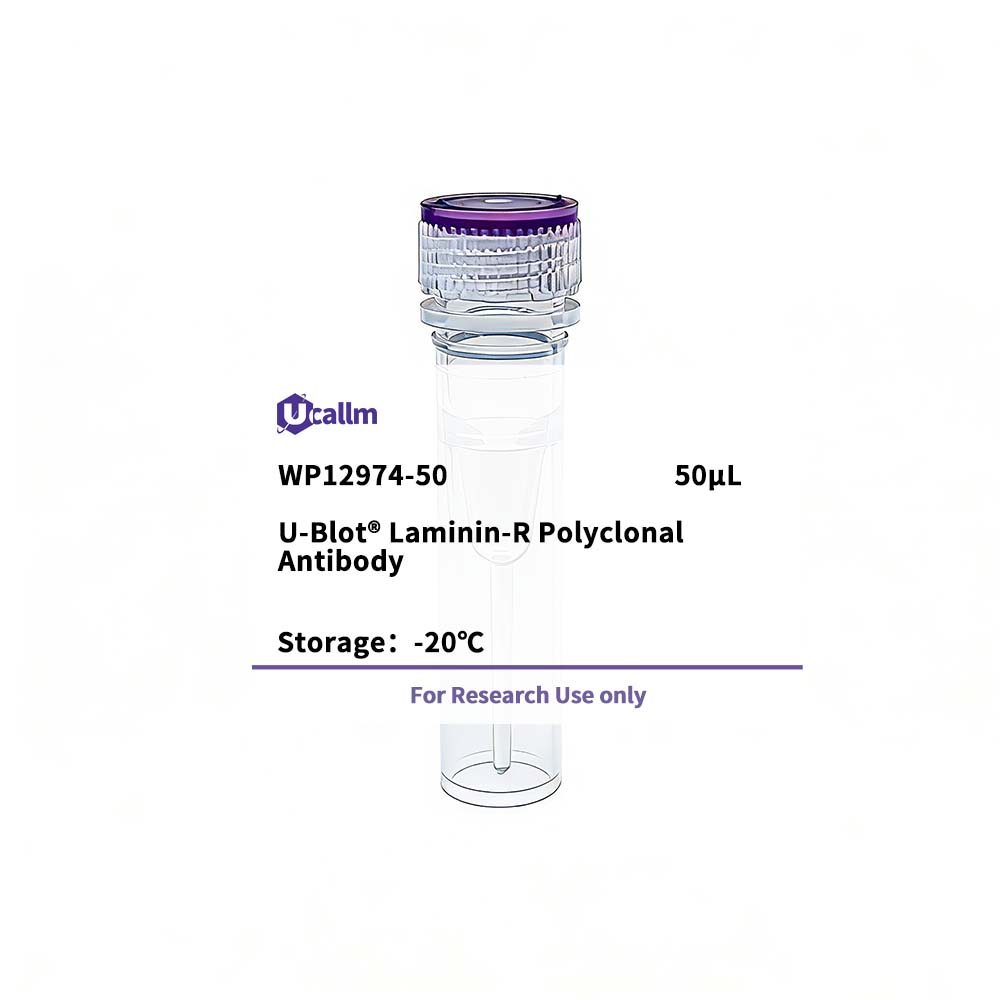
SKU: WP12974 Categories: ,

Laminin-R Polyclonal Antibody

Price range: $268.00 through $328.00

SKU: WP12974-100
Enter the quantity you would like, or drag the panel to find the quantity and price that best for you
Bulk QuoteAuthorize OEM & ODM

Product details

Background:

Laminins, a family of extracellular matrix glycoproteins, are the major noncollagenous constituent of basement membranes. They have been implicated in a wide variety of biological processes including cell adhesion, differentiation, migration, signaling, neurite outgrowth and metastasis. Many of the effects of laminin are mediated through interactions with cell surface receptors. These receptors include members of the integrin family, as well as non-integrin laminin-binding proteins. This gene encodes a high-affinity, non-integrin family, laminin receptor 1. This receptor has been variously called 67 kD laminin receptor, 37 kD laminin receptor precursor (37LRP) and p40 ribosome-associated protein. The amino acid sequence of laminin receptor 1 is highly conserved through evolution, suggesting a key biological function. It has been observed that the level of the laminin receptor transcript is higher in

Specifications

Size50μL/100μL
TargetLaminin-R
ReactivityHuman, Mouse, Rat
ApplicationsWB, IHC, IF, ELISA
MW(Calculated)
MW(Observed)43kD
Host SpeciesRabbit
IsotypeIgG
Conjugate/ModificationUnmodified
Recommended Dilution RatioWB 1:500-1:2000; IHC 1:100-1:300; ELISA 1:40000; IF 1:50-200 / Note: For IHC, we suggest antigen retrieval with TE buffer pH 9.0 (Cat#WT1004)
FormulationLiquid in PBS containing 50% glycerol, 0.5% BSA and 0.02% sodium azide.
PurificationThe antibody was affinity-purified from rabbit antiserum by affinity-chromatography using epitope-specific immunogen.
Storage-15°C to -25°C/1 year(Do not lower than -25°C)
Concentration1 mg/ml
ClonalityPolyclonal
Clone Number
ImmunogenThe antiserum was produced against synthesized peptide derived from human Laminin-R. AA range:166-215
SpecificityLaminin-R Polyclonal Antibody detects endogenous levels of Laminin-R protein.
Gene NameRPSA
Protein Name40S ribosomal protein SA
Other NameRPSA; / LAMBR; / LAMR1; / 40S ribosomal protein SA; / 37 kDa laminin receptor precursor; / 37LRP; / 37/67 kDa laminin receptor; / LRP/LR; / 67 kDa laminin receptor; / 67LR; / Colon carcinoma laminin-binding protein; / Laminin receptor 1; / LamR; / Laminin-binding pr
SpeciesHuman
Gene ID3921
UniprotP08865,
Species.1Mouse
Gene ID.116785
Uniprot.1P14206,
Species.2Rat
Gene ID.229236
Uniprot.2P38983
Cellular LocalizationCell membrane. Cytoplasm. Nucleus . 67LR is found at the surface of the plasma membrane, with its C-terminal laminin-binding domain accessible to extracellular ligands. 37LRP is found at the cell surface, in the cytoplasm and in the nucleus (By similarity). Colocalizes with PPP1R16B in the cell membrane. .
Tissue ExpressionB-cell lymphoma,Blood,Bone marrow,Brain,Cajal-Retzius cell,Cervix,Fetal brain corte
Signaling_pathway
Research Areas>>Ribosome; / >>Coronavirus disease - COVID-19
FunctionFunction:Required for the assembly and/or stability of the 40S ribosomal subunit. Required for the processing of the 20S rRNA-precursor to mature 18S rRNA in a late step of the maturation of 40S ribosomal subunits. Also functions as a cell surface receptor for laminin. Plays a role in cell adhesion to the basement membrane and in the consequent activation of signaling transduction pathways. May play a role in cell fate determination and tissue morphogenesis. Also acts as a receptor for several other ligands, including the pathogenic prion protein, viruses, and bacteria.,miscellaneous:It is thought that in vertebrates 37/67 kDa laminin receptor acquired a dual function during evolution. It developed from the ribosomal protein SA, playing an essential role in the protein biosynthesis lacking any laminin binding activity, to a cell surface receptor with laminin binding activity.,miscellaneous:This protein appears to have acquired a second function as a laminin receptor specifically in the vertebrate lineage.,PTM:Acylated. Acylation may be a prerequisite for conversion of the monomeric 37 kDa laminin receptor precursor (37LRP) to the mature dimeric 67 kDa laminin receptor (67LR), and may provide a mechanism for membrane association.,PTM:Cleaved by stromelysin-3 (ST3) at the cell surface. Cleavage by stromelysin-3 may be a mechanism to alter cell-extracellular matrix interactions.,similarity:Belongs to the ribosomal protein S2P family.,subcellular location:67LR is found at the surface of the plasma membrane, with its C-terminal laminin-binding domain accessible to extracellular ligands. 37LRP is found at the cell surface, in the cytoplasm and in the nucleus.,subunit:Monomer (37LRP) and homodimer (67LR). Component of the small ribosomal subunit. Mature ribosomes consist of a small (40S) and a large (60S) subunit. The 40S subunit contains about 33 different proteins and 1 molecule of RNA (18S). The 60S subunit contains about 49 different proteins and 3 molecules of RNA (28S, 5.8S and 5S). Interacts with RPS21. Interacts with several laminins including at least LAMB1. Interacts with MDK (By similarity). Interacts with PRNP.,
Please login to post questions
Back to Top
Product has been added to your cart


