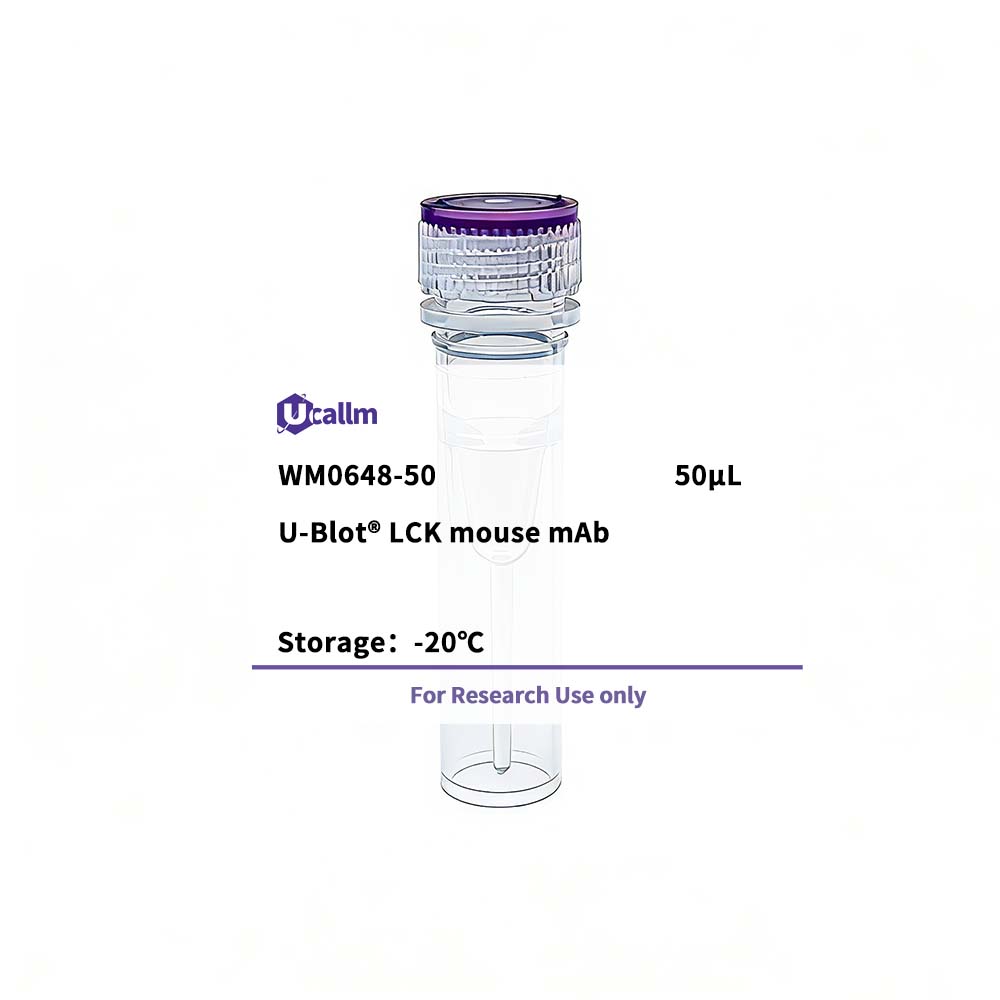
SKU: WM0648 Categories: ,

LCK mouse mAb

Price range: $268.00 through $328.00

SKU: WM0648-50
Enter the quantity you would like, or drag the panel to find the quantity and price that best for you
Bulk QuoteAuthorize OEM & ODM

Product details

Background:
This gene is a member of the Src family of protein tyrosine kinases (PTKs). The encoded protein is a key signaling molecule in the selection and maturation of developing T-cells. It contains N-terminal sites for myristylation and palmitylation, a PTK domain, and SH2 and SH3 domains which are involved in mediating protein-protein interactions with phosphotyrosine-containing and proline-rich motifs, respectively. The protein localizes to the plasma membrane and pericentrosomal vesicles, and binds to cell surface receptors, including CD4 and CD8, and other signaling molecules. Multiple alternatively spliced variants encoding different isoforms have been described. [provided by RefSeq, Aug 2016],

Specifications

Size50μL/100μL
TargetLck
ReactivityHuman
ApplicationsWB
MW(Calculated)
MW(Observed)58kD
Host SpeciesMouse
Isotype
Conjugate/ModificationUnmodified
Recommended Dilution RatioWB 1:1000
FormulationLiquid in PBS containing 50% glycerol, 0.5% BSA and 0.02% sodium azide.
PurificationThe antibody was affinity-purified from mouse ascites by affinity-chromatography using epitope-specific immunogen.
Storage-15°C to -25°C/1 year(Do not lower than -25°C)
Concentration
ClonalityMonoclonal
Clone Number16G6
ImmunogenPurified recombinant human LCK protein fragments expressed in E.coli.
SpecificityThis antibody detects endogenous levels of LCK and does not cross-react with related proteins.
Gene NameLCK
Protein Name
Other NameLCK; / Lck p56; / LCK_HUMAN; / Leukocyte C-terminal Src kinase; / LSK; / Lymphocyte cell specific protein tyrosine kinase; / Lymphocyte cell-specific protein-tyrosine kinase; / Lymphocyte Specific Protein Tyrosine Kinase; / Membrane associated protein tyrosine kinase; / Oncogene lck; / P56 LCK; / p56; / LSTRA; / protein tyrosine kinase; / p56-LCK; / p56lck; / pp58 lck; / pp58lck; / Protein YT16; / Proto oncogene tyrosine protein kinase LCK; / Proto-oncogene Lck; / Protooncogene tyrosine protein kinase LCK; / T cell specific protein tyrosine kinase; / T cell-specific protein-tyrosine kinase; / T lymphocyte specific protein tyrosine kinase p56lck; / Tyrosine-protein kinase Lck; / YT 16; / YT16.
SpeciesHuman
Gene ID3932
UniprotP06239
Species.1
Gene ID.1
Uniprot.1
Species.2
Gene ID.2
Uniprot.2
Cellular LocalizationCell membrane; Lipid-anchor; Cytoplasmic side . Cytoplasm, cytosol . Present in lipid rafts in an inactive form. .
Tissue ExpressionExpressed specifically in lymphoid cells.
Signaling_pathwayOrganismal Systems >> Immune system >> Natural killer cell mediated cytotoxicity;Organismal Systems >> Immune system >> T cell receptor signaling pathway;Organismal Systems >> Immune system >> Th1 and Th2 cell differentiation;Organismal Systems >> Immune system >> Th17 cell differentiation;Organismal Systems >> Development and regeneration >> Osteoclast differentiation;Human Diseases >> Cancer: overview >> PD-L1 expression and PD-1 checkpoint pathway in cancer;Human Diseases >> Immune disease >> Primary immunodeficiency;Environmental Information Processing >> Signal transduction >> NF-kappa B signaling pathway
Research Areas>>NF-kappa B signaling pathway; / >>Osteoclast differentiation; / >>Natural killer cell mediated cytotoxicity; / >>Th1 and Th2 cell differentiation; / >>Th17 cell differentiation; / >>T cell receptor signaling pathway; / >>Yersinia infection; / >>Human T-cell leukemia virus 1 infection; / >>PD-L1 expression and PD-1 checkpoint pathway in cancer; / >>Primary immunodeficiency
FunctionCatalytic activity:ATP + a [protein]-L-tyrosine = ADP + a [protein]-L-tyrosine phosphate.,Disease:A chromosomal aberration involving LCK is found in leukemias. Translocation t(1; 7)(p34; q34) with TCRB.,Domain:The SH2 domain mediates interaction with SQSTM1. Interaction is regulated by Ser-59 phosphorylation.,enzyme regulation:Inhibited by tyrosine phosphorylation.,Function:Tyrosine kinase that plays an essential role for the selection and maturation of developing T-cell in the thymus and in mature T-cell function. Is constitutively associated with the cytoplasmic portions of the CD4 and CD8 surface receptors and plays a key role in T-cell antigen receptor(TCR)-linked signal transduction pathways. Association of the TCR with a peptide antigen-bound MHC complex facilitates the interaction of CD4 and CD8 with MHC class II and class I molecules, respectively, and thereby recruits the associated LCK to the vicinity of the TCR/CD3 complex. LCK then phosphorylates tyrosines residues within the immunoreceptor tyrosines-based activation motifs (ITAMs) in the cytoplasmic tails of the TCRgamma chains and CD3 subunits, initiating the TCR/CD3 signaling pathway. In addition, contributes to signaling by other receptor molecules. Associates directly with the cytoplasmic tail of CD2, and upon engagement of the CD2 molecule, LCK undergoes hyperphosphorylation and activation. Also plays a role in the IL2 receptor-linked signaling pathway that controls T-cell proliferative response. Binding of IL2 to its receptor results in increased activity of LCK. Is expressed at all stages of thymocyte development and is required for the regulation of maturation events that are governed by both pre-TCR and mature alpha beta TCR.,mass spectrometry: PubMed:11840567,online information:Lck entry,PTM:Phosphorylated on Tyr-394, which increases enzymatic activity (By similarity). Phosphorylated on Tyr-505, which decreases activity.,similarity:Belongs to the protein kinase superfamily. Tyr protein kinase family. SRC subfamily.,similarity:Contains 1 protein kinase domain.,similarity:Contains 1 SH2 domain.,similarity:Contains 1 SH3 domain.,subcellular location:Present in lipid rafts in an unactive form.,subunit:Binds to the cytoplasmic domain of cell surface receptors, such as CD2, CD4, CD5, CD8, CD44, CD45 and CD122. Also binds to effector molecules, such as PI4K, VAV1, RASA1, FYB and to other protein kinases including CDC2, RAF1, ZAP70 and SYK. Binds to phosphatidylinositol 3'-kinase (PI3K) from T-lymphocytes through its SH3 domain and to the tyrosine phosphorylated form of KHDRBS1/p70 through its SH2 domain. Binds to HIV-1 Nef through its SH3 domain. This interaction inhibits its tyrosine-kinase activity. Interacts with SQSTM1. Interacts with phosphorylated LIME1. Interacts with CBLB and PTPRH.,tissue specificity:Expressed specifically in lymphoid cells.,
Please login to post questions
Back to Top
Product has been added to your cart