

Product details
Background:
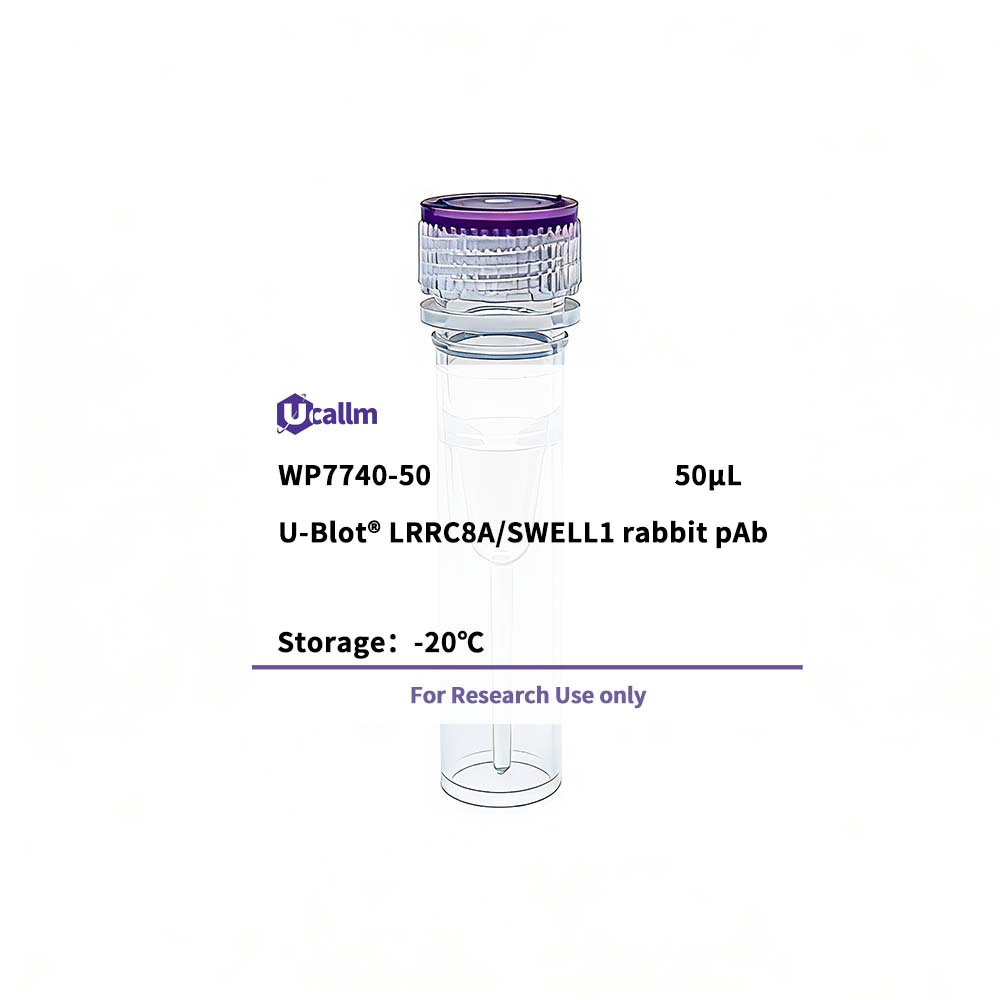
Price range: $268.00 through $328.00
Background:
| Size | 50μL/100μL |
| Target | LRRC8A |
| Reactivity | Human, Mouse, Rat |
| Applications | WB |
| MW(Calculated) | 89kD |
| MW(Observed) | |
| Host Species | Rabbit |
| Isotype | IgG |
| Conjugate/Modification | Unmodified |
| Recommended Dilution Ratio | WB 1:500-2000 |
| Formulation | Liquid in PBS containing 50% glycerol, 0.5% BSA and 0.02% sodium azide. |
| Purification | The antibody was affinity-purified from rabbit antiserum by affinity-chromatography using epitope-specific immunogen. |
| Storage | -15°C to -25°C/1 year(Do not lower than -25°C) |
| Concentration | 1 mg/ml |
| Clonality | Polyclonal |
| Clone Number | |
| Immunogen | Synthesized peptide derived from human LRRC8A/SWELL1 |
| Specificity | This antibody detects endogenous levels of LRRC8A/SWELL1 at Human, Mouse,Rat |
| Gene Name | LRRC8A KIAA1437 LRRC8 UNQ221/PRO247 |
| Protein Name | Leucine-rich repeat-containing protein 8A |
| Other Name | |
| Species | Human |
| Gene ID | 56262 |
| Uniprot | Q8IWT6, |
| Species.1 | Mouse |
| Gene ID.1 | 241296 |
| Uniprot.1 | Q80WG5, |
| Species.2 | Rat |
| Gene ID.2 | 311846 |
| Uniprot.2 | Q4V8I7 |
| Cellular Localization | Cell membrane; Multi-pass membrane protein . Lysosome membrane; Multi-pass membrane protein . Mainly localizes to the cell membrane, with some intracellular localization to lysosomes. . |
| Tissue Expression | Expressed in brain, kidney, ovary, lung, liver, heart, and fetal brain and liver. Found at high levels in bone marrow; lower levels are detected in peripheral blood cells. Expressed on T-cells as well as on B-lineage cells. |
| Signaling_pathway | |
| Research Areas | |
| Function | Essential component of the volume-regulated anion channel (VRAC, also named VSOAC channel), an anion channel required to maintain a constant cell volume in response to extracellular or intracellular osmotic changes . The VRAC channel conducts iodide better than chloride and can also conduct organic osmolytes like taurine . Mediates efflux of amino acids, such as aspartate and glutamate, in response to osmotic stress . LRRC8A and LRRC8D are required for the uptake of the drug cisplatin . In complex with LRRC8C or LRRC8E, acts as a transporter of immunoreactive cyclic dinucleotide GMP-AMP (2'-3'-cGAMP), an immune messenger produced in response to DNA virus in the cytosol: mediates both import and export of 2'-3'-cGAMP, thereby promoting transfer of 2'-3'-cGAMP to bystander cells . In contrast, complexes containing LRRC8D inhibit transport of 2'-3'-cGAMP . Required for in vivo channel activity, together with at least one other family member (LRRC8B, LRRC8C, LRRC8D or LRRC8E); channel characteristics depend on the precise subunit composition . Can form functional channels by itself (in vitro) . Involved in B-cell development: required for the pro-B cell to pre-B cell transition . Also required for T-cell development (By similarity). Required for myoblast differentiation: VRAC activity promotes membrane hyperpolarization and regulates insulin-stimulated glucose metabolism and oxygen consumption (By similarity). Also acts as a regulator of glucose-sensing in pancreatic beta cells: VRAC currents, generated in response to hypotonicity- or glucose-induced beta cell swelling, depolarize cells, thereby causing electrical excitation, leading to increase glucose sensitivity and insulin secretion . Also plays a role in lysosome homeostasis by forming functional lysosomal VRAC channels in response to low cytoplasmic ionic strength condition: lysosomal VRAC channels are necessary for the formation of large lysosome-derived vacuoles, which store and then expel excess water to maintain cytosolic water homeostasis . |





