

Lyn Monoclonal Antibody
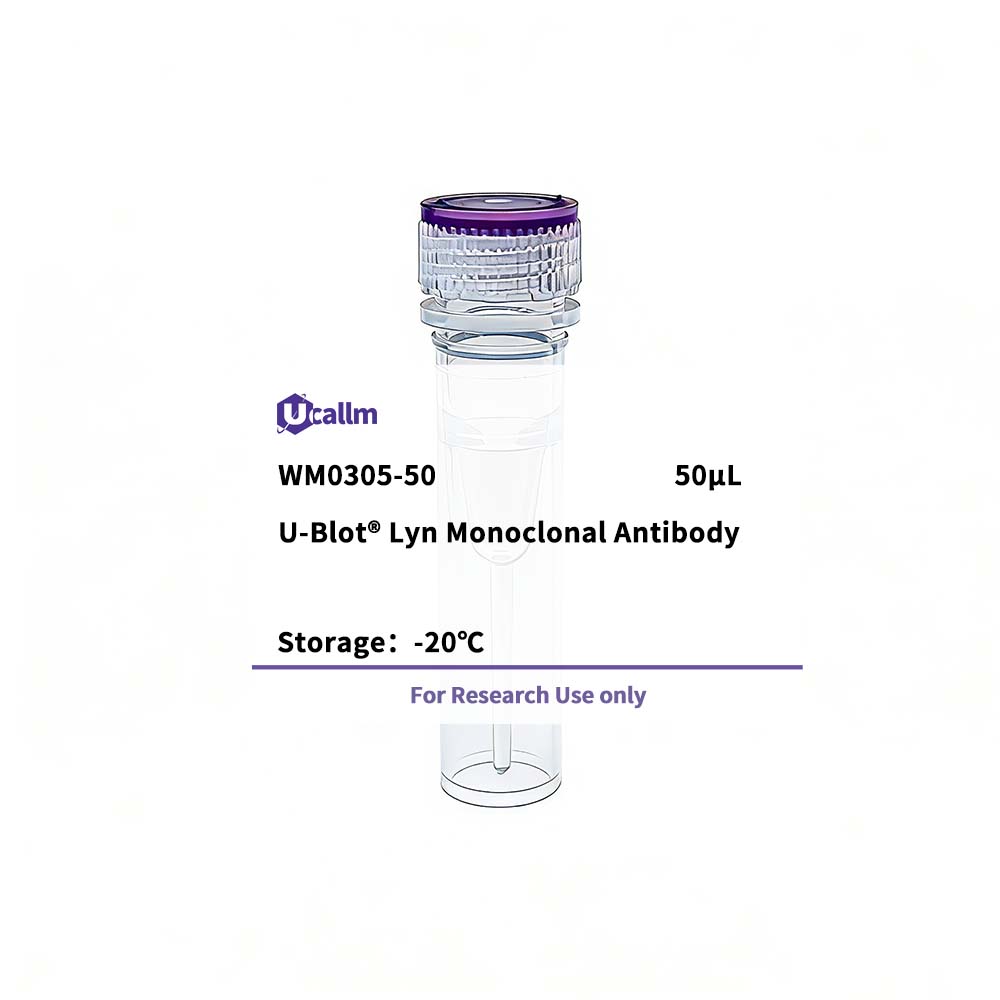
Ucallm_WM0305-50
Price range: $268.00 through $328.00
Product details
Background:
This gene encodes a tyrosine protein kinase, which maybe involved in the regulation of mast cell degranulation, and erythroid differentiation. Alternatively spliced transcript variants encoding different isoforms have been found for this gene. [provided by RefSeq, Jul 2011],
Specifications
| Size | 50μL/100μL |
| Target | Lyn |
| Reactivity | Human |
| Applications | WB, ELISA |
| MW(Calculated) | 59kD |
| MW(Observed) | |
| Host Species | Mouse |
| Isotype | |
| Conjugate/Modification | Unmodified |
| Recommended Dilution Ratio | WB 1:500-1:2000; ELISA 1:10000; Not yet tested in other applications. |
| Formulation | Liquid in PBS containing 50% glycerol, 0.5% BSA and 0.02% sodium azide. |
| Purification | Affinity purification |
| Storage | -15°C to -25°C/1 year(Do not lower than -25°C) |
| Concentration | |
| Clonality | Monoclonal |
| Clone Number | 11B2 |
| Immunogen | Purified recombinant fragment of Lyn expressed in E. Coli. |
| Specificity | Lyn Monoclonal Antibody detects endogenous levels of Lyn protein. |
| Gene Name | LYN |
| Protein Name | Tyrosine-protein kinase Lyn |
| Other Name | LYN; / JTK8; / Tyrosine-protein kinase Lyn; / Lck/Yes-related novel protein tyrosine kinase; / V-yes-1 Yamaguchi sarcoma viral related oncogene homolog; / p53Lyn; / p56Lyn |
| Species | Human |
| Gene ID | 4067 |
| Uniprot | P07948, |
| Species.1 | Mouse |
| Gene ID.1 | |
| Uniprot.1 | P25911 |
| Species.2 | |
| Gene ID.2 | |
| Uniprot.2 | |
| Cellular Localization | Cell membrane. Nucleus. Cytoplasm. Cytoplasm, perinuclear region. Golgi apparatus. Membrane; Lipid-anchor . Accumulates in the nucleus by inhibition of CRM1-mediated nuclear export. Nuclear accumulation is increased by inhibition of its kinase activity. The trafficking from the Golgi apparatus to the plasma membrane occurs in a kinase domain-dependent but kinase activity independent manner and is mediated by exocytic vesicular transport. Detected on plasma membrane lipid rafts. |
| Tissue Expression | Detected in monocytes (at protein level). Detected in placenta, and in fetal brain, lung, liver and kidney. Widely expressed in a variety of organs, tissues, and cell types such as epidermoid, hematopoietic, and neuronal cells. Expressed in primary neuroblastoma tumors. |
| Signaling_pathway | Organismal Systems >> Immune system >> Platelet activation;Organismal Systems >> Immune system >> B cell receptor signaling pathway;Organismal Systems >> Immune system >> Fc epsilon RI signaling pathway;Organismal Systems >> Immune system >> Fc gamma R-mediated phagocytosis;Organismal Systems >> Immune system >> Chemokine signaling pathway;Environmental Information Processing >> Signal transduction >> NF-kappa B signaling pathway |
| Research Areas | >>Chemokine signaling pathway; / >>NF-kappa B signaling pathway; / >>Platelet activation; / >>B cell receptor signaling pathway; / >>Fc epsilon RI signaling pathway; / >>Fc gamma R-mediated phagocytosis; / >>Long-term depression; / >>Epithelial cell signaling in Helicobacter pylori infection; / >>Kaposi sarcoma-associated herpesvirus infection; / >>Epstein-Barr virus infection; / >>Viral carcinogenesis; / >>Lipid and atherosclerosis |
| Function | Catalytic activity:ATP + a [protein]-L-tyrosine = ADP + a [protein]-L-tyrosine phosphate.,similarity:Belongs to the protein kinase superfamily. Tyr protein kinase family.,similarity:Belongs to the protein kinase superfamily. Tyr protein kinase family. SRC subfamily.,similarity:Contains 1 protein kinase domain.,similarity:Contains 1 SH2 domain.,similarity:Contains 1 SH3 domain.,subunit:Interacts with phosphorylated LIME1 and with CD79A upon BCR activation. Interacts with Epstein-Barr virus LMP2A. Interacts with TGFB1I1. Interaction, via the SH2 and SH3, domains with MUC1 is stimulated by IL7 and, the subsequent phosphorylation increases the binding between MUC1 and CTNNB1/beta-catenin. Interacts with PPP1R15A via the SH3 domain.,tissue specificity:Expressed in primary neuroblastoma tumors., |
Please login to post questions
Related products





