

Product details
Background:Predicted to enable laminin binding activity. Involved in negative regulation of smooth muscle cell apoptotic process. Located in extracellular space. [provided by Alliance of Genome Resources, Feb 2025]
Price range: $268.00 through $328.00
Background:Predicted to enable laminin binding activity. Involved in negative regulation of smooth muscle cell apoptotic process. Located in extracellular space. [provided by Alliance of Genome Resources, Feb 2025]
| Size | 50μL/100μL |
| Target | LYPD3 |
| Reactivity | Human |
| Applications | WB, IHC, IP |
| MW(Calculated) | |
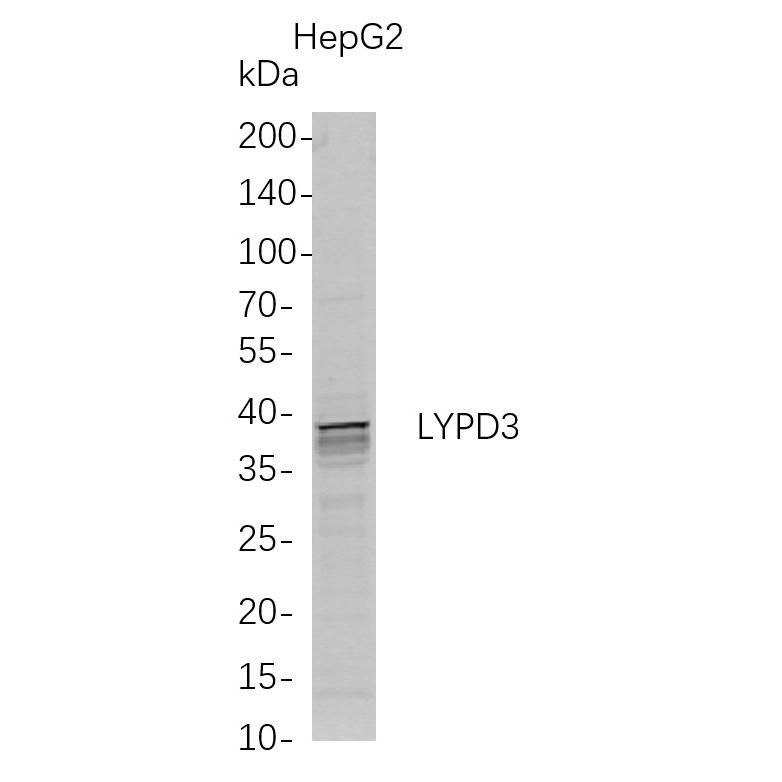
| MW(Observed) | 38kD |
| Host Species | Rabbit |
| Isotype | IgG,Kappa |
| Conjugate/Modification | Unmodified |
| Recommended Dilution Ratio | WB 1:1000-5000; IHC 1:100-300; IP 1:50-100 / Note: For IHC, we suggest antigen retrieval with TE buffer pH 9.0 (Cat#WT1004) |
| Formulation | PBS, 50% glycerol, 0.05% Proclin 300, 0.05%BSA |
| Purification | Recombinant Antibody expressed in animal component-free (ACF) media, purified via Protein A affinity chromatography. |
| Storage | -15°C to -25°C/1 year(Do not lower than -25°C) |
| Concentration | |
| Clonality | Monoclonal |
| Clone Number | RM0801R |
| Immunogen | The specific immunogen used to produce this antibody is proprietary information. |
| Specificity | Endogenous |
| Gene Name | LYPD3; C4.4A; UNQ491/PRO1007 |
| Protein Name | Ly6/PLAUR domain-containing protein 3; GPI-anchored metastasis-associated protein C4.4A homolog; Matrigel-induced gene C4 protein; MIG-C4 |
| Other Name | LYPD3; / C4.4A; / UNQ491/PRO1007; / Ly6/PLAUR domain-containing protein 3; / GPI-anchored metastasis-associated protein C4.4A homolog; / Matrigel-induced gene C4 protein; / MIG-C4 |
| Species | Human |
| Gene ID | 27076 |
| Uniprot | O95274 |
| Species.1 | |
| Gene ID.1 | |
| Uniprot.1 | |
| Species.2 | |
| Gene ID.2 | |
| Uniprot.2 | |
| Cellular Localization | Cell membrane; Lipid-anchor, GPI-anchor. |
| Tissue Expression | Expressed in placenta, skin and urothelium. Found in suprabasal keratinocytes of chronic wounds. Weak expression is found in esophagus and peripheral blood mononuclear cells. Found in the majority of primary and metastatic transitional cell carcinomas (TCCs) and as well in breast cancer tissues, but not in adjacent normal tissues. High expression is found in the tumor component of some noninvasive superficial lesions and in invasive and metastatic urothelial cancers. {ECO:0000269|PubMed:11179665, ECO:0000269|PubMed:12592373, ECO:0000269|PubMed:15012588}. |
| Signaling_pathway | |
| Research Areas | |
| Function | Supports cell migration. May be involved in urothelial cell-matrix interactions. May be involved in tumor progression. {ECO:0000269|PubMed:11179665, ECO:0000269|PubMed:11245483, ECO:0000269|PubMed:12592373, ECO:0000269|PubMed:15012588}. |


