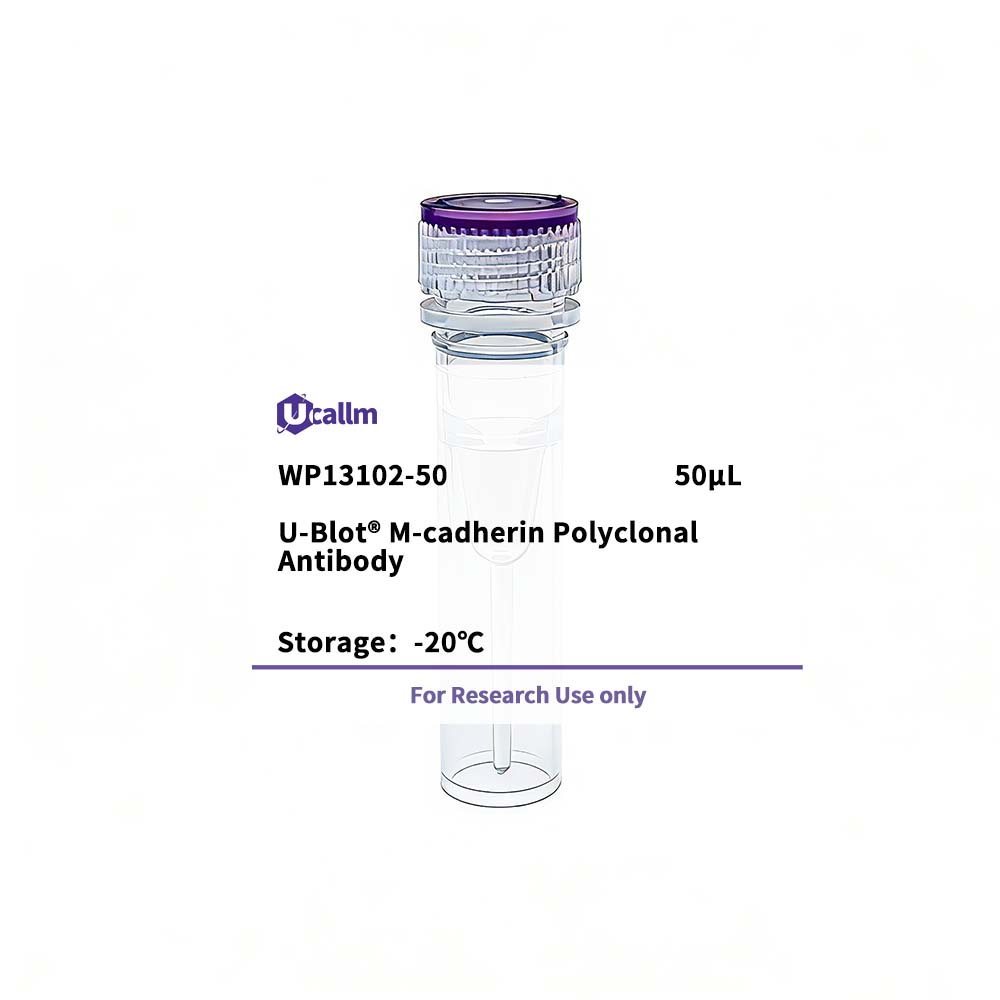
SKU: WP13102 Categories: ,

M-cadherin Polyclonal Antibody

Price range: $268.00 through $328.00

SKU: WP13102-100
Enter the quantity you would like, or drag the panel to find the quantity and price that best for you
Bulk QuoteAuthorize OEM & ODM

Product details

Background:

This gene is a member of the cadherin superfamily of genes, encoding calcium-dependent intercellular adhesion glycoproteins. Cadherins consist of an extracellular domain containing 5 cadherin domains, a transmembrane region, and a conserved cytoplasmic domain. Transcripts from this particular cadherin are expressed in myoblasts and upregulated in myotubule-forming cells. The protein is thought to be essential for the control of morphogenetic processes, specifically myogenesis, and may provide a trigger for terminal muscle cell differentiation. [provided by RefSeq, Jul 2008],


Specifications

Size50μL/100μL
TargetM-cadherin
ReactivityHuman, Mouse, Rat
ApplicationsWB, IHC, IF, ELISA
MW(Calculated)
MW(Observed)89kD
Host SpeciesRabbit
IsotypeIgG
Conjugate/ModificationUnmodified
Recommended Dilution RatioWB 1:500-1:2000; IHC 1:100-1:300; ELISA 1:10000; IF 1:50-200 / Note: For IHC, we suggest antigen retrieval with TE buffer pH 9.0 (Cat#WT1004)
FormulationLiquid in PBS containing 50% glycerol, 0.5% BSA and 0.02% sodium azide.
PurificationThe antibody was affinity-purified from rabbit antiserum by affinity-chromatography using epitope-specific immunogen.
Storage-15°C to -25°C/1 year(Do not lower than -25°C)
Concentration1 mg/ml
ClonalityPolyclonal
Clone Number
ImmunogenThe antiserum was produced against synthesized peptide derived from human CDH15. AA range:81-130
SpecificityM-cadherin Polyclonal Antibody detects endogenous levels of M-cadherin protein.
Gene NameCDH15
Protein NameCadherin-15
Other NameCDH15; / CDH14; / CDH3; / Cadherin-15; / Cadherin-14; / Muscle cadherin; / M-cadherin
SpeciesHuman
Gene ID1013
UniprotP55291,
Species.1Mouse
Gene ID.112555
Uniprot.1P33146
Species.2
Gene ID.2
Uniprot.2
Cellular LocalizationCell membrane; Single-pass type I membrane protein.
Tissue ExpressionExpressed in the brain and cerebellum.
Signaling_pathwayEnvironmental Information Processing >> Signaling molecules and interaction >> Cell adhesion molecules
Research Areas>>Cell adhesion molecules
FunctionDisease:A chromosomal aberration involving CDH15 and KIRREL3 is found in a patient with severe mental retardation and dysmorphic facial features. Translocation t(11; 16)(q24.2; q24).,Disease:Defects in CDH15 are the cause of mental retardation autosomal dominant type 3 (MRD3) [MIM:612580]. Mental retardation is characterized by significantly sub-average general intellectual functioning associated with impairments in adaptative behavior and manifested during the developmental period.,Function:Cadherins are calcium dependent cell adhesion proteins. They preferentially interact with themselves in a homophilic manner in connecting cells; cadherins may thus contribute to the sorting of heterogeneous cell types. M-cadherin is part of the myogenic program and may provide a trigger for terminal muscle differentiation.,similarity:Contains 5 cadherin domains.,tissue specificity:Expressed in the brain and cerebellum.,
Please login to post questions
Back to Top
Product has been added to your cart

