


MAGE-C1 [ABT339] mouse mAb
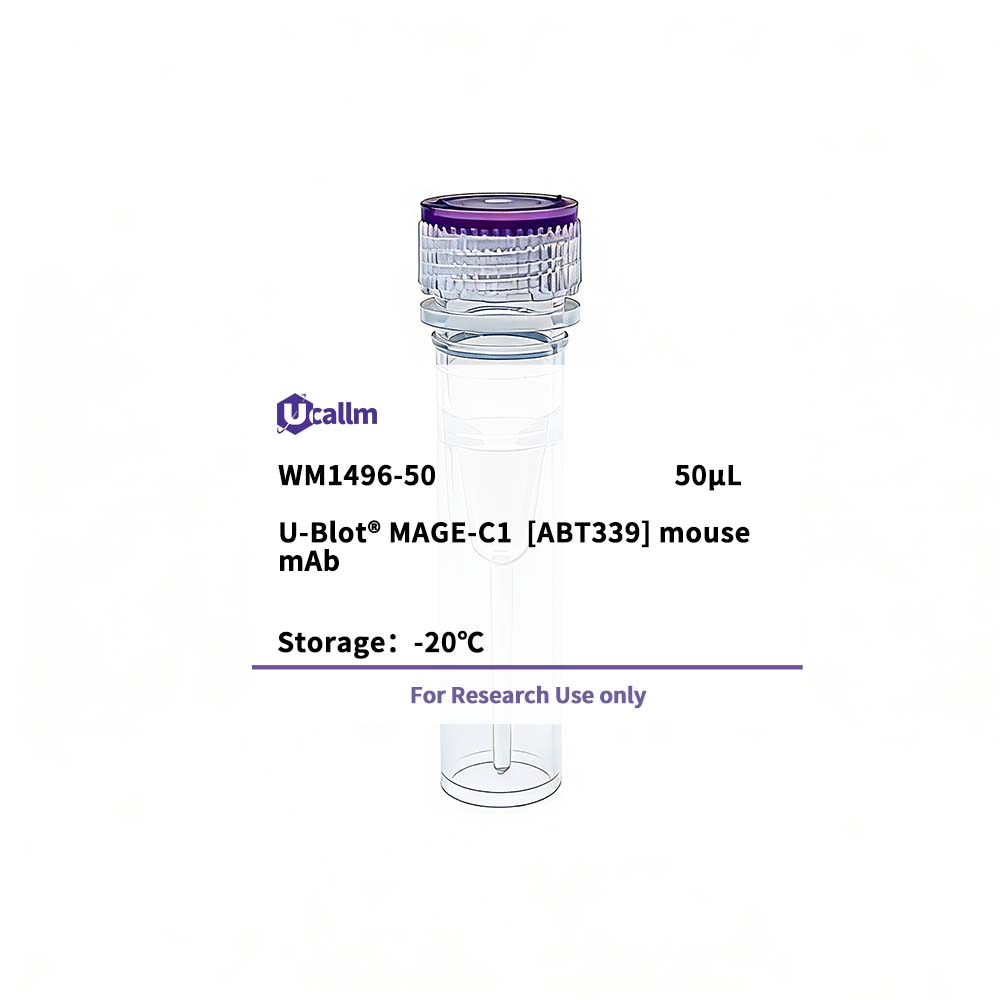
Ucallm_WM1496-50
Price range: $268.00 through $328.00
Product details
Background:
MAGE-C1 is a member of melanoma antigen gene family. The proteins of this family are tumor specific antigens and can be recognized by cytotoxic T lymphocytes.
Specifications
| Size | 50μL/100μL |
| Target | MAGE-C1 |
| Reactivity | Human |
| Applications | IHC, WB, IF, ELISA |
| MW(Calculated) | 124kD |
| MW(Observed) | 180kD |
| Host Species | Mouse |
| Isotype | IgG1,Kappa |
| Conjugate/Modification | Unmodified |
| Recommended Dilution Ratio | IHC 1:200-1000; WB 1:500-2000; IF 1:100-500; ELISA 1:1000-5000 / Note: For IHC, we suggest antigen retrieval with TE buffer pH 9.0 (Cat#WT1004) |
| Formulation | PBS, 50% glycerol, 0.05% Proclin 300, 0.05%BSA |
| Purification | Recombinant Antibody expressed in animal component-free (ACF) media, purified via Protein G affinity chromatography. |
| Storage | -15°C to -25°C/1 year(Do not lower than -25°C) |
| Concentration | |
| Clonality | Monoclonal |
| Clone Number | RMM339 |
| Immunogen | Synthesized peptide derived from human MAGE-C1 AA range: 700-800 |
| Specificity | The antibody can specifically recognize human MAGE-C1 protein. In western blotting of K562 cell lysate, the antibody can label a 190 kDa band corresponding to MAGE-C1. |
| Gene Name | MAGEC1 |
| Protein Name | MAGE-C1 |
| Other Name | Cancer/testis antigen 7.1; / Cancer/testis antigen family 7 member 1; / CT7; / CT7.1; / MAGC1_HUMAN; / MAGE C1; / MAGE C1 antigen; / MAGE-C1 antigen; / MAGEC1; / melanoma antigen family C, 1; / Melanoma associated antigen C1; / Melanoma-associated antigen C1; / MGC39366 |
| Species | Human |
| Gene ID | 9947 |
| Uniprot | O60732 |
| Species.1 | |
| Gene ID.1 | |
| Uniprot.1 | |
| Species.2 | |
| Gene ID.2 | |
| Uniprot.2 | |
| Cellular Localization | Cytoplasmic |
| Tissue Expression | Expressed in testis and in tumors of a wide variety of histologic types. |
| Signaling_pathway | |
| Research Areas | |
| Function | similarity:Contains 1 MAGE domain.,tissue specificity:Expressed in testis and in tumors of a wide variety of histologic types., |
Please login to post questions
Related products





