


MAVS Polyclonal Antibody
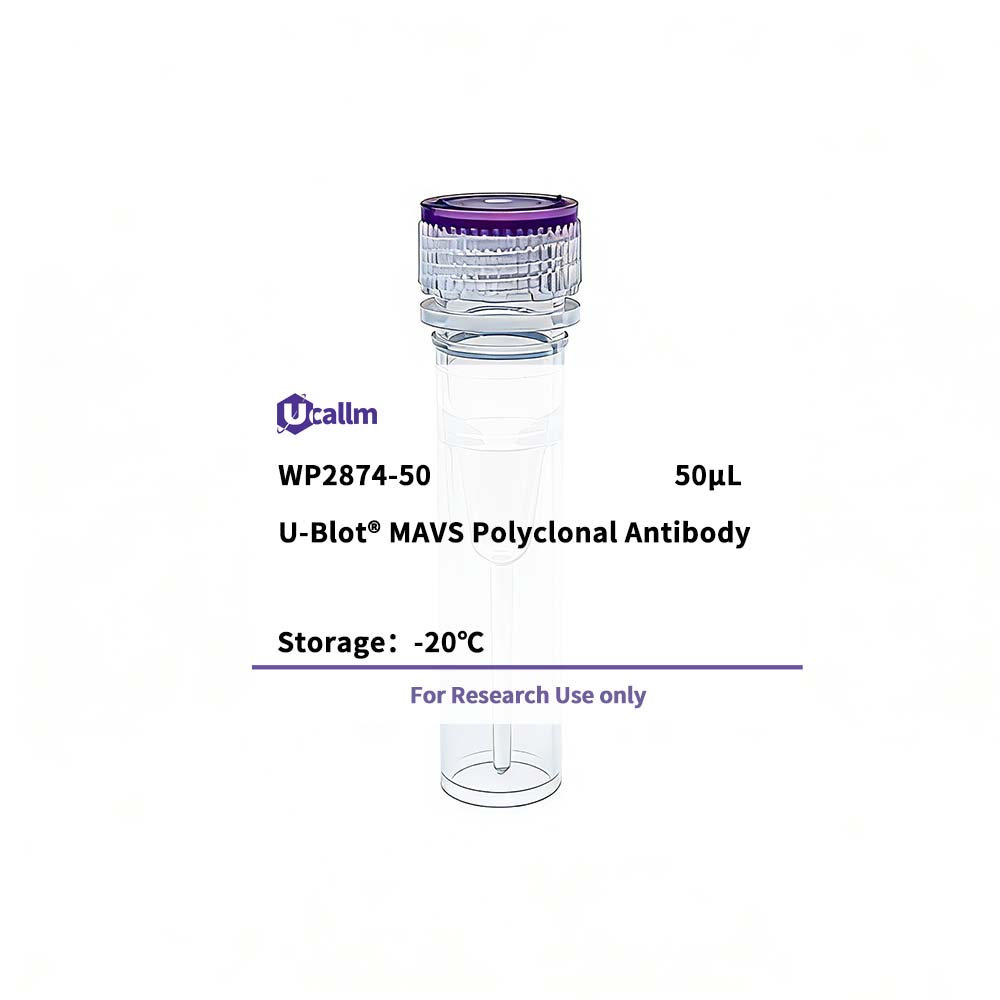
Ucallm_WP2874-50
Price range: $268.00 through $328.00
Product details
Background:
mitochondrial antiviral signaling protein(MAVS) Homo sapiens This gene encodes an intermediary protein necessary in the virus-triggered beta interferon signaling pathways. It is required for activation of transcription factors which regulate expression of beta interferon and contributes to antiviral immunity. Multiple transcript variants encoding different isoforms have been found for this gene. [provided by RefSeq, Sep 2011],
Specifications
| Size | 50μL/100μL |
| Target | MAVS |
| Reactivity | Human, Mouse, Rat |
| Applications | WB, ELISA |
| MW(Calculated) | |
| MW(Observed) | 59kD |
| Host Species | Rabbit |
| Isotype | IgG |
| Conjugate/Modification | Unmodified |
| Recommended Dilution Ratio | WB 1:500-2000; ELISA 1:5000-20000 |
| Formulation | Liquid in PBS containing 50% glycerol,0.5% BSA and 0.02% sodium azide. |
| Purification | The antibody was affinity-purified from rabbit antiserum by affinity-chromatography using epitope-specific immunogen. |
| Storage | -15°C to -25°C/1 year(Do not lower than -25°C) |
| Concentration | 1 mg/ml |
| Clonality | Polyclonal |
| Clone Number | |
| Immunogen | Synthesized peptide derived from human protein . at AA range: 461-510 |
| Specificity | MAVS Polyclonal Antibody detects endogenous levels of protein. |
| Gene Name | MAVS IPS1 KIAA1271 VISA |
| Protein Name | Mitochondrial antiviral-signaling protein (MAVS) (CARD adapter inducing interferon beta) (Cardif) (Interferon beta promoter stimulator protein 1) (IPS-1) (Putative NF-kappa-B-activating protein 031N) (Virus-induced-signaling adapter) (VISA) |
| Other Name | |
| Species | Human |
| Gene ID | 57506 |
| Uniprot | Q7Z434, |
| Species.1 | Mouse |
| Gene ID.1 | |
| Uniprot.1 | Q8VCF0, |
| Species.2 | Rat |
| Gene ID.2 | |
| Uniprot.2 | Q66HG9 |
| Cellular Localization | Mitochondrion outer membrane . Mitochondrion . Peroxisome . |
| Tissue Expression | Present in T-cells, monocytes, epithelial cells and hepatocytes (at protein level). Ubiquitously expressed, with highest levels in heart, skeletal muscle, liver, placenta and peripheral blood leukocytes. |
| Signaling_pathway | Organismal Systems >> Immune system >> NOD-like receptor signaling pathway;Organismal Systems >> Immune system >> RIG-I-like receptor signaling pathway;Organismal Systems >> Immune system >> Cytosolic DNA-sensing pathway |
| Research Areas | >>NOD-like receptor signaling pathway; / >>RIG-I-like receptor signaling pathway; / >>Cytosolic DNA-sensing pathway; / >>Hepatitis C; / >>Hepatitis B; / >>Measles; / >>Influenza A; / >>Herpes simplex virus 1 infection; / >>Epstein-Barr virus infection; / >>Coronavirus disease - COVID-19 |
| Function | Domain:Both CARD and transmembrane domains are essential for antiviral function. The CARD domain is responsible for interaction with DDX58 and IFIH1.,Function:Required for innate immune defense against viruses. Acts downstream of DDX58 and IFIH1/MDA5, which detect intracellular dsRNA produced during viral replication, to coordinate pathways leading to the activation of NF-kappa-B, IRF3 and IRF7, and to the subsequent induction of antiviral cytokines such as IFN-beta and RANTES (CCL5). May activate the same pathways following detection of extracellular dsRNA by TLR3. May protect cells from apoptosis.,miscellaneous:Cleavage by HCV protease complex leads to inactivation.,similarity:Contains 1 CARD domain.,subunit:Interacts with DDX58, IFIH1, TRAF2 and TRAF6. May interact with IRF3, FADD, RIPK1, IKBKE, CHUK and IKBKB. Does not interact with TBK1. Interacts with and is cleaved by HCV and hepatitis GB virus B NS3/4A proteases. Interacts with and is cleaved by HHAV protein 3ABC. Interacts with NLRX1. Interaction with NLRX1 requires the CARD domain.,tissue specificity:Present in T-cells, monocytes, epithelial cells and hepatocytes (at protein level). Ubiquitously expressed, with highest levels in heart, skeletal muscle, liver, placenta and peripheral blood leukocytes., |
Please login to post questions
Related products




