


MDFIC Polyclonal Antibody
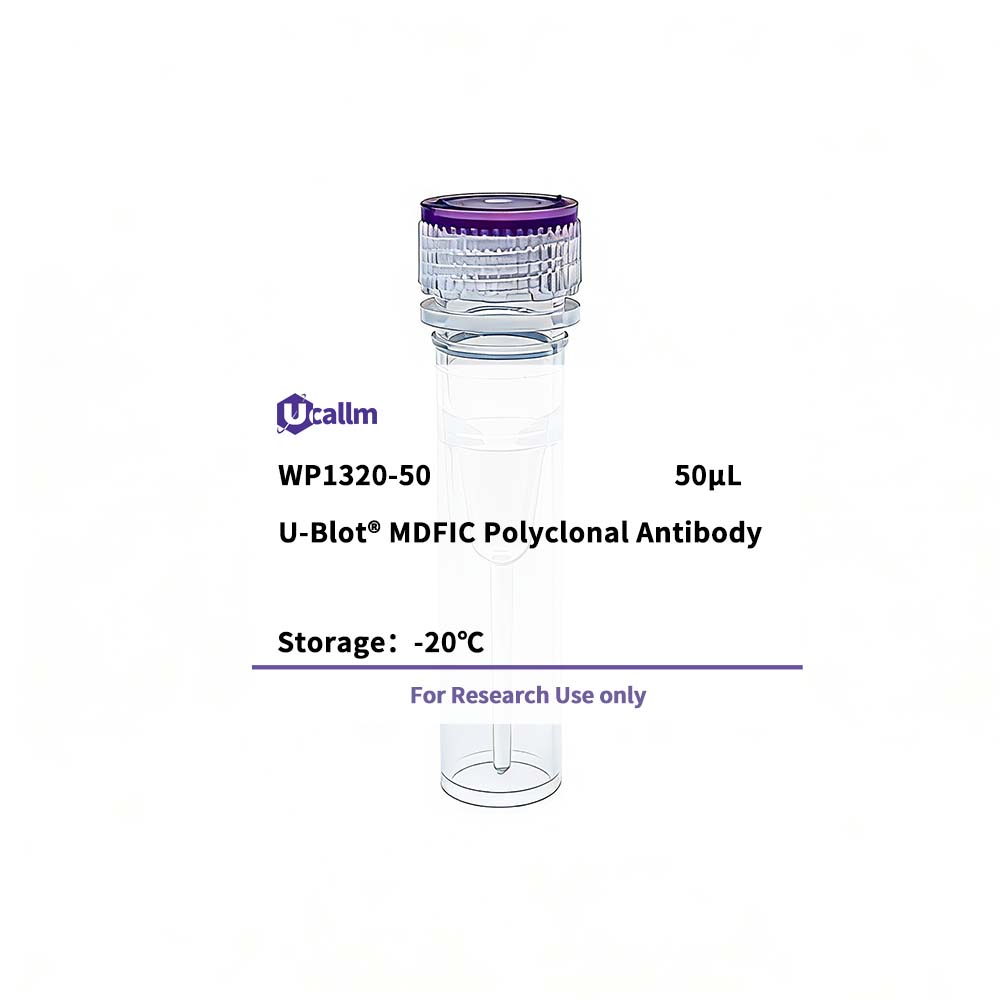
Ucallm_WP1320-50
Price range: $268.00 through $328.00
Product details
Background:
This gene product is a member of a family of proteins characterized by a specific cysteine-rich C-terminal domain, which is involved in transcriptional regulation of viral genome expression. Alternative translation initiation from an upstream non-AUG (GUG), and an in-frame, downstream AUG codon, results in the production of two isoforms, p40 and p32, respectively, which have different subcellular localization; p32 is mainly found in the cytoplasm, whereas p40 is targeted to the nucleolus. Both isoforms have transcriptional regulatory activity that is attributable to the cysteine-rich C-terminal domain. Alternative splicing results in multiple transcript variants. [provided by RefSeq, Oct 2009],
Specifications
| Size | 50μL/100μL |
| Target | MDFIC |
| Reactivity | Human, Mouse |
| Applications | WB, ELISA |
| MW(Calculated) | |
| MW(Observed) | 27kD |
| Host Species | Rabbit |
| Isotype | IgG |
| Conjugate/Modification | Unmodified |
| Recommended Dilution Ratio | WB 1:500-2000; ELISA 1:5000-20000 |
| Formulation | Liquid in PBS containing 50% glycerol,0.5% BSA and 0.02% sodium azide. |
| Purification | The antibody was affinity-purified from rabbit antiserum by affinity-chromatography using epitope-specific immunogen. |
| Storage | -15°C to -25°C/1 year(Do not lower than -25°C) |
| Concentration | 1 mg/ml |
| Clonality | Polyclonal |
| Clone Number | |
| Immunogen | Synthesized peptide derived from human protein . at AA range: 100-180 |
| Specificity | MDFIC Polyclonal Antibody detects endogenous levels of protein. |
| Gene Name | MDFIC |
| Protein Name | MyoD family inhibitor domain-containing protein (I-mfa domain-containing protein) (hIC) |
| Other Name | |
| Species | Human |
| Gene ID | 29969 |
| Uniprot | Q9P1T7, |
| Species.1 | Mouse |
| Gene ID.1 | |
| Uniprot.1 | Q8BX65 |
| Species.2 | |
| Gene ID.2 | |
| Uniprot.2 | |
| Cellular Localization | [Isoform 1]: Nucleus, nucleolus. Also shows a granular distribution in the cytoplasm.; [Isoform 2]: Cytoplasm . Weak expression in the nucleus. |
| Tissue Expression | Expressed in lymphoid organs (spleen, thymus, peripheral blood leukocytes) as well as prostate, uterus and small intestine. |
| Signaling_pathway | |
| Research Areas | |
| Function | Domain:The cysteine-rich C-terminus is involved in its granular distribution in the cytoplasm.,Function:Modulates the expression from both cellular and viral promoters. Down-regulates Tat-dependent transcription of the human immunodeficiency virus type 1 (HIV-1) LTR by interacting with HIV-1 Tat and Rev and impairing their nuclear import, probably by rendering the NLS domains inaccessible to importin-beta. Also stimulates activation of human T-cell leukemia virus type I (HTLV-I) LTR. Binds to the axin complex, resulting in an increase in the level of free beta-catenin. Affects axin regulation of the WNT and JNK signaling pathways.,similarity:Belongs to the MDFI family.,subcellular location:Isoform 1 localizes to the nucleolus and also shows a granular distribution in the cytoplasm. Isoform 2 is predominantly distributed throughout the cytoplasm, with only weak expression in the nucleus.,subunit:The C-terminus interacts with HIV-1 Tat and Rev, AXIN1, the histidine-rich region of CCNT1/CYCLIN T and weakly with LEF1.,tissue specificity:Expressed in lymphoid organs (spleen, thymus, peripheral blood leukocytes) as well as prostate, uterus and small intestine., |
Please login to post questions
Related products



