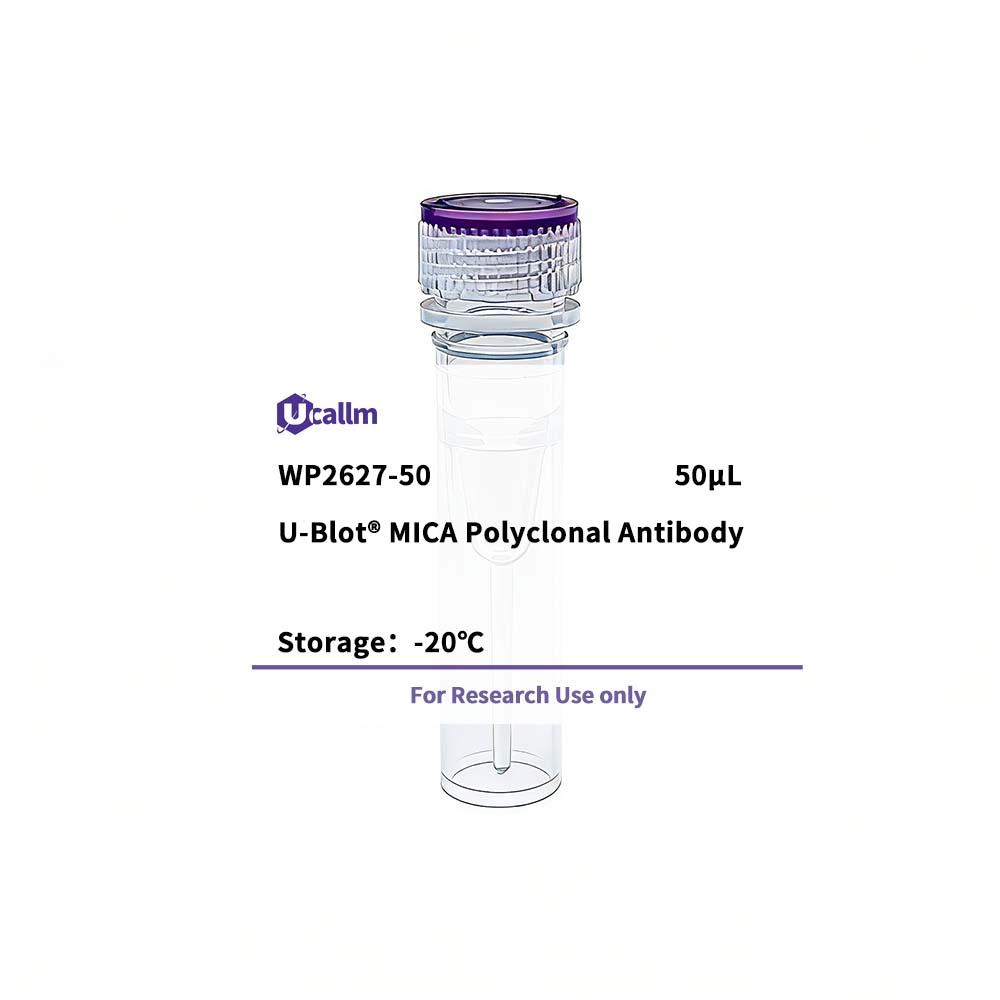
SKU: WP2627 Categories: ,

MICA Polyclonal Antibody

Price range: $268.00 through $328.00

SKU: WP2627-100
Enter the quantity you would like, or drag the panel to find the quantity and price that best for you
Bulk QuoteAuthorize OEM & ODM

Product details

Background:

This gene encodes the highly polymorphic major histocompatability complex class I chain-related protein A. The protein product is expressed on the cell surface, although unlike canonical class I molecules it does not seem to associate with beta-2-microglobulin. It is a ligand for the NKG2-D type II integral membrane protein receptor. The protein functions as a stress-induced antigen that is broadly recognized by intestinal epithelial gamma delta T cells. Variations in this gene have been associated with susceptibility to psoriasis 1 and psoriatic arthritis, and the shedding of MICA-related antibodies and ligands is involved in the progression from monoclonal gammopathy of undetermined significance to multiple myeloma. Alternative splicing of this gene results in multiple transcript variants. [provided by RefSeq, Jan 2014],

Specifications

Size50μL/100μL
TargetMICA
ReactivityHuman
ApplicationsWB, ELISA
MW(Calculated)
MW(Observed)42kD
Host SpeciesRabbit
IsotypeIgG
Conjugate/ModificationUnmodified
Recommended Dilution RatioWB 1:500-2000; ELISA 1:5000-20000
FormulationLiquid in PBS containing 50% glycerol,0.5% BSA and 0.02% sodium azide.
PurificationThe antibody was affinity-purified from rabbit antiserum by affinity-chromatography using epitope-specific immunogen.
Storage-15°C to -25°C/1 year(Do not lower than -25°C)
Concentration1 mg/ml
ClonalityPolyclonal
Clone Number
ImmunogenSynthesized peptide derived from human protein . at AA range: 30-110
SpecificityMICA Polyclonal Antibody detects endogenous levels of protein.
Gene NameMICA PERB11.1
Protein NameMHC class I polypeptide-related sequence A (MIC-A)
Other Name
SpeciesHuman
Gene ID100507436
UniprotQ29983
Species.1
Gene ID.1
Uniprot.1
Species.2
Gene ID.2
Uniprot.2
Cellular LocalizationCell membrane; Single-pass type I membrane protein . Cytoplasm . Expressed on the cell surface in gastric epithelium, endothelial cells and fibroblasts and in the cytoplasm in keratinocytes and monocytes. Infection with human adenovirus 5 suppresses cell surface expression due to the adenoviral E3-19K protein which causes retention in the endoplasmic reticulum. .
Tissue ExpressionWidely expressed with the exception of the central nervous system where it is absent. Expressed predominantly in gastric epithelium and also in monocytes, keratinocytes, endothelial cells, fibroblasts and in the outer layer of Hassal's corpuscles within the medulla of normal thymus. In skin, expressed mainly in the keratin layers, basal cells, ducts and follicles. Also expressed in many, but not all, epithelial tumors of lung, breast, kidney, ovary, prostate and colon. In thyomas, overexpressed in cortical and medullar epithelial cells. Tumors expressing MICA display increased levels of gamma delta T-cells.
Signaling_pathwayOrganismal Systems >> Immune system >> Natural killer cell mediated cytotoxicity
Research Areas>>Natural killer cell mediated cytotoxicity; / >>Kaposi sarcoma-associated herpesvirus infection
Functioncell activation, activation of innate immune response, innate immune response activating cell surface receptor signaling pathway, stimulatory C-type lectin receptor signaling pathway, immune effector process, activation of immune response, response to tumor cell, immune response to tumor cell, immune response-activating cell surface receptor signaling pathway, antigen processing and presentation of peptide antigen via MHC class I, positive regulation of immune system process, immune response-activating signal transduction, innate immune response-activating signal transduction, immune response-regulating signal transduction, immune response-regulating cell surface receptor signaling pathway, defense response, immune response, response to DNA damage stimulus, cell surface receptor linked signal transduction, cell death, response to temperature stimulus, response to heat, response to virus, response to bacterium, response to abiotic stimulus, death, cytolysis, antigen processing and presentation,positive regulation of defense response, cellular response to stress, T cell activation, defense response to bacterium,regulation of innate immune response, positive regulation of innate immune response, leukocyte activation, gamma-delta T cell activation, lymphocyte activation, antigen processing and presentation of peptide antigen, positive regulation of response to stimulus, positive regulation of immune response, defense response to virus,
Please login to post questions
Back to Top
Product has been added to your cart

