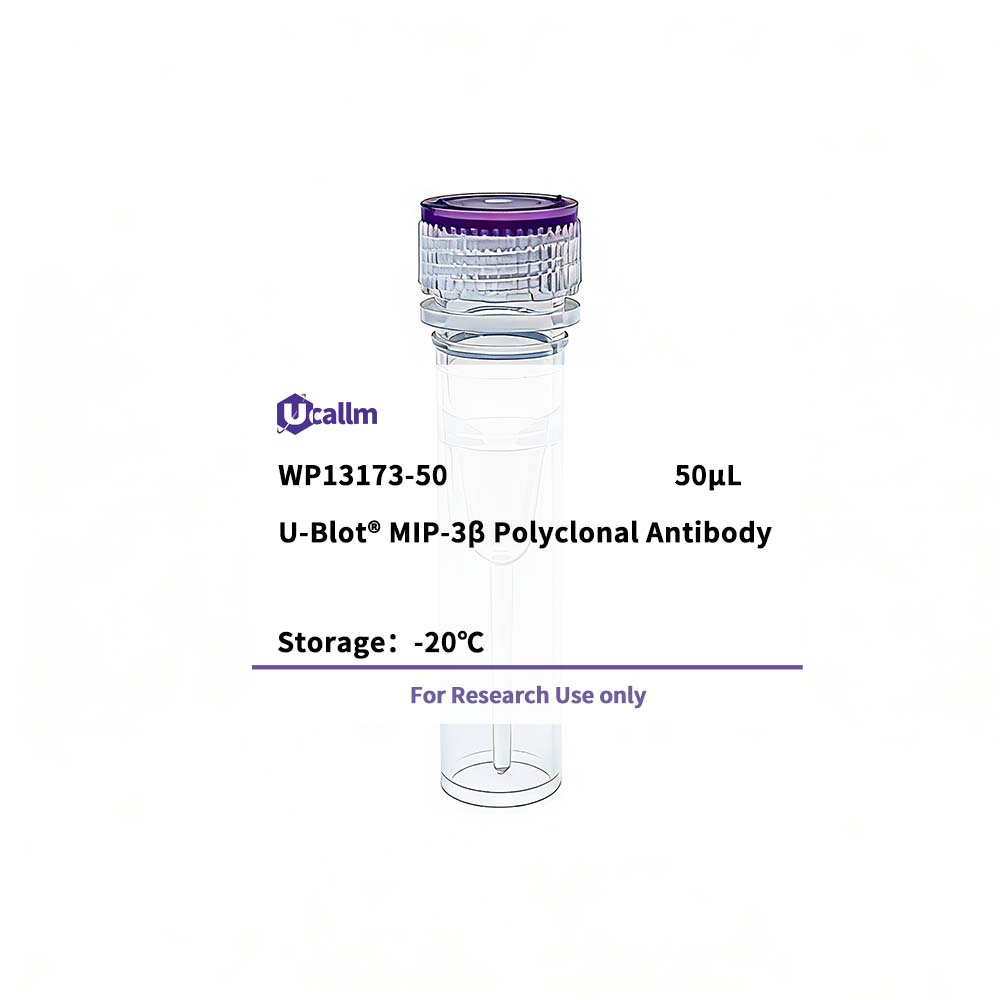
SKU: WP13173 Categories: ,

MIP-3β Polyclonal Antibody

Price range: $268.00 through $328.00

SKU: WP13173-100
Enter the quantity you would like, or drag the panel to find the quantity and price that best for you
Bulk QuoteAuthorize OEM & ODM

Product details

Background:

This antimicrobial gene is one of several CC cytokine genes clustered on the p-arm of chromosome 9. Cytokines are a family of secreted proteins involved in immunoregulatory and inflammatory processes. The CC cytokines are proteins characterized by two adjacent cysteines. The cytokine encoded by this gene may play a role in normal lymphocyte recirculation and homing. It also plays an important role in trafficking of T cells in thymus, and in T cell and B cell migration to secondary lymphoid organs. It specifically binds to chemokine receptor CCR7. [provided by RefSeq, Sep 2014],


Specifications

Size50μL/100μL
TargetMIP-3β
ReactivityHuman, Mouse
ApplicationsIHC, IF, ELISA
MW(Calculated)11kD
MW(Observed)
Host SpeciesRabbit
IsotypeIgG
Conjugate/ModificationUnmodified
Recommended Dilution RatioIHC 1:100-1:300; ELISA 1:40000; IF 1:50-200 / Note: For IHC, we suggest antigen retrieval with TE buffer pH 9.0 (Cat#WT1004)
FormulationLiquid in PBS containing 50% glycerol, 0.5% BSA and 0.02% sodium azide.
PurificationThe antibody was affinity-purified from rabbit antiserum by affinity-chromatography using epitope-specific immunogen.
Storage-15°C to -25°C/1 year(Do not lower than -25°C)
Concentration1 mg/ml
ClonalityPolyclonal
Clone Number
ImmunogenSynthesized peptide derived from MIP-3β . at AA range: 20-100
SpecificityMIP-3β Polyclonal Antibody detects endogenous levels of MIP-3β protein.
Gene NameCCL19
Protein NameC-C motif chemokine 19
Other NameCCL19; / ELC; / MIP3B; / SCYA19; / C-C motif chemokine 19; / Beta-chemokine exodus-3; / CK beta-11; / Epstein-Barr virus-induced molecule 1 ligand chemokine; / EBI1 ligand chemokine; / ELC; / Macrophage inflammatory protein 3 beta; / MIP-3-beta; / Small-inducible
SpeciesHuman
Gene ID6363
UniprotQ99731,
Species.1Mouse
Gene ID.1
Uniprot.1O70460
Species.2
Gene ID.2
Uniprot.2
Cellular LocalizationSecreted.
Tissue ExpressionExpressed at high levels in the lymph nodes, thymus and appendix. Intermediate levels seen in colon and trachea, while low levels found in spleen, small intestine, lung, kidney and stomach.
Signaling_pathwayOrganismal Systems >> Immune system >> Chemokine signaling pathway;Environmental Information Processing >> Signal transduction >> NF-kappa B signaling pathway;Environmental Information Processing >> Signaling molecules and interaction >> Cytokine-cytokine receptor interaction;Environmental Information Processing >> Signaling molecules and interaction >> Viral protein interaction with cytokine and cytokine receptor
Research Areas>>Cytokine-cytokine receptor interaction; / >>Viral protein interaction with cytokine and cytokine receptor; / >>Chemokine signaling pathway; / >>NF-kappa B signaling pathway
FunctionFunction:May play a role not only in inflammatory and immunological responses but also in normal lymphocyte recirculation and homing. May play an important role in trafficking of T-cells in thymus, and T-cell and B-cell migration to secondary lymphoid organs. Specifically binds to chemokine receptor CCR7. Recombinant SCYA19 shows potent chemotactic activity for T-cells and B-cells but not for granulocytes and monocytes.,online information:CCL19 entry,similarity:Belongs to the intercrine beta (chemokine CC) family.,tissue specificity:Expressed at high levels in the lymph nodes, thymus and appendix. Intermediate levels seen in colon and trachea, while low levels found in spleen, small intestine, lung, kidney and stomach.,
Please login to post questions
Back to Top
Product has been added to your cart
