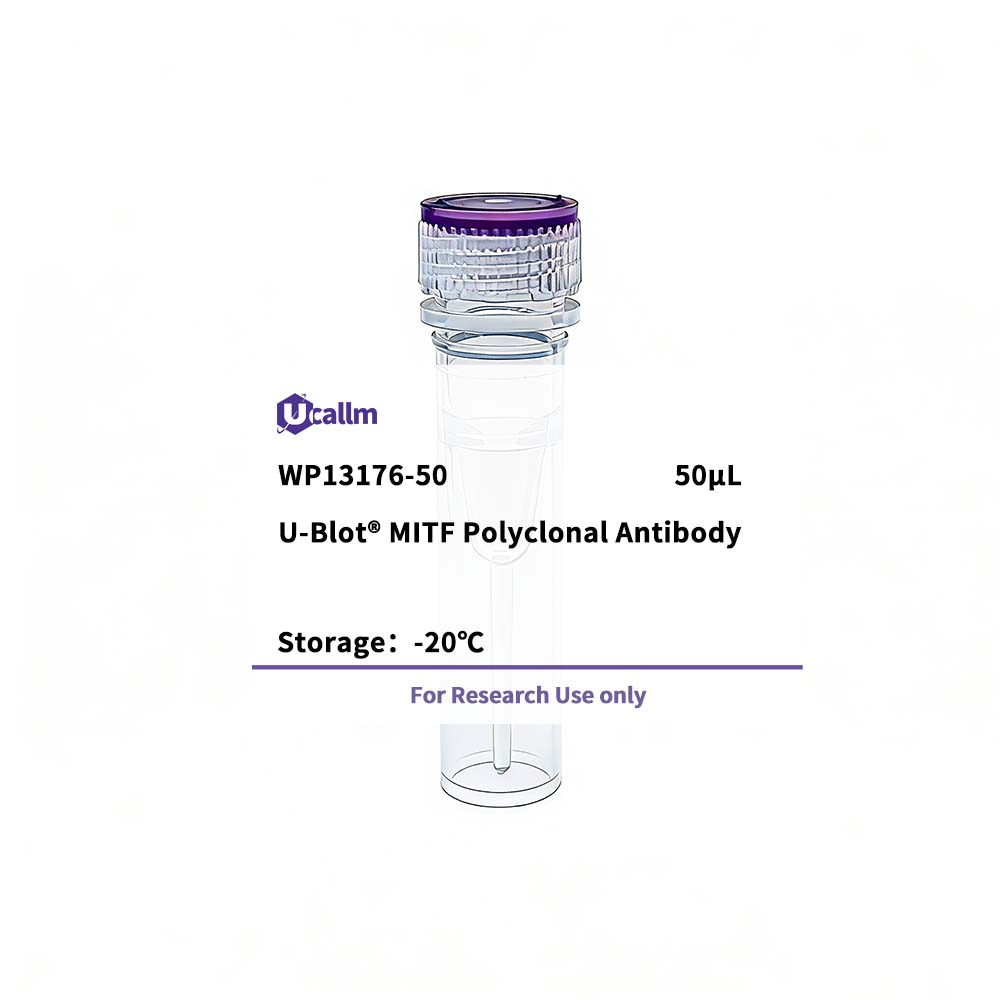
SKU: WP13176 Categories: ,

MITF Polyclonal Antibody

Price range: $268.00 through $328.00

SKU: WP13176-100
Enter the quantity you would like, or drag the panel to find the quantity and price that best for you
Bulk QuoteAuthorize OEM & ODM

Product details

Background:

This gene encodes a transcription factor that contains both basic helix-loop-helix and leucine zipper structural features. It regulates the differentiation and development of melanocytes retinal pigment epithelium and is also responsible for pigment cell-specific transcription of the melanogenesis enzyme genes. Heterozygous mutations in the this gene cause auditory-pigmentary syndromes, such as Waardenburg syndrome type 2 and Tietz syndrome. Alternatively spliced transcript variants encoding different isoforms have been identified. [provided by RefSeq, Jul 2008],

Specifications

Size50μL/100μL
TargetMITF
ReactivityHuman, Mouse
ApplicationsWB, IHC, IF, ELISA
MW(Calculated)
MW(Observed)52kD
Host SpeciesRabbit
IsotypeIgG
Conjugate/ModificationUnmodified
Recommended Dilution RatioWB 1:500-1:2000; IHC 1:100-1:300; IF 1:200-1:1000; ELISA 1:10000; Not yet tested in other applications. / Note: For IHC, we suggest antigen retrieval with TE buffer pH 9.0 (Cat#WT1004)
FormulationLiquid in PBS containing 50% glycerol, 0.5% BSA and 0.02% sodium azide.
PurificationThe antibody was affinity-purified from rabbit antiserum by affinity-chromatography using epitope-specific immunogen.
Storage-15°C to -25°C/1 year(Do not lower than -25°C)
Concentration1 mg/ml
ClonalityPolyclonal
Clone Number
ImmunogenThe antiserum was produced against synthesized peptide derived from human MITF. AA range:151-200
SpecificityMITF Polyclonal Antibody detects endogenous levels of MITF protein.
Gene NameMITF
Protein NameMicrophthalmia-associated transcription factor
Other NameMITF; / BHLHE32; / Microphthalmia-associated transcription factor; / Class E basic helix-loop-helix protein 32; / bHLHe32
SpeciesHuman
Gene ID4286
UniprotO75030,
Species.1Mouse
Gene ID.117342
Uniprot.1Q08874
Species.2
Gene ID.2
Uniprot.2
Cellular LocalizationNucleus . Cytoplasm . Found exclusively in the nucleus upon phosphorylation. .
Tissue ExpressionExpressed in melanocytes (at protein level).; [Isoform A2]: Expressed in the retinal pigment epithelium, brain, and placenta (PubMed:9647758). Expressed in the kidney (PubMed:9647758, PubMed:10578055).; [Isoform C2]: Expressed in the kidney and retinal pigment epithelium.; [Isoform H1]: Expressed in the kidney.; [Isoform H2]: Expressed in the kidney.; [Isoform M1]: Expressed in melanocytes.; [Isoform Mdel]: Expressed in melanocytes.
Signaling_pathwayCellular Processes >> Transport and catabolism >> Mitophagy - animal;Organismal Systems >> Development and regeneration >> Osteoclast differentiation;Human Diseases >> Cancer: overview >> Pathways in cancer;Human Diseases >> Cancer: overview >> Transcriptional misregulation in cancer;Human Diseases >> Cancer: specific types >> Melanoma
Research Areas>>Mitophagy - animal; / >>Osteoclast differentiation; / >>Melanogenesis; / >>Pathways in cancer; / >>Transcriptional misregulation in cancer; / >>Melanoma
FunctionAlternative products:The X2-type isoforms differ from the X1-type isoforms by the absence of a 6 residue insert,Disease:Defects in MITF are a cause of Waardenburg syndrome type 2 with ocular albinism (WS2-OA) [MIM:103470]. It is an ocular albinism with sensorineural deafness.,Disease:Defects in MITF are the cause of Tietz syndrome [MIM:103500]. It is an autosomal dominant disorder characterized by generalized hypopigmentation and profound, congenital, bilateral deafness. Penetrance is complete.,Disease:Defects in MITF are the cause of Waardenburg syndrome type 2A (WS2A) [MIM:193510]. It is a dominant inherited disorder characterized by sensorineural hearing loss and patches of depigmentation. The features show variable expression and penetrance.,Function:Transcription factor for tyrosinase and tyrosinase-related protein 1. Binds to a symmetrical DNA sequence (E-boxes) (5'-CACGTG-3') found in the tyrosinase promoter. Plays a critical role in the differentiation of various cell types as neural crest-derived melanocytes, mast cells, osteoclasts and optic cup-derived retinal pigment epithelium.,PTM:Phosphorylation at Ser-405 significantly enhances the ability to bind the tyrosinase promoter.,similarity:Belongs to the MiT/TFE family.,similarity:Contains 1 basic helix-loop-helix (bHLH) domain.,subunit:Efficient DNA binding requires dimerization with another bHLH protein. Binds DNA in the form of homodimer or heterodimer with either TFE3, TFEB or TFEC.,tissue specificity:Isoform M is exclusively expressed in melanocytes and melanoma cells. Isoform A and isoform H are widely expressed in many cell types including melanocytes and retinal pigment epithelium (RPE). Isoform C is expressed in many cell types including RPE but not in melanocyte-lineage cells.,
Please login to post questions
Back to Top
Product has been added to your cart
