

Product details
Background:
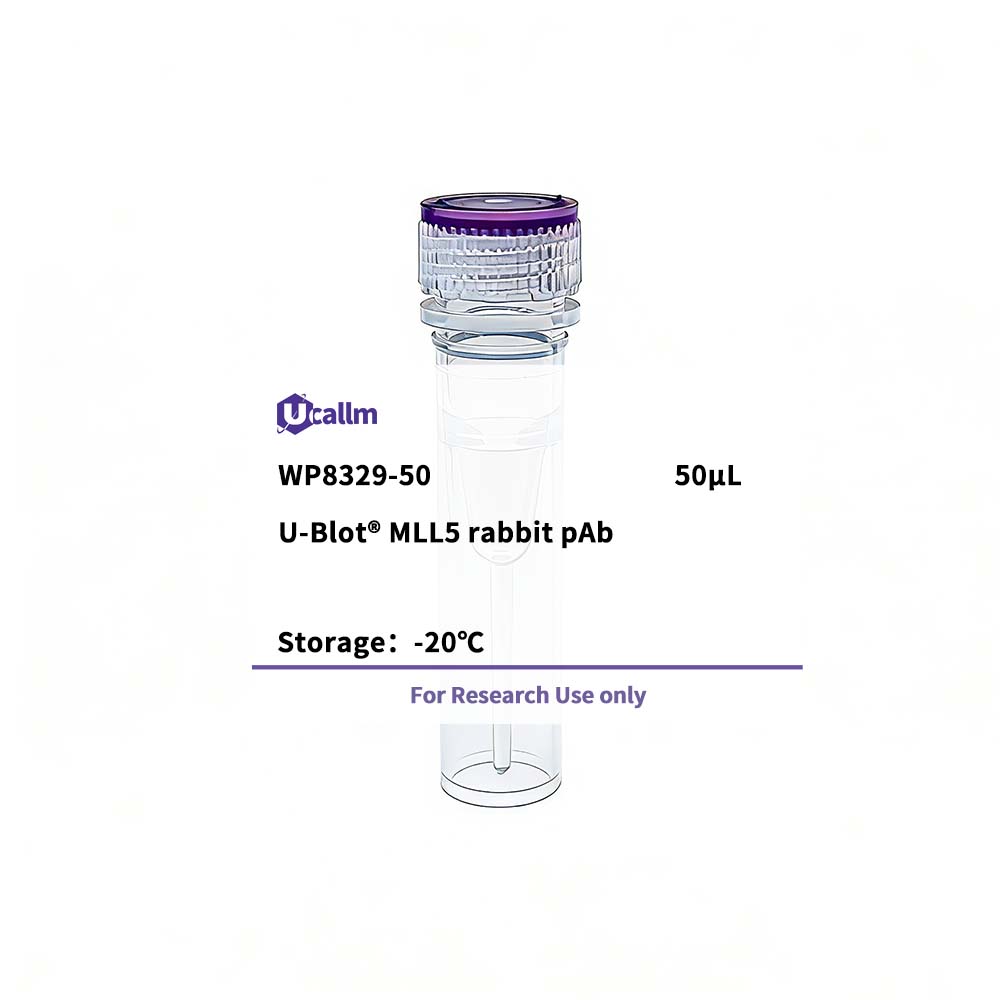
Price range: $268.00 through $328.00
Background:
| Size | 50μL/100μL |
| Target | KMT2E |
| Reactivity | Human, Mouse |
| Applications | WB |
| MW(Calculated) | 204kD |
| MW(Observed) | |
| Host Species | Rabbit |
| Isotype | IgG |
| Conjugate/Modification | Unmodified |
| Recommended Dilution Ratio | WB 1:500-2000 |
| Formulation | Liquid in PBS containing 50% glycerol, 0.5% BSA and 0.02% sodium azide. |
| Purification | The antibody was affinity-purified from rabbit antiserum by affinity-chromatography using epitope-specific immunogen. |
| Storage | -15°C to -25°C/1 year(Do not lower than -25°C) |
| Concentration | 1 mg/ml |
| Clonality | Polyclonal |
| Clone Number | |
| Immunogen | Synthesized peptide derived from human MLL5 |
| Specificity | This antibody detects endogenous levels of MLL5 at Human, Mouse |
| Gene Name | MLL5 KMT2E |
| Protein Name | Histone-lysine N-methyltransferase MLL5 (Lysine N-methyltransferase 2E) (KMT2E) (Myeloid/lymphoid or mixed-lineage leukemia protein 5) |
| Other Name | |
| Species | Human |
| Gene ID | 55904 |
| Uniprot | Q8IZD2, |
| Species.1 | Mouse |
| Gene ID.1 | 69188 |
| Uniprot.1 | Q3UG20 |
| Species.2 | |
| Gene ID.2 | |
| Uniprot.2 | |
| Cellular Localization | Chromosome . Cytoplasm, cytoskeleton, microtubule organizing center, centrosome . Nucleus speckle . Absent from the nucleolus (PubMed:14718661). Localizes to chromosome during interphase and to centrosomes during mitosis (PubMed:23798402). Dissociation from mitotic chromosome is likely due to histone H3 phosphorylation on 'Thr-3' and 'Thr-6' (PubMed:23798402). .; [Isoform 3]: Nucleus, nucleoplasm . Nucleus speckle . Absent from the nucleolus (PubMed:23629655). Localizes to chromosome during interphase and to nucleus speckle during mitosis (PubMed:23798402). Dissociation from mitotic chromosome is likely due to histone H3 phosphorylation on 'Thr-3' and 'Thr-6' (PubMed:23798402). .; [Isoform NKp44L]: Cytoplasm . Cell membrane; Peripheral membrane protein . |
| Tissue Expression | Widely expressed in both adult and fetal tissues (PubMed:12101424, PubMed:23958951). Highest levels of expression observed in fetal thymus and kidney and in adult hematopoietic tissues, jejunum and cerebellum (PubMed:12101424, PubMed:23958951). Isoform NKp44L: Not detected on circulating cells from healthy individuals, but is expressed on a large panel of tumor and transformed cells (PubMed:23958951). |
| Signaling_pathway | |
| Research Areas | |
| Function | Associates with chromatin regions downstream of transcriptional start sites of active genes and thus regulates gene transcription . Chromatin interaction is mediated via the binding to tri-methylated histone H3 at 'Lys-4' (H3K4me3) . Key regulator of hematopoiesis involved in terminal myeloid differentiation and in the regulation of hematopoietic stem cell (HSCs) self-renewal by a mechanism that involves DNA methylation (By similarity). Also acts as an important cell cycle regulator, participating in cell cycle regulatory network machinery at multiple cell cycle stages including G1/S transition, S phase progression and mitotic entry . Recruited to E2F1 responsive promoters by HCFC1 where it stimulates tri-methylation of histone H3 at 'Lys-4' and transcriptional activation and thereby facilitates G1 to S phase transition . During myoblast differentiation, required to suppress inappropriate expression of S-phase-promoting genes and maintain expression of determination genes in quiescent cells (By similarity).; [Isoform NKp44L]: Cellular ligand for NCR2/NKp44, may play a role as a danger signal in cytotoxicity and NK-cell-mediated innate immunity. |




