

U-Blot® Neuropilin 1 Rabbit mAb
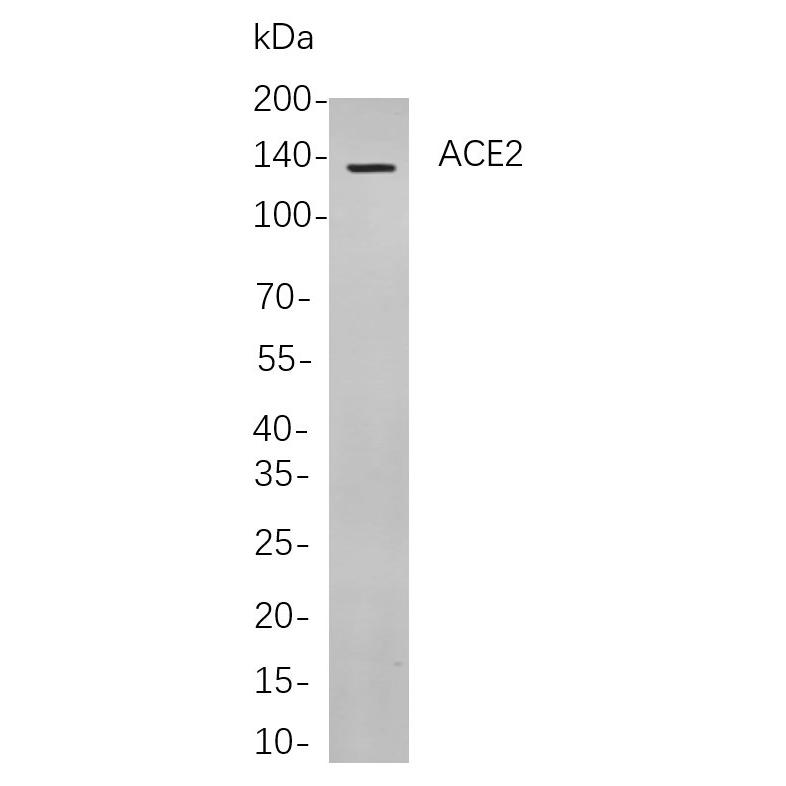
WR4028 Western blot analysis of lysates from CACO-2 cells, using ACE2 Rabbit mAb. The HRP-conjugated Goat anti-Rabbit IgG antibody (WS0002) was used to detect the antibody.
Price range: $268.00 through $328.00
Product details
Background:This gene encodes one of two neuropilins, which contain specific protein domains which allow them to participate in several different types of signaling pathways that control cell migration. Neuropilins contain a large N-terminal extracellular domain, made up of complement-binding, coagulation factor V/VIII, and meprin domains. These proteins also contains a short membrane-spanning domain and a small cytoplasmic domain. Neuropilins bind many ligands and various types of co-receptors; they affect cell survival, migration, and attraction. Some of the ligands and co-receptors bound by neuropilins are vascular endothelial growth factor (VEGF) and semaphorin family members. Several alternatively spliced transcript variants that encode different protein isoforms have been described for this gene. [provided by RefSeq, Oct 2011],
Specifications
| Size | 50μL/100μL |
| Target | Neuropilin |
| Reactivity | Human |
| Applications | WB, IHC, IF, IP, ELISA |
| MW(Calculated) | 103kD |
| MW(Observed) | 135kD |
| Host Species | Rabbit |
| Isotype | IgG,Kappa |
| Conjugate/Modification | Unmodified |
| Recommended Dilution Ratio | IHC 1:1000-1:4000; WB 1:1000-1:5000; IF 1:200-1:1000; ELISA 1:5000-1:20000; IP 1:50-1:200; / Note: For IHC, we suggest antigen retrieval with TE buffer pH 9.0 (Cat#WT1004) |
| Formulation | PBS, 50% glycerol, 0.05% Proclin 300, 0.05%BSA |
| Purification | Recombinant Antibody expressed in animal component-free (ACF) media, purified via Protein A affinity chromatography. |
| Storage | -15°C to -25°C/1 year(Do not lower than -25°C) |
| Concentration | |
| Clonality | Monoclonal |
| Clone Number | RM0182R |
| Immunogen | The specific immunogen used to produce this antibody is proprietary information. |
| Specificity | Endogenous |
| Gene Name | NRP1 |
| Protein Name | Neuropilin-1 |
| Other Name | NRP1; / NRP; / VEGF165R; / Neuropilin-1; / Vascular endothelial cell growth factor 165 receptor; / CD antigen CD304 |
| Species | Human |
| Gene ID | 59272 |
| Uniprot | O14786, |
| Species.1 | Mouse |
| Gene ID.1 | 18186 |
| Uniprot.1 | P97333, |
| Species.2 | Rat |
| Gene ID.2 | 302668 |
| Uniprot.2 | Q5EGZ1 |
| Cellular Localization | Cytoplasmic, Membranous |
| Tissue Expression | Expressed in endothelial cells from small and large arteries, and in arterial smooth muscle cells (at protein level) (PubMed:15141377). Expressed in enterocytes of the small intestine, Leydig cells and Sertoli cells (at protein level) (PubMed:15141377). Expressed in the renal proximal tubule and the small intestine (at protein level) (PubMed:18424768). Expressed in heart, kidney, testis, and gastrointestinal system (at protein level) (PubMed:10969042, PubMed:10924499, PubMed:15231706, PubMed:12459472, PubMed:15671045, PubMed:32715618, PubMed:32170560). In lung, expressed at low levels in some alveolar type 2 cells, the expression seems to be individual-specific (at protein level) (PubMed:32425701, PubMed:15141377, PubMed:32715618, PubMed:32170560, PubMed:33432184). Expressed in nasal epithelial cells (at protein level) (PubMed:33432184, PubMed:32333915). Coexpressed with TMPRSS2 within some lung alveolar type 2 cells, ileal absorptive enterocytes, intestinal epithelial cells, cornea, gallbladder and nasal goblet secretory cells (PubMed:32413319, PubMed:32327758, PubMed:32358202). Coexpressed with TMPRSS4 within mature enterocytes (PubMed:32404436).; [Isoform 2]: Expressed in nasal and bronchial epithelial cells (at protein level). |
| Signaling_pathway | Organismal Systems >> Endocrine system >> Renin-angiotensin system |
| Research Areas | |
| Function | Function:The membrane-bound isoform 1 is a receptor involved in the development of the cardiovascular system, in angiogenesis, in the formation of certain neuronal circuits and in organogenesis outside the nervous system. It mediates the chemorepulsant activity of semaphorins. It binds to semaphorin 3A, The PLGF-2 isoform of PGF, The VEGF-165 isoform of VEGF and VEGF-B. Coexpression with KDR results in increased VEGF-165 binding to KDR as well as increased chemotaxis. It may regulate VEGF-induced angiogenesis.,Function:The soluble isoform 2 binds VEGF-165 and appears to inhibit its binding to cells. It may also induce apoptosis by sequestering VEGF-165. May bind as well various members of the semaphorin family. Its expression has an averse effect on blood vessel number and integrity.,similarity:Belongs to the neuropilin family.,similarity:Contains 1 F5/8 type C domain.,similarity:Contains 1 MAM domain.,similarity:Contains 2 CUB domains.,similarity:Contains 2 F5/8 type C domains.,subunit:Heterodimer with NRP2 (Probable). Binds PLXNB1.,tissue specificity:The expression of isoforms 1 and 2 does not seem to overlap. Isoform 1 is expressed by the blood vessels of different tissues. In the developing embryo it is found predominantly in the nervous system. In adult tissues, it is highly expressed in heart and placenta; moderately in lung, liver, skeletal muscle, kidney and pancreas; and low in adult brain. Isoform 2 is found in liver hepatocytes, kidney distal and proximal tubules., |
Please login to post questions
Related products





