SKU: WM0342 Categories: ,

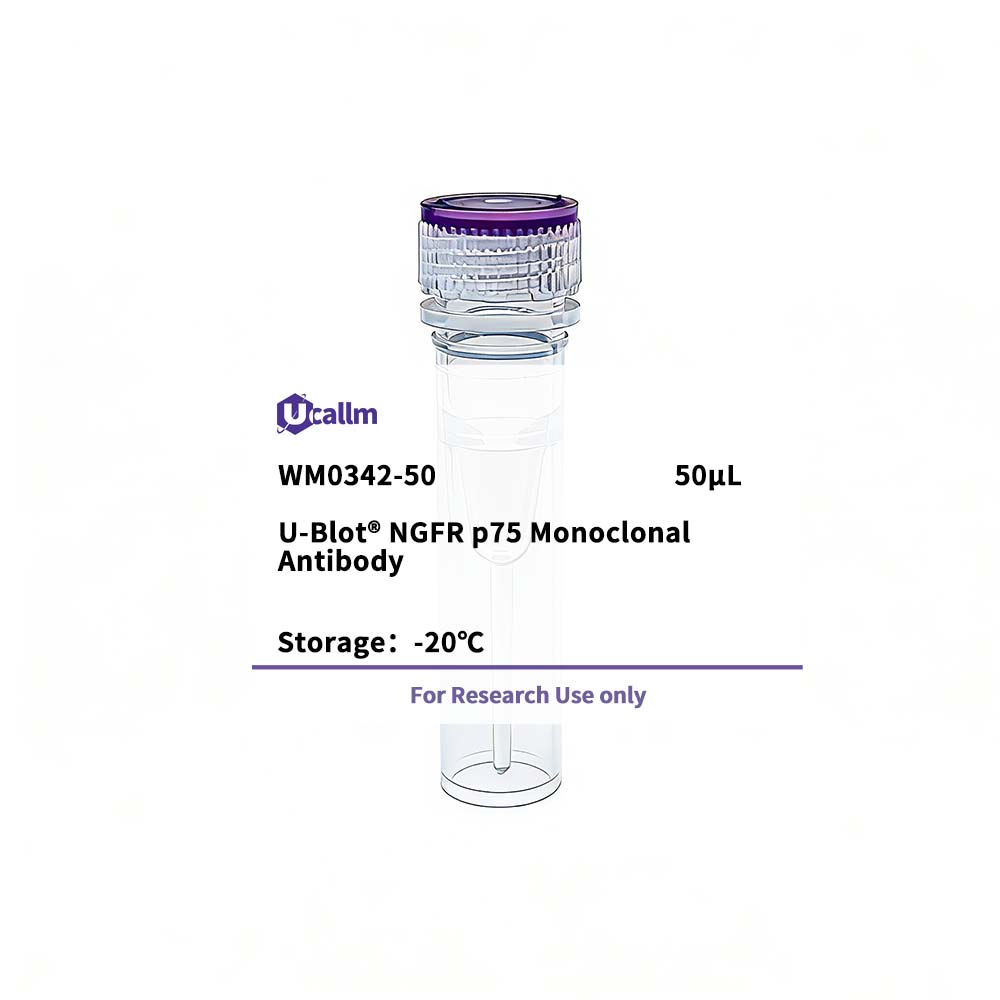
NGFR p75 Monoclonal Antibody

Price range: $268.00 through $328.00

SKU: WM0342-50
Enter the quantity you would like, or drag the panel to find the quantity and price that best for you
Bulk QuoteAuthorize OEM & ODM

Product details

Background:
Nerve growth factor receptor contains an extracellular domain containing four 40-amino acid repeats with 6 cysteine residues at conserved positions followed by a serine/threonine-rich region, a single transmembrane domain, and a 155-amino acid cytoplasmic domain. The cysteine-rich region contains the nerve growth factor binding domain. [provided by RefSeq, Jul 2008],

Specifications

Size50μL/100μL
TargetNGFR p75
ReactivityHuman
ApplicationsWB, IF, FC, ELISA
MW(Calculated)45kD
MW(Observed)
Host SpeciesMouse
Isotype
Conjugate/ModificationUnmodified
Recommended Dilution RatioWB 1:500-1:2000; IF 1:200-1:1000; Flow Cyt 1:200-1:400; ELISA 1:10000; Not yet tested in other applications.
FormulationLiquid in PBS containing 50% glycerol, 0.5% BSA and 0.02% sodium azide.
PurificationAffinity purification
Storage-15°C to -25°C/1 year(Do not lower than -25°C)
Concentration
ClonalityMonoclonal
Clone Number3D2
ImmunogenPurified recombinant fragment of human NGFR p75 expressed in E. Coli.
SpecificityNGFR p75 Monoclonal Antibody detects endogenous levels of NGFR p75 protein.
Gene NameNGFR
Protein NameTumor necrosis factor receptor superfamily member 16
Other NameNGFR; / TNFRSF16; / Tumor necrosis factor receptor superfamily member 16; / Gp80-LNGFR; / Low affinity neurotrophin receptor p75NTR; / Low-affinity nerve growth factor receptor; / NGF receptor; / p75 ICD; / CD antigen CD271
SpeciesHuman
Gene ID4804
UniprotP08138,
Species.1Mouse
Gene ID.1
Uniprot.1Q9Z0W1
Species.2
Gene ID.2
Uniprot.2
Cellular LocalizationCell membrane; Single-pass type I membrane protein . Perikaryon . Cell projection, growth cone . Cell projection, dendritic spine .
Tissue ExpressionBrain,
Signaling_pathwayCellular Processes >> Cell growth and death >> Apoptosis - multiple species;Organismal Systems >> Nervous system >> Neurotrophin signaling pathway;Human Diseases >> Cancer: overview >> Transcriptional misregulation in cancer;Environmental Information Processing >> Signal transduction >> MAPK signaling pathway;Environmental Information Processing >> Signal transduction >> Ras signaling pathway;Environmental Information Processing >> Signal transduction >> Rap1 signaling pathway;Environmental Information Processing >> Signal transduction >> PI3K-Akt signaling pathway;Environmental Information Processing >> Signaling molecules and interaction >> Cytokine-cytokine receptor interaction
Research Areas>>MAPK signaling pathway; / >>Ras signaling pathway; / >>Rap1 signaling pathway; / >>Cytokine-cytokine receptor interaction; / >>PI3K-Akt signaling pathway; / >>Apoptosis - multiple species; / >>Neurotrophin signaling pathway; / >>Transcriptional misregulation in cancer
FunctionDomain:Death domain is responsible for interaction with RANBP9.,Domain:The extracellular domain is responsible for interaction with NTRK1.,Function:Low affinity receptor which can bind to NGF, BDNF, NT-3, and NT-4. Can mediate cell survival as well as cell death of neural cells.,PTM:N- and O-glycosylated.,PTM:O-linked glycans consist of Gal(1-3)GalNAc core elongated by 1 or 2 NeuNAc.,PTM:Phosphorylated on serine residues.,similarity:Contains 1 death domain.,similarity:Contains 4 TNFR-Cys repeats.,subunit:Homodimer; disulfide-linked. Interacts with p75NTR-associated cell death executor. Interacts with TRAF2, TRAF4, TRAF6, PTPN13 and RANBP9. Interacts through TRAF6 with SQSTM1 which bridges NGFR to NTRK1. Interacts with BEX1 and NGFRAP1/BEX3. Interacts with KIDINS220 and NTRK1. Can form a ternary complex with NTRK1 and KIDINS220 and this complex is affected by the expression levels of KIDINS220. An increase in KIDINS220 expression leads to a decreased association of NGFR and NTRK1 (By similarity). Interacts with LINGO1.,
Please login to post questions
Back to Top
Product has been added to your cart

